Solution:
Key idea: By Lenz's law, the current induced in the ring opposes the change in flux through it. Opposite currents in coaxial loops repel each other.
Step 1 — Find the change in flux through the ring.
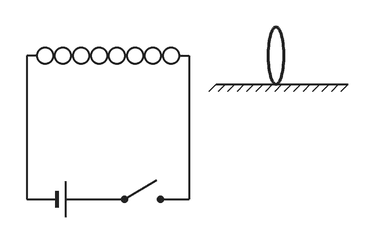
When the switch is closed, the current in the solenoid rises from zero to its steady value. The field of the solenoid, and so the flux through the coaxial ring, grows.
Step 2 — Find the direction of the induced current.
The ring's induced current opposes the growth of this flux, so it circulates in the opposite sense to the current in the solenoid. The face of the ring towards the solenoid therefore has the same polarity as the near end of the solenoid.
Step 3 — Find the force on the ring.
Like poles facing each other repel, just as opposite currents in coaxial loops repel. The track is frictionless, so the ring is pushed along the axis away from the solenoid.
Step 4 — Say how long the push lasts.
Once the current in the solenoid becomes steady, the flux stops changing and the induced current stops. The push then ends, and the ring keeps moving away with the speed it has gained.
Therefore, when the switch is closed the ring is repelled and moves away from the solenoid.