
Question 91 markMCQEasy
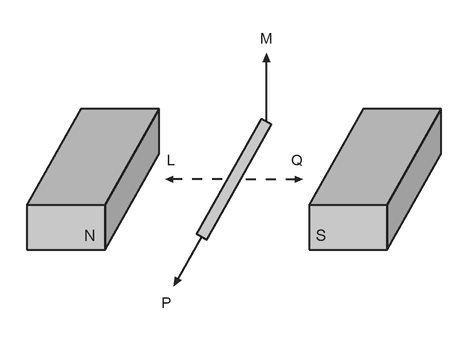
An electric potential difference will be induced between the ends of the conductor shown in the given diagram, when the conductor moves in the direction
Confirming your payment
Sign up now and get 250 free tokens.
Electromagnetic Induction · Question 9 of 78
An electric potential difference will be induced between the ends of the conductor shown in the given diagram, when the conductor moves in the direction
(A) P
(B) Q
(C) L
(D) M
Answer: (D) M
Key idea: A potential difference appears between the ends of a moving conductor only if the magnetic force on its free charges has a part along the conductor. This happens when the conductor cuts the field lines.
Step 1 — Read the directions in the figure.
The field runs from the N block to the S block, along the line L–Q. The rod is drawn in perspective pointing into the gap between the blocks, so it is at right angles to the field. M points straight up, at right angles to both the field and the rod. P is the arrow drawn along the rod itself.
Step 2 — Test motion along M.
Moving along M, the velocity is at right angles to the field, and points along the rod. The free electrons are pushed towards one end, so the rod cuts the field lines and a potential difference appears between its ends.
Step 3 — Compare with the other directions.
For L and Q the velocity is along the field, so the magnetic force is zero. For P the rod slides along its own length; is then at right angles to the rod and cannot move charges from one end to the other.
Why the other options are wrong:
Therefore, a potential difference is induced when the conductor moves in the direction M: option (D).