Solution:
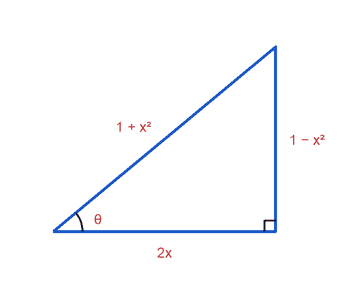
Key idea: The two angles inside the bracket are complementary. One right triangle with sides 2x, 1−x2 and hypotenuse 1+x2 shows this, because (2x)2+(1−x2)2=(1+x2)2.
Step 1 — Name the first angle.
For 0<x<1, both 1−x2 and 2x are positive, so 2x1−x2>0. Let θ=tan−12x1−x2; then θ is acute, in (0,2π).
Step 2 — Check the hypotenuse.
In a right triangle with θ between the side 2x (adjacent) and the hypotenuse, the opposite side is 1−x2. We find the hypotenuse by Pythagoras.
(2x)2+(1−x2)2=4x2+1−2x2+x4
(2x)2+(1−x2)2=(1+x2)2
So the hypotenuse is 1+x2.
Step 3 — Write θ as an inverse sine.
From the triangle, the sine of θ is opposite over hypotenuse.
sinθ=1+x21−x2
Since θ is acute, it lies in the principal branch of sin−1.
θ=sin−11+x21−x2
Step 4 — Use the complementary-angle identity.
The number 1+x21−x2 lies in (0,1), so sin−1 and cos−1 of it add up to 2π.
θ+cos−11+x21−x2=2π
Step 5 — Take the sine.
The bracket in the question is exactly this sum.
LHS=sin2π
LHS=1
Therefore, sin[tan−1(2x1−x2)+cos−1(1+x21−x2)]=1 for 0<x<1, as required.
