Solution:
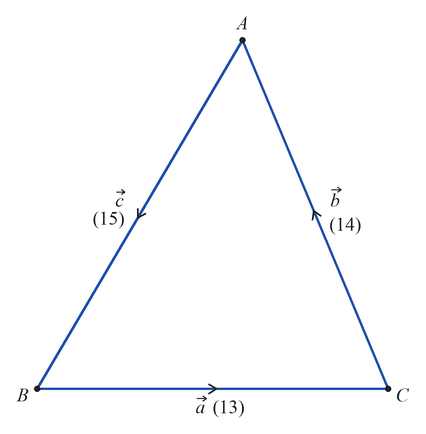
Key idea: Going round the triangle, BC+CA+AB=0, so a+b+c=0. The angle C is the angle between the two sides that start at C, namely CB=−a and CA=b.
Step 1 — Write c in terms of a and b.
From the sum of the three sides being 0, we get c=−(a+b). We square the magnitudes, using ∣v∣2=v⋅v.
∣c∣2=∣a∣2+∣b∣2+2a⋅b
Step 2 — Find a · b.
We substitute ∣a∣=13, ∣b∣=14 and ∣c∣=15.
225=169+196+2a⋅b
2a⋅b=225−365
a⋅b=−70
Step 3 — Find cos C.
The angle C lies between the sides CB and CA. As vectors these are −a and b, so we use the dot product of −a and b.
(−a)⋅b=−(−70)
(−a)⋅b=70
Now we divide by the lengths of the two sides; the length of −a is the same as that of a.
cosC=∣a∣∣b∣(−a)⋅b
cosC=13×1470
cosC=135
Watch out: The angle between a and b themselves is π−C (its cosine is −135), because a points into C while b points out of C.
Check: The cosine rule for the side c opposite C gives the same value.
cosC=2×13×14132+142−152
cosC=364140
cosC=135
Therefore, ∠C=cos−1(135) (about 67.4∘).