Solution:
Key idea: The area of △ A B C \triangle ABC △ A B C 1 2 ∣ A B → × A C → ∣ \dfrac{1}{2}|\overrightarrow{AB} \times \overrightarrow{AC}| 2 1 ∣ A B × A C ∣
Step 1 — Find the side vectors for part (i).
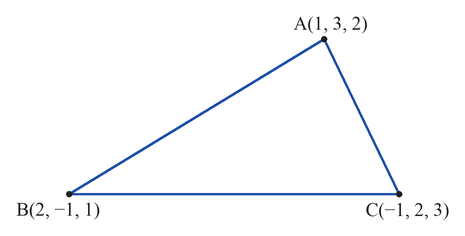
With A ( 1 , 3 , 2 ) A(1, 3, 2) A ( 1 , 3 , 2 ) B ( 2 , − 1 , 1 ) B(2, -1, 1) B ( 2 , − 1 , 1 ) C ( − 1 , 2 , 3 ) C(-1, 2, 3) C ( − 1 , 2 , 3 ) A A A
A B → = ( 2 − 1 ) i ^ + ( − 1 − 3 ) j ^ + ( 1 − 2 ) k ^ \overrightarrow{AB} = (2 - 1)\hat{i} + (-1 - 3)\hat{j} + (1 - 2)\hat{k} A B = ( 2 − 1 ) i ^ + ( − 1 − 3 ) j ^ + ( 1 − 2 ) k ^
A B → = i ^ − 4 j ^ − k ^ \overrightarrow{AB} = \hat{i} - 4\hat{j} - \hat{k} A B = i ^ − 4 j ^ − k ^
A C → = ( − 1 − 1 ) i ^ + ( 2 − 3 ) j ^ + ( 3 − 2 ) k ^ \overrightarrow{AC} = (-1 - 1)\hat{i} + (2 - 3)\hat{j} + (3 - 2)\hat{k} A C = ( − 1 − 1 ) i ^ + ( 2 − 3 ) j ^ + ( 3 − 2 ) k ^
A C → = − 2 i ^ − j ^ + k ^ \overrightarrow{AC} = -2\hat{i} - \hat{j} + \hat{k} A C = − 2 i ^ − j ^ + k ^
Step 2 — Find the area for part (i).
We take the vector product, find its magnitude and halve it.
A B → × A C → = ∣ i ^ j ^ k ^ 1 − 4 − 1 − 2 − 1 1 ∣ \overrightarrow{AB} \times \overrightarrow{AC} = \begin{vmatrix} \hat{i} & \hat{j} & \hat{k} \\ 1 & -4 & -1 \\ -2 & -1 & 1 \end{vmatrix} A B × A C = i ^ 1 − 2 j ^ − 4 − 1 k ^ − 1 1
A B → × A C → = i ^ [ ( − 4 ) ( 1 ) − ( − 1 ) ( − 1 ) ] − j ^ [ ( 1 ) ( 1 ) − ( − 1 ) ( − 2 ) ] + k ^ [ ( 1 ) ( − 1 ) − ( − 4 ) ( − 2 ) ] \overrightarrow{AB} \times \overrightarrow{AC} = \hat{i}\big[(-4)(1) - (-1)(-1)\big] - \hat{j}\big[(1)(1) - (-1)(-2)\big] + \hat{k}\big[(1)(-1) - (-4)(-2)\big] A B × A C = i ^ [ ( − 4 ) ( 1 ) − ( − 1 ) ( − 1 ) ] − j ^ [ ( 1 ) ( 1 ) − ( − 1 ) ( − 2 ) ] + k ^ [ ( 1 ) ( − 1 ) − ( − 4 ) ( − 2 ) ]
A B → × A C → = i ^ ( − 4 − 1 ) − j ^ ( 1 − 2 ) + k ^ ( − 1 − 8 ) \overrightarrow{AB} \times \overrightarrow{AC} = \hat{i}\,(-4 - 1) - \hat{j}\,(1 - 2) + \hat{k}\,(-1 - 8) A B × A C = i ^ ( − 4 − 1 ) − j ^ ( 1 − 2 ) + k ^ ( − 1 − 8 )
A B → × A C → = − 5 i ^ + j ^ − 9 k ^ \overrightarrow{AB} \times \overrightarrow{AC} = -5\hat{i} + \hat{j} - 9\hat{k} A B × A C = − 5 i ^ + j ^ − 9 k ^
∣ A B → × A C → ∣ = ( − 5 ) 2 + 1 2 + ( − 9 ) 2 |\overrightarrow{AB} \times \overrightarrow{AC}| = \sqrt{(-5)^2 + 1^2 + (-9)^2} ∣ A B × A C ∣ = ( − 5 ) 2 + 1 2 + ( − 9 ) 2
∣ A B → × A C → ∣ = 25 + 1 + 81 |\overrightarrow{AB} \times \overrightarrow{AC}| = \sqrt{25 + 1 + 81} ∣ A B × A C ∣ = 25 + 1 + 81
∣ A B → × A C → ∣ = 107 |\overrightarrow{AB} \times \overrightarrow{AC}| = \sqrt{107} ∣ A B × A C ∣ = 107
Area = 1 2 107 \text{Area} = \frac{1}{2}\sqrt{107} Area = 2 1 107
Step 3 — Find the side vectors for part (ii).
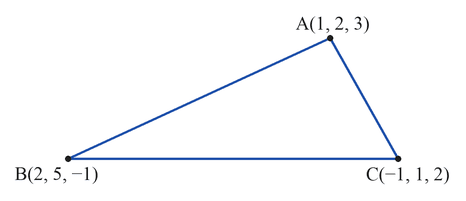
With A ( 1 , 2 , 3 ) A(1, 2, 3) A ( 1 , 2 , 3 ) B ( 2 , 5 , − 1 ) B(2, 5, -1) B ( 2 , 5 , − 1 ) C ( − 1 , 1 , 2 ) C(-1, 1, 2) C ( − 1 , 1 , 2 )
A B → = ( 2 − 1 ) i ^ + ( 5 − 2 ) j ^ + ( − 1 − 3 ) k ^ \overrightarrow{AB} = (2 - 1)\hat{i} + (5 - 2)\hat{j} + (-1 - 3)\hat{k} A B = ( 2 − 1 ) i ^ + ( 5 − 2 ) j ^ + ( − 1 − 3 ) k ^
A B → = i ^ + 3 j ^ − 4 k ^ \overrightarrow{AB} = \hat{i} + 3\hat{j} - 4\hat{k} A B = i ^ + 3 j ^ − 4 k ^
A C → = ( − 1 − 1 ) i ^ + ( 1 − 2 ) j ^ + ( 2 − 3 ) k ^ \overrightarrow{AC} = (-1 - 1)\hat{i} + (1 - 2)\hat{j} + (2 - 3)\hat{k} A C = ( − 1 − 1 ) i ^ + ( 1 − 2 ) j ^ + ( 2 − 3 ) k ^
A C → = − 2 i ^ − j ^ − k ^ \overrightarrow{AC} = -2\hat{i} - \hat{j} - \hat{k} A C = − 2 i ^ − j ^ − k ^
Step 4 — Find the area for part (ii).
Again we take the vector product, its magnitude and half of it.
A B → × A C → = ∣ i ^ j ^ k ^ 1 3 − 4 − 2 − 1 − 1 ∣ \overrightarrow{AB} \times \overrightarrow{AC} = \begin{vmatrix} \hat{i} & \hat{j} & \hat{k} \\ 1 & 3 & -4 \\ -2 & -1 & -1 \end{vmatrix} A B × A C = i ^ 1 − 2 j ^ 3 − 1 k ^ − 4 − 1
A B → × A C → = i ^ [ ( 3 ) ( − 1 ) − ( − 4 ) ( − 1 ) ] − j ^ [ ( 1 ) ( − 1 ) − ( − 4 ) ( − 2 ) ] + k ^ [ ( 1 ) ( − 1 ) − ( 3 ) ( − 2 ) ] \overrightarrow{AB} \times \overrightarrow{AC} = \hat{i}\big[(3)(-1) - (-4)(-1)\big] - \hat{j}\big[(1)(-1) - (-4)(-2)\big] + \hat{k}\big[(1)(-1) - (3)(-2)\big] A B × A C = i ^ [ ( 3 ) ( − 1 ) − ( − 4 ) ( − 1 ) ] − j ^ [ ( 1 ) ( − 1 ) − ( − 4 ) ( − 2 ) ] + k ^ [ ( 1 ) ( − 1 ) − ( 3 ) ( − 2 ) ]
A B → × A C → = i ^ ( − 3 − 4 ) − j ^ ( − 1 − 8 ) + k ^ ( − 1 + 6 ) \overrightarrow{AB} \times \overrightarrow{AC} = \hat{i}\,(-3 - 4) - \hat{j}\,(-1 - 8) + \hat{k}\,(-1 + 6) A B × A C = i ^ ( − 3 − 4 ) − j ^ ( − 1 − 8 ) + k ^ ( − 1 + 6 )
A B → × A C → = − 7 i ^ + 9 j ^ + 5 k ^ \overrightarrow{AB} \times \overrightarrow{AC} = -7\hat{i} + 9\hat{j} + 5\hat{k} A B × A C = − 7 i ^ + 9 j ^ + 5 k ^
∣ A B → × A C → ∣ = ( − 7 ) 2 + 9 2 + 5 2 |\overrightarrow{AB} \times \overrightarrow{AC}| = \sqrt{(-7)^2 + 9^2 + 5^2} ∣ A B × A C ∣ = ( − 7 ) 2 + 9 2 + 5 2
∣ A B → × A C → ∣ = 49 + 81 + 25 |\overrightarrow{AB} \times \overrightarrow{AC}| = \sqrt{49 + 81 + 25} ∣ A B × A C ∣ = 49 + 81 + 25
∣ A B → × A C → ∣ = 155 |\overrightarrow{AB} \times \overrightarrow{AC}| = \sqrt{155} ∣ A B × A C ∣ = 155
Area = 1 2 155 \text{Area} = \frac{1}{2}\sqrt{155} Area = 2 1 155
Watch out: Both side vectors must start at the same vertex; mixing A B → \overrightarrow{AB} A B C A → \overrightarrow{CA} C A
Therefore, the areas are (i) 1 2 107 \dfrac{1}{2}\sqrt{107} 2 1 107 1 2 155 \dfrac{1}{2}\sqrt{155} 2 1 155