
Question 1122 marksMedium
Write an equation in ionic form to represent the oxidising action of in acidic medium. Also draw the structure of .
Confirming your payment
Sign up now and get 250 free tokens.
d- and f-Block Elements · Question 112 of 142
Write an equation in ionic form to represent the oxidising action of in acidic medium. Also draw the structure of .
Solution:
Key idea: In acid solution chromium in dichromate is reduced from +6 to +3. Each Cr gains 3 electrons, so one ion gains 6 electrons.
Step 1 — Write the half-equation.
The oxygen atoms of dichromate combine with hydrogen ions to form water, and the two Cr atoms become ions. Balancing atoms and charge gives the equation below (charge on each side: −2 + 14 − 6 = +6 and 2 × 3 = +6).
Step 2 — Show the oxidising action with an example.
The 6 electrons come from the substance being oxidised. With iodide ions, for example, iodine is set free and the orange solution turns green ().
Step 3 — Describe the structure.
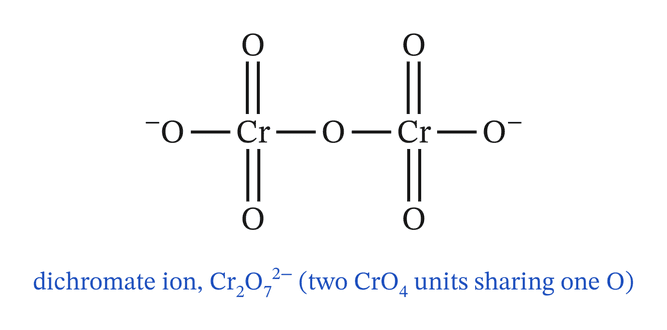
The dichromate ion is made of two tetrahedra that share one corner oxygen atom. Each Cr has three terminal oxygen atoms (Cr–O about 163 pm) and the shared bridging oxygen (Cr–O about 179 pm); the Cr–O–Cr angle is about 126°.
Step 4 — Draw the structure.
In the structure below each Cr is joined to two oxygens by double bonds, to one oxygen carrying a negative charge, and to the bridging oxygen. (In the real ion the three terminal Cr–O bonds on each Cr are equal, because the double bonds and the charge are spread over them.)
Watch out: Dichromate is a chromium(VI) compound, which is toxic and can cause cancer; it is handled with gloves in small amounts.
Therefore, the oxidising action of dichromate in acid is , and the ion consists of two tetrahedra sharing one oxygen atom (Cr–O–Cr about 126°).