
Question 1682 marksEasy
How does the rate of enzyme-catalysed reactions vary with
(i) temperature
(ii) pH? Represent diagrammatically.
Confirming your payment
Sign up now and get 250 free tokens.
Surface Chemistry · Question 168 of 225
How does the rate of enzyme-catalysed reactions vary with
(i) temperature
(ii) pH? Represent diagrammatically.
Solution:
Key idea: Enzymes are proteins. Their catalytic activity depends on the exact three-dimensional shape of the active site, which is changed by heat and by the acidity of the medium.
Step 1 — Describe the effect of temperature up to the optimum.
As the temperature rises, the molecules move faster and collide with the enzyme more often and with more energy, so the rate of the enzyme-catalysed reaction increases. The rate is greatest at the optimum temperature, which is about 37 °C (310 K) for enzymes of the human body.
Step 2 — Describe the effect of temperature above the optimum.
Above the optimum, heat breaks the weak bonds that hold the protein in shape. The enzyme is denatured, its active site no longer fits the substrate, and the rate falls steeply.
Step 3 — Describe the effect of pH.
Each enzyme works fastest at its own optimum pH; for example, pepsin works best near pH 2 and trypsin near pH 8, while many enzymes in cells work best near pH 7. On either side of the optimum, the charges on the active site change, so the rate falls.
Step 4 — Represent both effects on graphs.
The graphs show enzyme activity against temperature, graph (a), and against pH, graph (b), for a typical enzyme of the human body. Each curve rises to a peak at the optimum and falls on the other side.
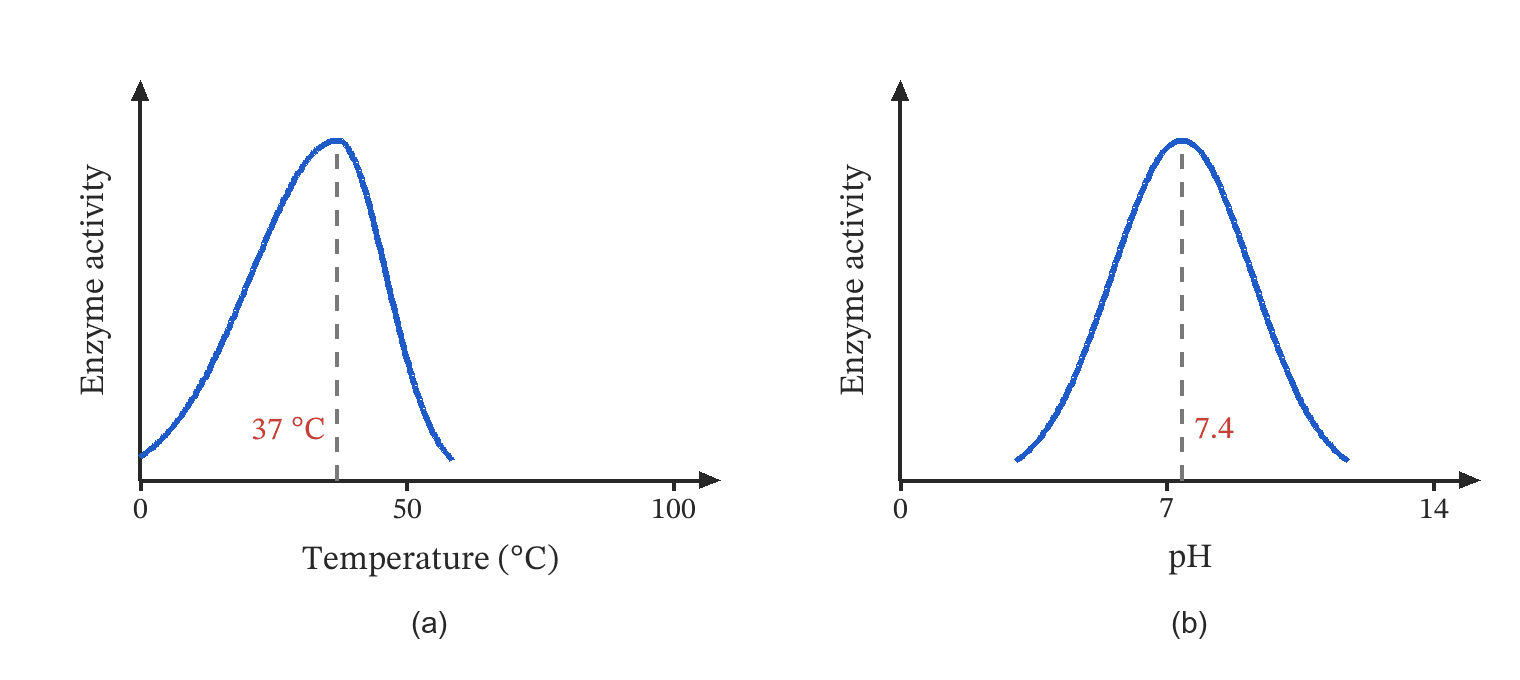
Therefore, the rate of an enzyme-catalysed reaction is greatest at the optimum temperature (about 37 °C for body enzymes) and at the optimum pH, and it falls on either side, falling steeply above the optimum temperature because the enzyme is denatured.