
Question 1422 marksMedium
How can the constants K and n of the Freundlich adsorption equation be calculated?
Confirming your payment
Sign up now and get 250 free tokens.
Surface Chemistry · Question 142 of 225
How can the constants K and n of the Freundlich adsorption equation be calculated?
Solution:
Key idea: The Freundlich isotherm, , is a power law. Taking logarithms turns it into the equation of a straight line, so the two constants can be read from the slope and the intercept of a graph.
Step 1 — Write the Freundlich equation and name its symbols.
At constant temperature, the mass of gas adsorbed on a mass of adsorbent at equilibrium pressure is given by the relation below, where and are constants for the given gas, adsorbent and temperature ().
Step 2 — Take logarithms to get a straight-line form.
Taking the logarithm of both sides turns the product into a sum and the power into a multiplier.
This has the same form as a straight line, , with on the vertical axis and on the horizontal axis.
Step 3 — Plot the experimental results.
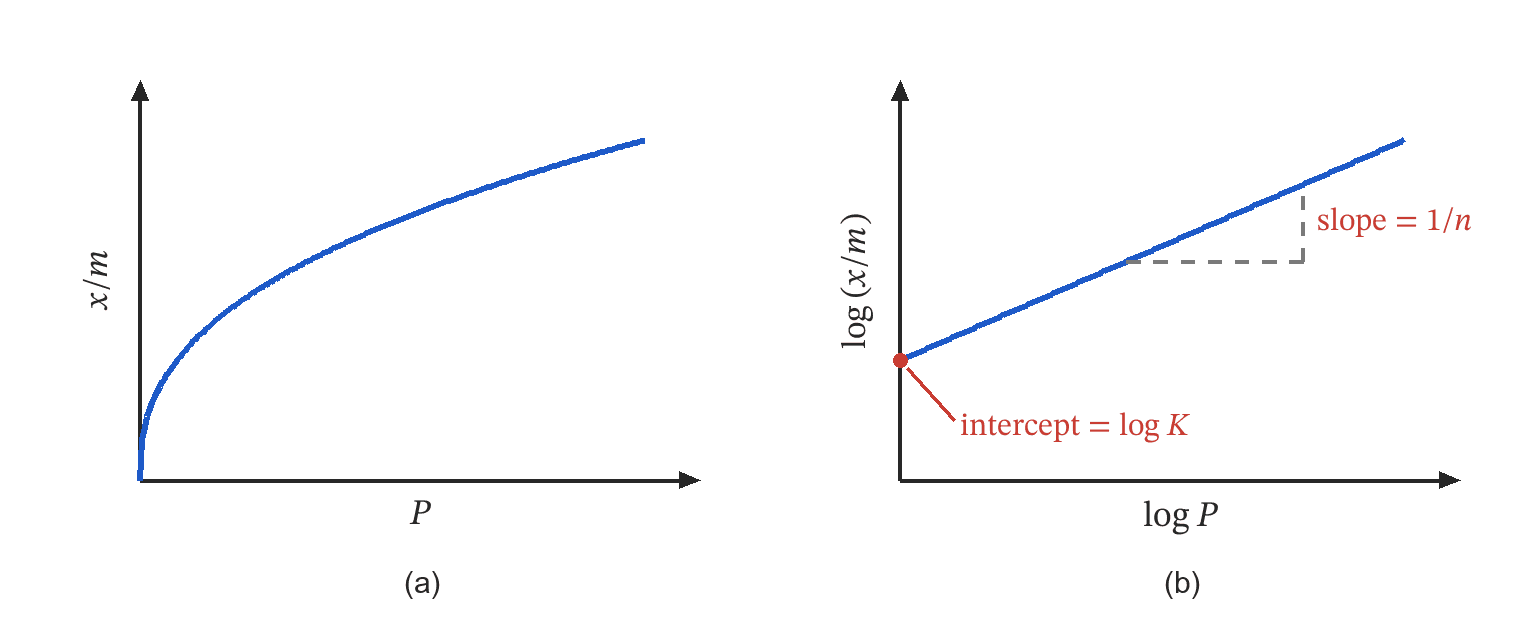
We measure at several pressures at one fixed temperature and plot against . If the data obey the Freundlich isotherm, the points lie on a straight line, as in graph (b) below; graph (a) shows the same data as against , which is a curve.
Step 4 — Find n from the slope.
The slope of the straight line equals the coefficient of , so is the reciprocal of the slope.
Step 5 — Find K from the intercept.
The intercept on the axis, where , equals , so is the antilog of the intercept.
Watch out: The intercept is read where , that is at unit of pressure, not at .
Therefore, a plot of log (x/m) against log P is a straight line: n is the reciprocal of its slope and K is the antilog of its intercept.