Solution:
Key idea: A catalyst provides another path for the reaction with a lower activation energy. It lowers the energy barrier for the forward and the backward reactions by the same amount, but it does not change the energies of the reactants and products, so the heat of reaction stays the same.
Step 1 — Read the labels on the given diagram.
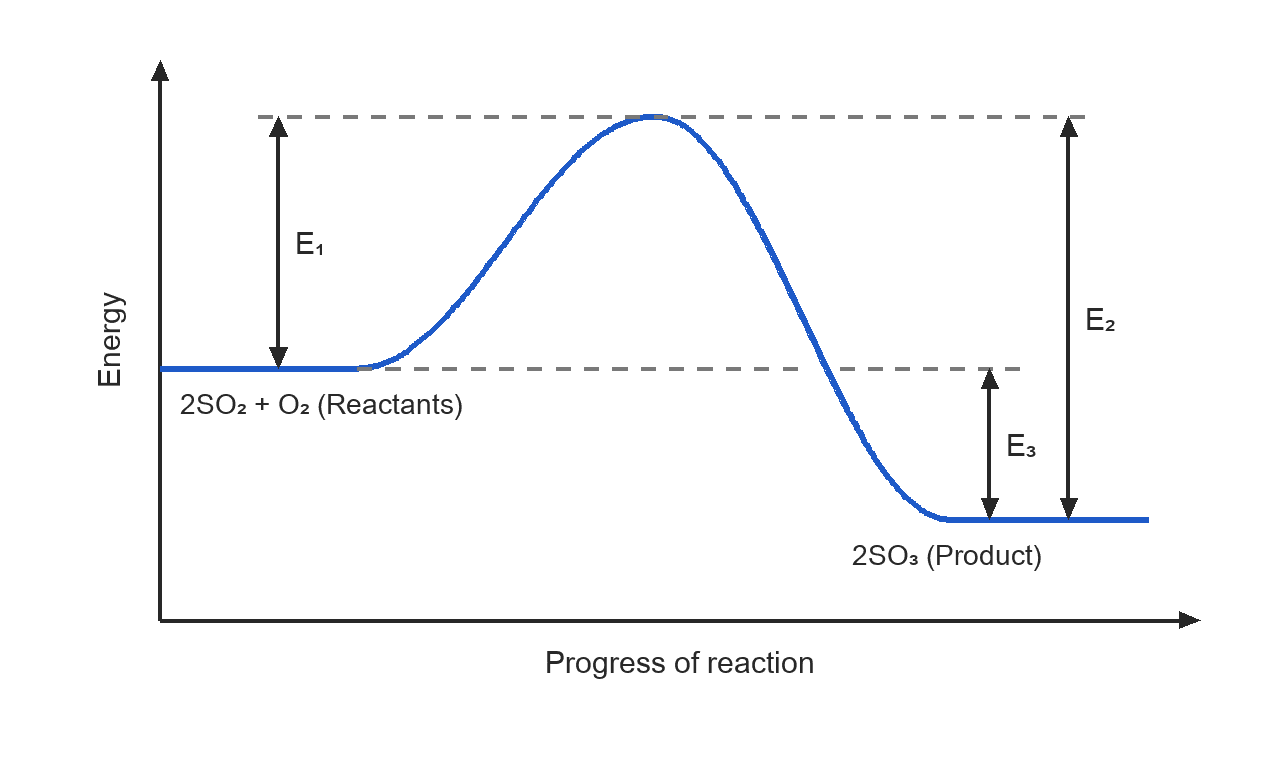
In the diagram, E1 is the activation energy of the forward reaction (from the reactants up to the peak), E2 is the activation energy of the backward reaction (from the product up to the peak), and E3 is the energy given out by the reaction (the heat of reaction). Since the reaction is exothermic, E2=E1+E3.
Step 2 — Describe the change made by a catalyst (part a).
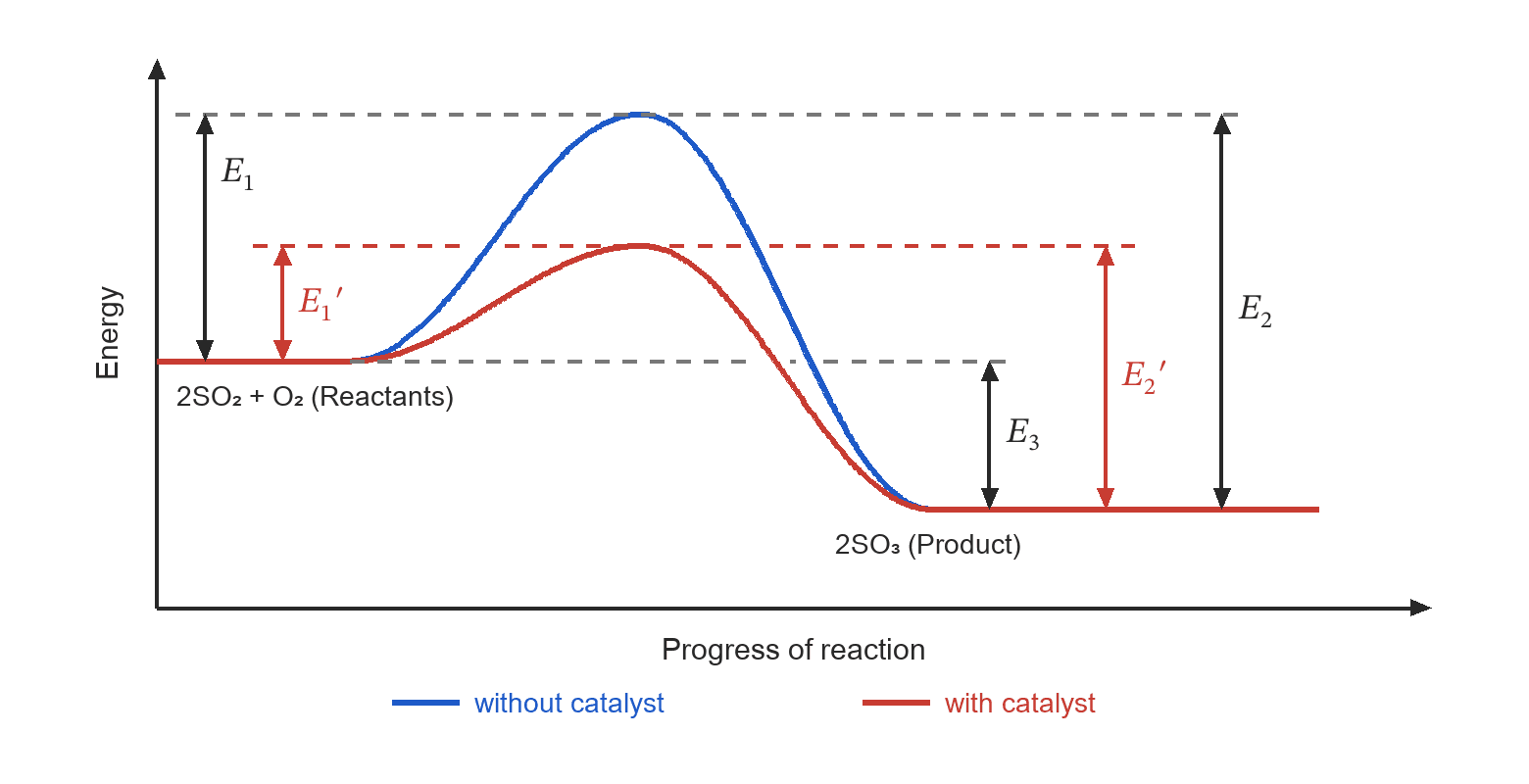
With a catalyst the peak of the curve is lower. E1 and E2 both decrease by the same amount. The levels of the reactants and the product do not move, so E3, the heat of reaction (ΔH), is unchanged.
Step 3 — Draw and label the diagram (part a).
The diagram below shows both paths. The upper curve is the reaction without a catalyst, and the lower curve is the catalysed reaction. E1 and E2 are the forward and backward activation energies without the catalyst, E1′ and E2′ are the smaller values with the catalyst, and E3 (ΔH) is the same for both paths.
Step 4 — Name the catalyst (part b).
The catalyst commonly used is vanadium(V) oxide, V2O5, in the contact process, at about 400–450 °C. Platinum was used in early plants, but it is costly and easily poisoned by impurities such as arsenic.
Step 5 — Decide the type of catalysis (part c).
The catalyst V2O5 is a solid and the reactants are gases, so the catalyst is in a different phase and this is heterogeneous catalysis. (If nitric oxide gas were used, as in the old lead chamber process, it would be homogeneous catalysis.)
Therefore, (a) a catalyst lowers the peak, so E₁ and E₂ fall by the same amount while E₃ (ΔH) is unchanged, (b) the catalyst commonly used is V₂O₅, and (c) with solid V₂O₅ and gaseous reactants it is heterogeneous catalysis.