
Question 1903 marksMedium
Draw the typical adsorption isotherms obtained in the case of unimolecular and multimolecular adsorption.
Confirming your payment
Sign up now and get 250 free tokens.
Surface Chemistry · Question 190 of 225
Draw the typical adsorption isotherms obtained in the case of unimolecular and multimolecular adsorption.
Solution:
Key idea: An adsorption isotherm is a graph of the mass of gas adsorbed per gram of adsorbent, , against the gas pressure at constant temperature. Its shape shows whether adsorption stops at one layer of molecules or goes on to build up many layers.
Step 1 — Describe the unimolecular (Type I) isotherm.
When only one layer of molecules can form, rises steeply at low pressure and then levels off at a limiting value once the single layer covers the whole surface. This is the Type I (Langmuir-type) isotherm, given for example by nitrogen on charcoal at low temperature and by chemisorption of gases.
Step 2 — Describe the multimolecular (Type II and Type III) isotherms.
When many layers can form, keeps rising as the pressure approaches the saturation vapour pressure of the gas. In Type II there is a bend when the first layer is complete, followed by a steep rise as further layers form (for example nitrogen on an iron catalyst or on silica gel at low temperature). In Type III the first layer is held only weakly, so there is no bend and the curve simply rises more and more steeply (for example bromine on silica gel).
Step 3 — Draw the isotherms.
The sketches below show against for each type; the dashed line marks the saturation vapour pressure .
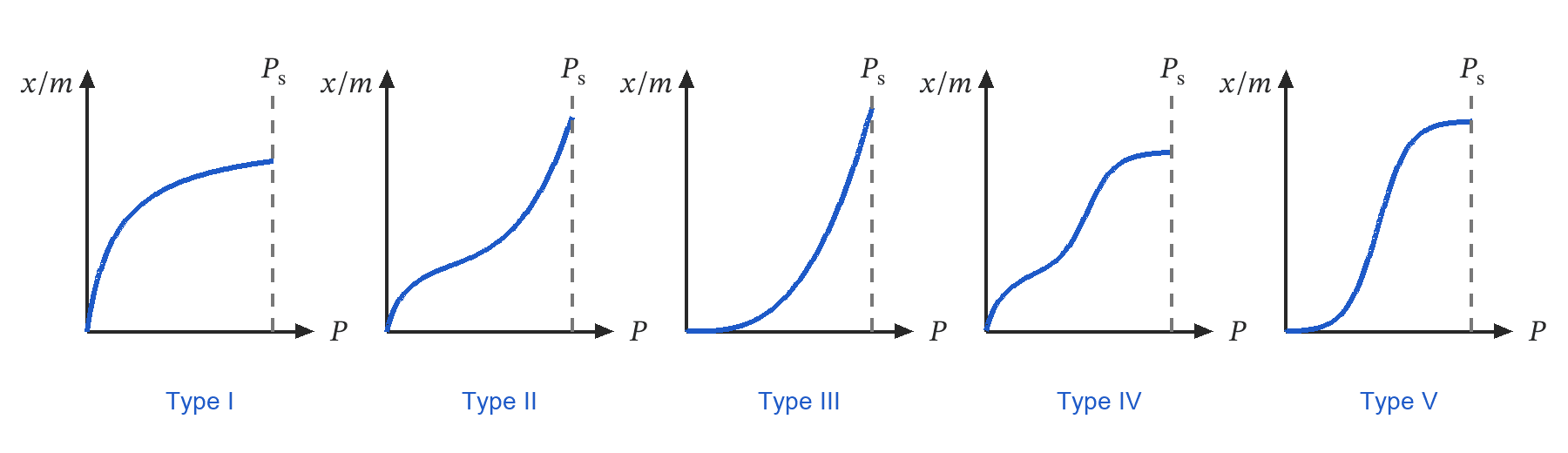
Types IV and V are like Types II and III, but they level off near because the gas condenses in the fine pores of the adsorbent (capillary condensation).
Therefore, unimolecular adsorption gives the Type I isotherm, which levels off at a limiting value, while multimolecular adsorption gives Type II (a bend, then a steep rise near Pₛ) or Type III (no bend) isotherms, and Types IV and V when capillary condensation occurs.