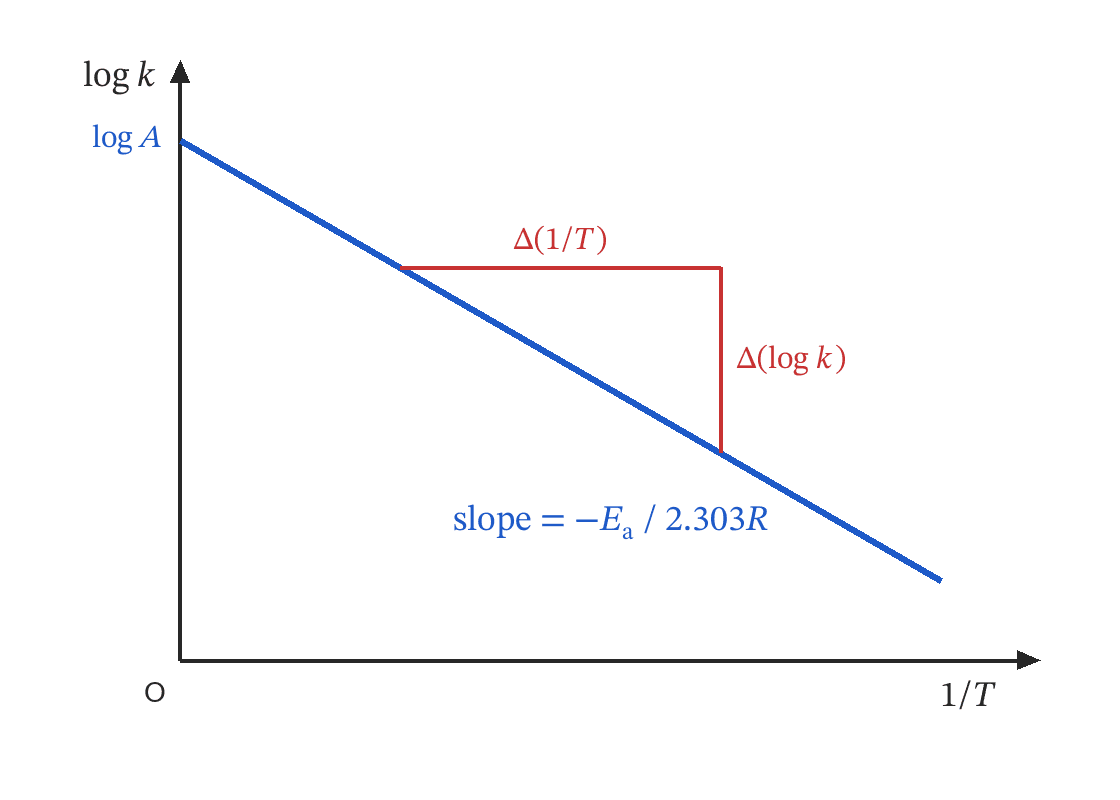
(i) Draw a graph which is used to calculate the activation energy of a reaction.
Question 1845 marksMedium
(i) Draw a graph which is used to calculate the activation energy of a reaction. Give the appropriate expressions used to calculate the activation energy graphically.
(ii) Give one example each of homogeneous and heterogeneous catalysis.
Solution:
Key idea: Taking logarithms of the Arrhenius equation k=Ae−Ea/RT gives a straight-line equation in logk and 1/T, so the slope of that graph gives Ea. In homogeneous catalysis the catalyst is in the same phase as the reactants; in heterogeneous catalysis it is in a different phase.
Step 1 — Write the equation used for the graph (part i).
Taking logarithms to base 10 gives:
logk=logA−2.303REa⋅T1
This has the form y = c + mx, with y = log k and x = 1/T.
Step 2 — Draw the graph (part i).
We plot logk against 1/T (with T in kelvin). The result is a straight line sloping downwards, with intercept logA on the logk axis.
Step 3 — Give the expressions for the activation energy (part i).
The slope is measured as Δ(log k) divided by Δ(1/T) from a triangle on the line, and it equals:
slope=−2.303REa
Rearranging gives the activation energy:
Ea=−2.303R×slope
If lnk is plotted instead, the slope is −Ea/R, so Ea=−R×slope.
Step 4 — Give an example of homogeneous catalysis (part ii).
In the lead chamber process (an old method for sulphuric acid), sulphur dioxide is oxidised by oxygen with nitric oxide gas as the catalyst. The reactants and the catalyst are all gases.
2SO2(g)+O2(g)NO(g)2SO3(g)
Step 5 — Give an example of heterogeneous catalysis (part ii).
In the Haber process, nitrogen and hydrogen gases combine on a solid iron catalyst. The catalyst (solid) is in a different phase from the gases.
N2(g)+3H2(g)Fe(s)2NH3(g)
Therefore, (i) the graph of log k against 1/T is a straight line of slope −Ea/2.303R, so Ea = −2.303R × slope; (ii) homogeneous catalysis: oxidation of SO₂ to SO₃ with NO gas as catalyst; heterogeneous catalysis: synthesis of NH₃ from N₂ and H₂ on solid iron.