
Opening your dashboard
Class 12 Chemistry Chapter 2: Solutions
242 textbook questions with step-by-step answers, free to read, for ISC 2026-27.
Get talked through Ch 2, not just shown the answer
Reading a finished solution is not the same as being able to do it. The AI tutor takes one question at a time and works it with you, in your own words, until you can.
- Ask it out loud, in your own words
- It gives you the next step, not the answer
- Stuck on part (ii)? Start there
242 questions with solutions
1–5 marks · Mixed difficulty
The first 23 solutions are on this page. This chapter is a long one, so the rest open on their own page to keep this one quick to load.
- 11 mark
Question 1
2.5 litre of 1 M NaOH solution are mixed with another 3 litre of 0.5 M NaOH solution. Then the molarity of the resulting solution is
Solve with AIAnswer
(A) 0.80 M
(B) 0.1 M
- Correct
(C) 0.73 M
(D) 0.50 M
Answer: (C) 0.73 M
Key idea: When two solutions of the same solute are mixed, the moles of solute add up and (for dilute aqueous solutions) the volumes add up. The molarity of the mixture is the total moles divided by the total volume.
Step 1 — Find the moles of NaOH in each solution.
The moles in each solution are its molarity times its volume in litres.
Step 2 — Add the moles and the volumes.
The mixture holds all the NaOH and all the solution from both portions.
Step 3 — Find the molarity of the mixture.
We divide the total moles by the total volume.
This rounds to 0.73 M.
Why the other options are wrong:
- (A) is wrong: A molarity of 0.80 M in 5.5 L would need 4.4 mol of NaOH, but the mixture contains only 4.0 mol.
- (B) is wrong: The molarity of a mixture must lie between those of the two solutions mixed (0.5 M and 1 M), so 0.1 M is impossible.
- (D) is wrong: The value 0.50 M is the molarity of the second solution alone; adding the 1 M solution must raise it above 0.50 M.
Therefore, the molarity of the resulting solution is about 0.73 M: option (C).
- 21 mark
Question 2
The volume of 4 N HCl and 10 N HCl required to make 1 litre of 6 N HCl are
Solve with AIAnswer
(A) 0.75 litre of 4 N HCl and 0.25 litre of 10 N HCl
(B) 0.25 litre of 4 N HCl and 0.75 litre of 10 N HCl
- Correct
(C) 0.67 litre of 4 N HCl and 0.33 litre of 10 N HCl
(D) 0.50 litre of 4 N HCl and 0.20 litre of 10 N HCl
Answer: (C) 0.67 litre of 4 N HCl and 0.33 litre of 10 N HCl
Key idea: On mixing, the gram-equivalents of HCl add up. The number of gram-equivalents in a solution is its normality times its volume in litres.
Step 1 — Choose an unknown.
Let L of 4 N HCl be mixed with L of 10 N HCl, so that the total volume is 1 L.
Step 2 — Write the balance of equivalents.
The equivalents from the two acids must equal those in 1 L of 6 N HCl.
Step 3 — Solve for the volume of the 4 N acid.
We expand the bracket and collect the terms in .
The volume of 10 N acid is , about 0.33 L.
Why the other options are wrong:
- (A) is wrong: 0.75 L of 4 N and 0.25 L of 10 N contain 3 + 2.5, or 5.5 equivalents, which makes 5.5 N, not 6 N.
- (B) is wrong: 0.25 L of 4 N and 0.75 L of 10 N contain 1 + 7.5, or 8.5 equivalents, which makes 8.5 N.
- (D) is wrong: These volumes add up to only 0.70 L, not 1 L, and the 4.0 equivalents in them would make the mixture about 5.71 N.
Therefore, 0.67 litre of 4 N HCl and 0.33 litre of 10 N HCl are needed: option (C).
- 31 mark
Question 3
The mole fraction of methanol in its 4.5 molal aqueous solution is
Solve with AIAnswer
(A) 0.250
(B) 0.125
(C) 0.100
- Correct
(D) 0.075
Answer: (D) 0.075
Key idea: A solution of molality contains moles of solute in 1 kg of solvent. The mole fraction of the solute is its moles divided by the total moles.
Step 1 — Find the moles of water.
A 4.5 molal solution has 4.5 mol of methanol in 1000 g of water. The molar mass of water is 18 g mol⁻¹.
Step 2 — Find the mole fraction of methanol.
We divide the moles of methanol by the total moles.
Why the other options are wrong:
- (A) is wrong: A mole fraction of 0.250 would need about 18.5 mol of methanol per kg of water, an 18.5 molal solution.
- (B) is wrong: A mole fraction of 0.125 would need about 7.94 mol of methanol per kg of water.
- (C) is wrong: A mole fraction of 0.100 would need about 6.17 mol of methanol per kg of water.
Therefore, the mole fraction of methanol is 0.075: option (D).
- 41 mark
Question 4
Density of 3 M NaCl solution is 1.28 g/cc. The molality of the solution is
Solve with AIAnswer
- Correct
(A) 2.72 molal
(B) 0.279 molal
(C) 1.279 molal
(D) 3.85 molal
Answer: (A) 2.72 molal
Key idea: Molality is the moles of solute per kilogram of solvent. To change from molarity, take 1 L of solution, find its mass from the density, and subtract the mass of the solute to get the mass of the solvent.
Step 1 — Find the mass of 1 L of solution.
One litre is 1000 mL (1000 cc), and each mL has a mass of 1.28 g.
Step 2 — Find the mass of NaCl in 1 L.
A 3 M solution holds 3 mol of NaCl per litre, and the molar mass of NaCl is 58.5 g mol⁻¹.
Step 3 — Find the mass of water.
The rest of the solution is water.
This is 1.1045 kg.
Step 4 — Find the molality.
We divide the moles of NaCl by the mass of water in kilograms.
Why the other options are wrong:
- (B) is wrong: The value 0.279 molal is about ten times too small; each kilogram of water in this solution holds about 2.72 mol of NaCl, not 0.279 mol.
- (C) is wrong: A molality of 1.279 would mean the 3 mol of NaCl were in about 2.35 kg of water, but a litre of this solution contains only 1.1045 kg of water.
- (D) is wrong: A molality of 3.85 would need the 3 mol of NaCl to be in only 0.779 kg of water.
Note: The book prints this option as 2.79 molal. That is the molality for a density of 1.25 g/cc (1074.5 g of water per litre); with the printed density of 1.28 g/cc the molality is 2.72 molal, so the option shows this value.
Therefore, the molality of the solution is about 2.72 molal: option (A).
- 51 mark
Question 5
What volume of 12 M and 4M HCl must be mixed to prepare 100 mL of 6M HCl?
Solve with AIAnswer
(A) 200, 800
(B) 700, 300
- Correct
(C) 25, 75
(D) 400, 600
Answer: (C) 25, 75
Key idea: When two solutions of the same acid are mixed, the moles of HCl add up. The millimoles in a solution are its molarity times its volume in mL.
Step 1 — Choose an unknown.
Let mL of 12 M HCl be mixed with mL of 4 M HCl, so that the total volume is 100 mL.
Step 2 — Write the balance of millimoles.
The millimoles of HCl from the two solutions must equal those in 100 mL of 6 M HCl.
Step 3 — Solve for the volume of the 12 M acid.
We expand the bracket and collect the terms in .
So 25 mL of 12 M HCl is mixed with 100 − 25, or 75 mL, of 4 M HCl: a 1 : 3 ratio by volume.
Why the other options are wrong:
- (A) is wrong: Volumes in the ratio 200 : 800 (1 : 4) give , or 5.6 M, not 6 M.
- (B) is wrong: Volumes in the ratio 700 : 300 give , or 9.6 M.
- (D) is wrong: Volumes in the ratio 400 : 600 give , or 7.2 M.
Note: The book prints this option as 250, 750. Those are the volumes in mL for 1 L of 6 M HCl; for the 100 mL asked, the volumes are 25 mL and 75 mL, so the option shows these values. The other options add up to 1000 mL, so they are judged by the ratio of their volumes.
Therefore, 25 mL of 12 M HCl and 75 mL of 4 M HCl must be mixed: option (C).
- 61 mark
Question 6
The volume of 80% sulphuric acid () by weight (density = 1.80 g mL⁻¹) required to prepare 1 L of 0.2 M is
Solve with AIAnswer
(A) 14.7 mL
(B) 29.4 mL
(C) 6.8 mL
- Correct
(D) 13.60 mL
Answer: (D) 13.60 mL
Key idea: First find the molarity of the concentrated acid from its mass percentage and density. Then use the dilution rule , since the moles of do not change on dilution.
Step 1 — Find the mass of acid in 1 L of the concentrated solution.
One litre of the concentrated acid has a mass of 1000 × 1.80 g, and 80% of this mass is .
Step 2 — Find the molarity of the 80% acid.
The molar mass of is 98 g mol⁻¹, so we divide by 98.
Step 3 — Apply the dilution rule.
We need 1000 mL of 0.2 M acid, so we solve the dilution rule for .
Why the other options are wrong:
- (A) is wrong: 14.7 is the molarity of the 80% acid (14.7 M), not the volume needed.
- (B) is wrong: Each gives two ions, so 29.4 is the normality of the 80% acid (, about 29.4 N), not a volume; 29.4 mL of the acid would hold about 0.432 mol of , more than twice the 0.2 mol needed.
- (C) is wrong: Putting the normality, 29.4 N, in place of the molarity in the dilution rule gives , or 6.8 mL; this mixes normality with molarity, and 6.8 mL of the acid holds only about 0.100 mol of , half the amount needed.
Watch out: In the laboratory the concentrated acid is added slowly to the water, never water to the acid, because mixing gives out a lot of heat.
Therefore, about 13.6 mL of the 80% acid is needed: option (D).
- 71 mark
Question 7
Which of the following plots represents the behaviour of an ideal binary liquid solution?
Solve with AIAnswer
- Correct
(A) plot of vs is linear (mol fraction of A in vapour phase)
(B) plot of vs is linear
(C) plot of vs is linear
(D) plot of vs is non-linear
Answer: (A) plot of vs is linear
Key idea: For an ideal solution, Raoult's law gives each partial pressure, , and Dalton's law links it to the vapour, . Here is a mole fraction in the liquid and a mole fraction in the vapour.
Step 1 — Write each liquid mole fraction in terms of the vapour.
Setting the two expressions for equal gives , and in the same way we get .
Step 2 — Use the fact that the liquid mole fractions add up to 1.
We add the two expressions and set the sum equal to 1.
We divide both sides by .
Step 3 — Write the result in terms of the vapour mole fraction of A.
We put and collect the terms in .
This has the form constant + constant × , so the plot of against is a straight line.
Why the other options are wrong:
- (B) is wrong: The total pressure is linear in the liquid mole fraction ; against the vapour mole fraction it is the reciprocal of a straight line, which is a curve (unless the two pure vapour pressures are equal).
- (C) is wrong: For the same reason, the total pressure against is a curve, not a straight line.
- (D) is wrong: Putting into the same equation shows that is linear in as well, so "non-linear" is false.
Therefore, for an ideal solution the plot of against is linear: option (A).
- 81 mark
Question 8
When a gas is bubbled through water at 298 K, a very dilute solution of the gas is obtained. Henry's law constant for the gas at 298 K is 100 kbar. If the gas exerts a partial pressure of 1 bar, the number of millimoles of the gas dissolved in one litre of water
Solve with AIAnswer
- Correct
(A) 0.555
(B) 5.55
(C) 0.0555
(D) 55.5
Answer: (A) 0.555
Key idea: Henry's law in the mole-fraction form is , where is the partial pressure of the gas and its mole fraction in the solution. In a very dilute solution, is practically the moles of gas divided by the moles of water.
Step 1 — Put both pressures in the same unit.
Henry's law constant is 100 kbar. One kbar is 1000 bar, so the constant is bar, the same unit as the partial pressure of 1 bar.
Step 2 — Find the mole fraction of the gas.
We divide the partial pressure by Henry's law constant.
Step 3 — Find the moles of water in 1 L.
One litre of water has a mass of about 1000 g, and the molar mass of water is 18 g mol⁻¹.
Step 4 — Find the moles of gas dissolved.
For a very dilute solution the mole fraction is practically , so we multiply the mole fraction by the moles of water.
This is about 0.556 millimoles.
Why the other options are wrong:
- (B) is wrong: Ten times as much gas would need a mole fraction of , which needs a partial pressure of 10 bar, not 1 bar.
- (C) is wrong: One-tenth as much gas would need a mole fraction of , which needs a partial pressure of only 0.1 bar.
- (D) is wrong: The number 55.5 is the moles of water in one litre, not the millimoles of gas dissolved.
Note: The option 0.555 uses 55.5 mol for the water in one litre; with 55.56 mol the result is 0.556 mmol, the same to the accuracy of the data.
Therefore, about 0.555 millimoles of the gas dissolve in one litre of water: option (A).
- 91 mark
Question 9
The vapour pressure of pure components X and Y are 200 torr and 100 torr respectively. Assuming a solution of these components obeys Raoult's law, the mole fraction of component X in the vapour phase in equilibrium with a solution containing equimoles of X and Y is
Solve with AIAnswer
(A) 0.22
(B) 0.33
(C) 0.50
- Correct
(D) 0.67
Answer: (D) 0.67
Key idea: By Raoult's law, each partial pressure is the liquid mole fraction times the vapour pressure of the pure component. By Dalton's law, the mole fraction of a component in the vapour is its partial pressure divided by the total pressure.
Step 1 — Write the liquid mole fractions.
The solution has equal moles of X and Y, so the liquid mole fraction of each is 0.5.
Step 2 — Find the partial pressures.
We multiply each liquid mole fraction by the vapour pressure of the pure component.
Step 3 — Find the total vapour pressure.
The total pressure is the sum of the partial pressures.
Step 4 — Find the mole fraction of X in the vapour.
We divide the partial pressure of X by the total pressure.
Why the other options are wrong:
- (A) is wrong: X is the more volatile component, so the vapour is richer in X than the liquid; its vapour mole fraction must be more than 0.50, so 0.22 cannot be right.
- (B) is wrong: The value 0.33 is the mole fraction of Y in the vapour (50/150), not of X.
- (C) is wrong: The value 0.50 is the mole fraction of X in the liquid; the vapour is richer in the more volatile X.
Therefore, the mole fraction of X in the vapour is about 0.67: option (D).
- 101 mark
Question 10
If the ratio of vapour pressure of pure liquids A and B is 1 : 2 and their mole fraction in solution is 1 : 2, then mole fraction of B in vapours is
Solve with AIAnswer
(A) 0.25
- Correct
(B) 0.80
(C) 0.56
(D) 0.20
Answer: (B) 0.80
Key idea: By Raoult's law, each partial pressure is the liquid mole fraction times the pure vapour pressure. The mole fraction of a component in the vapour is its partial pressure divided by the total pressure. Only ratios are given, so we can call the pure vapour pressures and .
Step 1 — Write the data in symbols.
Let and . The liquid mole fractions are in the ratio 1 : 2, so and .
Step 2 — Find the partial pressures.
We multiply each liquid mole fraction by its pure vapour pressure.
Step 3 — Find the mole fraction of B in the vapour.
We divide the partial pressure of B by the total pressure; the common factor cancels.
Why the other options are wrong:
- (A) is wrong: The value 0.25 is the ratio of the partial pressures, (1 : 4), written as a number; it is not the mole fraction of B.
- (C) is wrong: B is the more volatile liquid, so the vapour is richer in B than the liquid, where its mole fraction is about 0.67; 0.56 is lower than that.
- (D) is wrong: The value 0.20 is the mole fraction of A in the vapour (1/5), not of B.
Therefore, the mole fraction of B in the vapour is 0.80: option (B).
- 111 mark
Question 11
Two completely miscible liquids A and B form an azeotropic mixture having maximum vapour pressure. If the liquid A is more volatile, then which of the following represents the boiling point-composition graph?
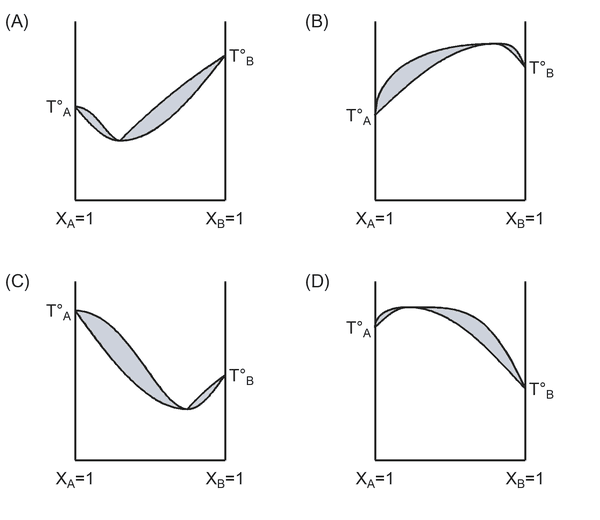 Solve with AI
Answer
- Correct
(A) Graph (A)
(B) Graph (B)
(C) Graph (C)
(D) Graph (D)
Answer: (A) Graph (A)
Key idea: A liquid boils when its vapour pressure equals the outside pressure. So the mixture with the highest vapour pressure boils at the lowest temperature, and the more volatile pure liquid has the lower boiling point.
Step 1 — Find the shape of the boiling-point curve.
The mixture has a maximum vapour pressure (positive deviation from Raoult's law), so the azeotrope boils at the lowest temperature of the whole system. The boiling point–composition curves must therefore dip to a minimum: a minimum-boiling azeotrope.
Step 2 — Find the order of the two end points.
A is more volatile, so pure A has the lower boiling point. On the graph, the left end point must lie below the right end point .
Step 3 — Match with the graphs.
Graph (A) dips to a minimum between the two ends, and its left end is lower than its right end . It is the only graph with both features.
Why the other options are wrong:
- (B) is wrong: The curves in this graph rise to a maximum, which is a maximum-boiling azeotrope; that goes with a minimum in vapour pressure (negative deviation), not a maximum.
- (C) is wrong: The curves in this graph have a minimum, but is drawn above , which would make A the less volatile liquid.
- (D) is wrong: This graph has both faults: a maximum in boiling point and above .
Therefore, the boiling point–composition graph is graph (A): option (A).
- 121 mark
Question 12
At 300 K, the vapour pressure of an ideal solution containing 1 mole of liquid A and 2 moles of liquid B is 500 mm of Hg. The vapour pressure of the solution increases by 25 mm of Hg if one more mole of B is added to the above ideal solution at 300 K. Then vapour pressure of A in its pure state is
Solve with AIAnswer
- Correct
(A) 300 mm of Hg
(B) 40 mm of Hg
(C) 500 mm of Hg
(D) 600 mm of Hg
Answer: (A) 300 mm of Hg
Key idea: For an ideal solution, Raoult's law gives the total vapour pressure as . Two solutions of different composition give two equations for the two unknowns and .
Step 1 — Write the equation for the first solution.
With 1 mol of A and 2 mol of B, the mole fractions are and .
We multiply by 3 to clear the fractions.
Step 2 — Write the equation for the second solution.
Adding one more mole of B gives 1 mol of A and 3 mol of B, so and . The vapour pressure is now 500 + 25, or 525 mm Hg.
We multiply by 4 to clear the fractions.
Step 3 — Solve the two equations.
Subtracting the first equation from the second removes .
We put this value back into the first equation.
Why the other options are wrong:
- (B) is wrong: With mm Hg, the first equation would need mm Hg; the second equation would then give , or 2230, instead of 2100.
- (C) is wrong: 500 mm Hg is the vapour pressure of the first solution, not of pure A.
- (D) is wrong: 600 mm Hg is the vapour pressure of pure B, not of pure A.
Therefore, the vapour pressure of pure A is 300 mm of Hg: option (A).
- 131 mark
Question 13
An aqueous solution of sucrose boils at 100.01°C. The number of dextrose molecules in 100 g solution are ( of water = 0.50 K kg mol⁻¹)
Solve with AIAnswer
- Correct
(A)
(B)
(C)
(D)
Answer: (A)
Key idea: For a non-volatile non-electrolyte, . The molality gives the moles of solute per kilogram of water, and multiplying moles by the Avogadro constant gives the number of molecules.
Step 1 — Find the elevation in boiling point.
Pure water boils at 100 °C, so we subtract.
Step 2 — Find the molality.
We divide the elevation by .
Step 3 — Find the moles of solute in 100 g of solution.
The solution is so dilute that 100 g of solution is practically 100 g (0.1 kg) of water.
Step 4 — Find the number of molecules.
We multiply the moles by the Avogadro constant, mol⁻¹.
Why the other options are wrong:
- (B) is wrong: That many molecules in 100 g of water would make a 0.33 molal solution, raising the boiling point by about 0.17 °C, not 0.01 °C.
- (C) is wrong: That many molecules is about 0.5 mol in 100 g of water, which would raise the boiling point by about 2.49 °C.
- (D) is wrong: That many molecules is only about mol, which would change the boiling point by far less than 0.01 °C.
Note: The stem names the solute first as sucrose and then as dextrose. The count depends only on the molality, so it is the same for any non-volatile non-electrolyte. The stem's of 0.50 K kg mol⁻¹ is a rounded value; with the accepted 0.512 K kg mol⁻¹ the count is about , which still matches option (A).
Therefore, about solute molecules are present in 100 g of the solution: option (A).
- 141 mark
Question 14
The vapour pressure of the solvent decreased by 10 mm of Hg when a non-volatile solute was added to the solvent. The mole fraction of the solute in the solution is 0.2. What should be the mole fraction of the solvent if a decrease in vapour pressure of 20 mm of Hg is desired?
Solve with AIAnswer
- Correct
(A) 0.6
(B) 0.8
(C) 0.4
(D) 0.2
Answer: (A) 0.6
Key idea: By Raoult's law, the lowering of vapour pressure is . For the same solvent at the same temperature is fixed, so the lowering is directly proportional to the mole fraction of the solute.
Step 1 — Set up the proportion.
The lowering doubles from 10 to 20 mm Hg, so the mole fraction of the solute must double too.
Step 2 — Find the new mole fraction of the solute.
We multiply both sides by 0.2.
Step 3 — Find the mole fraction of the solvent.
The mole fractions of the solvent and the solute add up to 1.
Why the other options are wrong:
- (B) is wrong: 0.8 is the mole fraction of the solvent in the first solution, where the lowering is only 10 mm Hg.
- (C) is wrong: 0.4 is the new mole fraction of the solute, not of the solvent asked for.
- (D) is wrong: 0.2 is the mole fraction of the solute in the first solution.
Therefore, the mole fraction of the solvent must be 0.6: option (A).
- 151 mark
Question 15
An aqueous solution of a substance X boils at 100.512°C. The freezing point of the solution is ( = 1.86 K m⁻¹ and = 0.512 K m⁻¹)
Solve with AIAnswer
(A) 0.93°C
(B) −0.93°C
(C) 1.86°C
- Correct
(D) −1.86°C
Answer: (D) −1.86°C
Key idea: Both colligative effects depend on the same molality of particles: and . The boiling-point data give , which then gives the depression in freezing point.
Step 1 — Find the elevation in boiling point.
Pure water boils at 100 °C, so we subtract.
Step 2 — Find the molality of particles.
We divide the elevation by .
Step 3 — Find the depression in freezing point.
The same molality of particles lowers the freezing point, so we multiply by .
Step 4 — Find the freezing point.
Pure water freezes at 0 °C, and the solute lowers this by 1.86 °C.
If X is an electrolyte, its van 't Hoff factor multiplies both effects equally, so the answer is the same.
Why the other options are wrong:
- (A) is wrong: A solute lowers the freezing point, so it cannot be above 0 °C; 0.93 °C also has only half the size of the change found.
- (B) is wrong: −0.93 °C is the freezing point of a 0.5 molal solution, half the molality found here.
- (C) is wrong: +1.86 °C has the right size of change but the wrong sign; the freezing point falls below 0 °C.
Therefore, the freezing point of the solution is −1.86 °C: option (D).
- 161 mark
Question 16
When a non-volatile solute (A) is added to solvent (B), its vapour pressure is reduced by 10%. If molar mass of B is 30% of molar mass of A, the mass ratio of B and A is
Solve with AIAnswer
(A) 0.33
(B) 6.0
- Correct
(C) 3.0
(D) 0.66
Answer: (C) 3.0
Key idea: For a dilute solution, the relative lowering of vapour pressure is , where is the moles of the solute A and the moles of the solvent B.
Step 1 — Write the mole ratio.
The vapour pressure falls by 10%, so the relative lowering is 0.10.
So is 10 times .
Step 2 — Write the moles in terms of mass and molar mass.
Moles are mass divided by molar mass, so the relation between and becomes the equation below.
Step 3 — Find the mass ratio.
We rearrange for the mass ratio and use .
Why the other options are wrong:
- (A) is wrong: The value 0.33 is the ratio taken the other way round, the mass of A to the mass of B.
- (B) is wrong: A mass ratio of 6.0 would mean 20 mol of B per mol of A, which gives a lowering of only 5%.
- (D) is wrong: A mass ratio of 0.66 would mean only 2.2 mol of B per mol of A, which by the same relation would be a lowering of about 45%, not 10%.
Note: The exact form, , gives and a mass ratio of 2.7, which is not among the options. A 10% lowering is not very small, so the two forms differ slightly; the options are based on the dilute-solution form.
Therefore, the mass ratio of B to A is 3.0: option (C).
- 171 mark
Question 17
A 6% solution of urea is isotonic with
Solve with AIAnswer
(A) 0.05 M solution of glucose
(B) 6% solution of glucose
(C) 25% solution of glucose
- Correct
(D) 1 M solution of glucose
Answer: (D) 1 M solution of glucose
Key idea: Isotonic solutions have the same osmotic pressure. For non-electrolytes at the same temperature, , so isotonic solutions must have the same molar concentration.
Step 1 — Find the concentration of the urea solution in grams per litre.
Taking the percentage as mass/volume, a 6% solution has 6 g of urea in 100 mL, so 1 L holds 60 g.
Step 2 — Convert it to molarity.
The molar mass of urea, , is 60 g mol⁻¹, so we divide the mass per litre by it.
Step 3 — Find the matching glucose solution.
Glucose is also a non-electrolyte, so the isotonic glucose solution must also be 1 M.
Why the other options are wrong:
- (A) is wrong: 0.05 M glucose is twenty times more dilute than the 1 M urea solution.
- (B) is wrong: 6% glucose is 60/180, about 0.333 M, because glucose has three times the molar mass of urea.
- (C) is wrong: 25% glucose is 250/180, about 1.39 M, more concentrated than 1 M.
Therefore, a 6% urea solution is isotonic with 1 M glucose: option (D).
- 181 mark
Question 18
Equal weights of m gram of the following substances were dissolved in equal amount of water. Which of these will have highest boiling points?
Solve with AIAnswer
(A) Urea ()
(B) Glucose ()
- Correct
(C) Sodium chloride (NaCl)
(D) Calcium chloride ()
Answer: (C) Sodium chloride (NaCl)
Key idea: The elevation in boiling point is , so it is proportional to the moles of particles in the solution. For equal masses in equal amounts of water, the solute that gives the most moles of particles per gram, , boils highest.
Step 1 — Find the particles per gram for each solute.
We divide the van 't Hoff factor (taking complete dissociation for the salts) by the molar mass .
Solute (g mol⁻¹) (mol per g) Urea 1 60 0.0167 Glucose 1 180 0.0056 NaCl 2 58.5 0.0342 3 111 0.0270 Step 2 — Pick the largest value.
Sodium chloride gives 0.0342 mol of particles per gram, the most of the four, so its solution has the highest boiling point.
Why the other options are wrong:
- (A) is wrong: Urea does not ionise and gives only 0.0167 mol of particles per gram, about half the value for NaCl.
- (B) is wrong: Glucose has the largest molar mass and does not ionise, so it gives the fewest particles per gram.
- (D) is wrong: gives 3 ions per formula unit, but its larger molar mass (111) means only 0.0270 mol of ions per gram, less than NaCl.
Therefore, the sodium chloride solution has the highest boiling point: option (C).
- 191 mark
Question 19
Which one of the following pairs of solutions can be expected to be isotonic at the same temperature?
Solve with AIAnswer
(A) 0.1 M urea and 0.1 M NaCl
(B) 0.1 M urea and 0.1 M
(C) 0.1 M NaCl and 0.1 M
- Correct
(D) 0.1 M and 0.1 M
Answer: (D) 0.1 M and 0.1 M
Key idea: Isotonic solutions have the same osmotic pressure. For electrolytes , so at the same temperature two solutions are isotonic when their concentrations of particles, , are the same.
Step 1 — Find the particle concentration of each solution.
We multiply the molarity by the number of particles each formula unit gives (taking complete dissociation for the salts).
Solution Particles per formula unit (M) 0.1 M urea 1 0.1 0.1 M NaCl 2 (, ) 0.2 0.1 M 3 (, 2 ) 0.3 0.1 M 3 (2 , ) 0.3 0.1 M 3 (, 2 ) 0.3 Step 2 — Find the pair with equal values.
Among the pairs offered, only the pair in option (D) has two solutions with the same particle concentration: both and give 0.3 M of particles.
Why the other options are wrong:
- (A) is wrong: Urea gives 0.1 M of particles but NaCl gives 0.2 M.
- (B) is wrong: Urea gives 0.1 M of particles but gives 0.3 M.
- (C) is wrong: NaCl gives 0.2 M of particles but gives 0.3 M.
Therefore, 0.1 M and 0.1 M are isotonic: option (D).
- 201 mark
Question 20
A 0.2 molal aqueous solution of weak acid (HX) is 20% ionized. The freezing point of this solution is: ( = 1.88 K kg mol⁻¹ for water)
Solve with AIAnswer
- Correct
(A) −0.45°C
(B) −0.90°C
(C) −0.31°C
(D) −0.53°C
Answer: (A) −0.45°C
Key idea: For a weak electrolyte, , where the van 't Hoff factor comes from the degree of ionisation .
Step 1 — Find the van 't Hoff factor.
For , starting from 1 mol of HX, mol stays un-ionised and mol each of and form. The total is mol of particles, and 20% ionisation means is 0.2.
Step 2 — Find the depression in freezing point.
We put , and the molality into the formula.
Step 3 — Find the freezing point.
Pure water freezes at 0 °C, so the solution freezes 0.451 °C lower.
Why the other options are wrong:
- (B) is wrong: −0.90 °C would need of about 2.4, but even complete ionisation of HX gives only , a freezing point of −0.75 °C.
- (C) is wrong: −0.31 °C is a smaller depression than even the un-ionised acid would give (, or 0.376 K); it would need association, not ionisation.
- (D) is wrong: −0.53 °C corresponds to , as if each ionised molecule gave three particles instead of two.
Note: The stem's of 1.88 K kg mol⁻¹ is slightly above the accepted 1.86 K kg mol⁻¹ for water; with 1.86 the depression is 0.446 K, and the freezing point is still about −0.45 °C.
Therefore, the freezing point of the solution is about −0.45 °C: option (A).
- 211 mark
Question 21
Electrolyte A gives 3 ions and B is a non-electrolyte. If molar solution of solute B produces an osmotic pressure p, then 0.05 molar solution of A will produce an osmotic pressure equal to
Solve with AIAnswer
(A) p
- Correct
(B) 0.15 p
(C) 0.5 p
(D) 0.75 p
Answer: (B) 0.15 p
Key idea: At a fixed temperature the osmotic pressure is , so it is proportional to , the total concentration of solute particles. Here (the van 't Hoff factor) is the number of particles each formula unit gives in solution.
Step 1 — Find the particle concentration of solution B.
B is a non-electrolyte, so it does not split into ions and . A molar solution is a 1 M solution.
Step 2 — Find the particle concentration of solution A.
Each unit of A gives 3 ions, so , and the solution is 0.05 M.
Step 3 — Compare the two osmotic pressures.
Both solutions are at the same temperature, so the ratio of their osmotic pressures equals the ratio of their particle concentrations.
Why the other options are wrong:
- (A) is wrong: Equal osmotic pressures need equal particle concentrations. Solution A has only 0.15 mol L⁻¹ of particles against 1 mol L⁻¹ for B; to reach , A would have to be about 0.333 M.
- (C) is wrong: An osmotic pressure of 0.5 needs 0.5 mol L⁻¹ of particles, which means a 0.167 M solution of A, not a 0.05 M one.
- (D) is wrong: An osmotic pressure of 0.75 needs 0.75 mol L⁻¹ of particles, which means a 0.25 M solution of A, five times stronger than the one given.
Note: The book prints this option as 1.5 . That value is right only if solution B is 0.1 M. For the molar (1 M) solution of B in the stem, the answer is 0.15 , so the option shows that value.
Therefore, the 0.05 M solution of A has an osmotic pressure of 0.15 p: option (B).
- 221 mark
Question 22
Which of the following 0.10 m aqueous solution will have the lowest freezing point?
Solve with AIAnswer
- Correct
(A)
(B)
(C)
(D) KI
Answer: (A)
Key idea: The depression of freezing point is . At the same molality , the solute that gives the most particles (largest ) lowers the freezing point most, so its solution has the lowest freezing point.
Step 1 — Find the van 't Hoff factor of each solute.
We assume that each salt dissociates completely, as such questions intend. gives , so . Glucose and sucrose are non-electrolytes, so for each. KI gives , so .
Step 2 — Compare the particle molalities.
Multiplying each by 0.10 mol kg⁻¹ gives the molality of particles: 0.50, glucose 0.10, sucrose 0.10 and KI 0.20 mol kg⁻¹.
Step 3 — Find the depression for the solution with the most particles.
The salt gives the most particles. For water K kg mol⁻¹, so its depression is the largest of the four.
Why the other options are wrong:
- (B) is wrong: Glucose does not ionise, so it gives only 0.10 mol kg⁻¹ of particles, one-fifth of the particles from .
- (C) is wrong: Sucrose is also a non-electrolyte; its 0.10 mol kg⁻¹ of molecules lower the freezing point by only about 0.19 K.
- (D) is wrong: KI gives two ions per formula unit, so it gives 0.20 mol kg⁻¹ of particles, fewer than the 0.50 mol kg⁻¹ from .
Therefore, the 0.10 m Al₂(SO₄)₃ solution has the lowest freezing point: option (A).
- 231 mark
Question 23
In a 0.2 molal aqueous solution of a weak acid, HX, the degree of dissociation is 0.3. Taking for water as 1.85, the freezing point of the solution will be nearest to
Solve with AIAnswer
(A) −0.360°C
(B) −0.206°C
(C) +0.480°C
- Correct
(D) −0.480°C
Answer: (D) −0.480°C
Key idea: A weak acid HX ionises only partly: . If a fraction (the degree of dissociation) ionises, the van 't Hoff factor is , and the depression of freezing point is .
Step 1 — Find the van 't Hoff factor.
From 1 mol of HX, mol stays as HX and mol each of and form, so the total is mol of particles.
Step 2 — Find the depression of freezing point.
We use the value K kg mol⁻¹ given in the stem and the molality mol kg⁻¹.
Step 3 — Find the freezing point.
Pure water freezes at 0 °C, and a fall of 0.481 K is a fall of 0.481 °C.
This is nearest to −0.480 °C.
Why the other options are wrong:
- (A) is wrong: With no dissociation at all () the depression would already be 0.370 K. Dissociation only adds particles, so the depression must be more than 0.370 K, but (A) gives only 0.360 K.
- (B) is wrong: A depression of 0.206 K is even further below 0.370 K, the smallest depression this 0.2 molal solution can show, so no degree of dissociation can give it.
- (C) is wrong: This value has the right size but the wrong sign. A dissolved solute lowers the freezing point below 0 °C; it never raises it.
Therefore, the freezing point is nearest to −0.480 °C: option (D).
- 241 mark
Question 24
Which of the following solutions are isotonic with one another?
(1) 0.15 M urea
(2) 0.05 M
(3) 0.1 M
(4) 0.15 M glucose
Select the correct answer using the codes given below
- 251 mark
Question 25
The correct equation for the degree of association 'α' of an associating solute, 'n' molecules of which undergoes association in solution, is
- 261 mark
Question 26
Molal depression constant for a solvent is 4.0 K kg mol⁻¹. The depression in the freezing point of the solvent 0.03 mol kg⁻¹ solution of is: (assume complete dissociation of the electrolyte)
- 271 mark
Question 27
The mass of a non-volatile solute of molar mass 40 g mol⁻¹ that should be dissolved in 114 g of octane to lower its vapour pressure by 20% is
- 281 mark
Question 28
31 g of ethylene glycol () is mixed with 500 g of a solvent ( of the solvent is 2 K kg mol⁻¹). What is the freezing point of the solution in K? (Freezing pt. of the solvent = 273 K)
- 291 mark
Question 29
A solution containing 1 mole of ethylene glycol dissolved in 1000 g of water (K = 18.6°C) will freeze at:
- 301 mark
Question 30
Which of the following liquids would possess the highest vapour pressure at room temperature?
- 311 mark
Question 31
Elevation in boiling point was 0.52°C when 0.6 g of a compound X was dissolved in 100 g of water. Molecular weight of X is ( = 5.2°C)
- 321 mark
Question 32
Which solution will have the highest boiling point?
- 331 mark
Question 33
Which has the highest freezing point at one atmosphere?
- 341 mark
Question 34
Mark the correct relationship between the boiling points of very dilute solutions of () and KCl () having the same molarity.
- 351 mark
Question 35
What would be the freezing point of aqueous solution containing 1.7 g of in 100 g of water? = 1.86 K mol⁻¹ kg
- 361 mark
Question 36
The freezing point of 1% solution of in water will be: ( = 1.86 K mol⁻¹ kg)
- 371 mark
Question 37
The freezing point of a 0.05 molal solution of non-electrolyte in water is:
- 381 mark
Question 38
Which one of the following solutions has the highest b.p.?
- 391 mark
Question 39
The mole fraction of in a solution containing 6 g of and 54 g of water will be:
- 401 mark
Question 40
The relative lowering of vapour pressure of a solvent by the addition of a solute is:
- 411 mark
Question 41
Which of the following salts has the same value of van 't Hoff factor as that of ?
- 421 mark
Question 42
How many grammes of should be added to water to prepare 150 mL solution of 2M ?
- 431 mark
Question 43
The concentration unit, independent of temperature would be:
- 441 mark
Question 44
According to Raoult's law, the relative lowering of vapour pressure for a solution is equal to:
- 451 mark
Question 45
What is the molarity of solution that has a density of 1.84 g/c.c. at 35°C and contains 98% by weight?
- 461 mark
Question 46
Vapour pressure of at 25°C is 143 mm Hg. 0.5 g of a non-volatile solute (mol. wt. = 65) is dissolved in 100 mL . Find the vapour pressure of the solution (density of = 1.58 g/cc).
- 471 mark
Question 47
The relationship between osmotic pressures at 273 K when 10 g glucose (), 10 g urea () and 10 g sucrose () are dissolved in 250 mL water:
- 481 mark
Question 48
Which of the following 0.10 M aqueous solutions will have the lowest freezing point?
- 491 mark
Question 49
A 5% solution of cane sugar (mol. wt. = 342) is isotonic with 1% solution of a substance X. The molecular weight of X is:
- 501 mark
Question 50
The vapour pressure of a solvent is decreased by 10 mm Hg, when a non-volatile solute was added to the solvent. The mole fraction of the solute in the solution is 0.2. What should be the mole fraction of the solvent if the decrease in the vapour pressure is to be 20 mm Hg?
- 511 mark
Question 51
If 0.15 g of a solute, dissolved in 15 g of a solvent, is boiled at a temperature higher by 0.216°C, than that of a pure solvent, the molecular weight of the substance is: ( for the solvent = 2.16 K mol⁻¹ kg)
- 521 mark
Question 52
How many grammes of a dibasic acid (mol. wt. = 200) should be present in 100 mL of the aqueous solution to give 0.1 normality?
- 531 mark
Question 53
The vapour pressure of benzene at a certain temperature is 640 mm Hg. A non-volatile and non-electrolyte solid, weighing 2.175 g, is added to 39.08 g of benzene. If the vapour pressure of the solution is 600 mm Hg, what is the molecular weight of the substance?
- 541 mark
Question 54
Which of the following colligative property can provide molar mass of proteins (or polymers or colloids) with great precision?
- 551 mark
Question 55
Molarity of liquid HCl, if density of solution is 1.17 g/cc, is:
- 561 mark
Question 56
1 M and 2.5 litre solution is mixed with another 0.5 M and 3 litre solution. The molarity of the resultant solution is:
- 571 mark
Question 57
A solution containing components A and B follows Raoult's law because:
- 581 mark
Question 58
Formation of a solution from two components can be considered as:
Step 1: Pure solvent → Separated solvent molecules,
Step 2: Pure solute → Separated solute molecules,
Step 3: Separated solvent and solute molecules → solution,
Solution so formed will be ideal if
- 591 mark
Question 59
The normality of 0.3 M phosphorus acid is:
- 601 mark
Question 60
In the depression of freezing point experiment it is found that the:
(A) vapour pressure of solution is less than that of pure solvent
(B) vapour pressure of the solution is more than that of pure solvent
(C) only solute molecules solidify at the freezing point
(D) only solvent molecules solidify at the freezing point.
(More than one option may be correct.)
- 611 mark
Question 61
A 0.2 molal aqueous solution of weak acid (HX) is 20 per cent ionised. The freezing point of this solution is: [ = 1.86 K mol⁻¹ kg]
- 621 mark
Question 62
By increasing the temperature, the vapour pressure of a substance
- 631 mark
Question 63
The unit of molality is:
- 641 mark
Question 64
Which of the following is not a colligative property?
- 651 mark
Question 65
The number of moles of in 1000 mL of 3 molar solution is
- 661 mark
Question 66
The freezing point of a solution, prepared from 1.25 g of a non-electrolyte and 20 g of water, is 271.9 K. If the molar depression constant is 1.86 K kg mol⁻¹, then the molar mass of the solute is:
- 671 mark
Question 67
An ideal solution is formed when its constituents:
- 681 mark
Question 68
Osmotic pressure is 0.0821 atm at 300 K. The concentration in mol/lit. is
- 691 mark
Question 69
Van't Hoff factor of is
- 701 mark
Question 70
Benzoic acid is dissolved in benzene. The value of Van't Hoff factor will be
- 711 mark
Question 71
Which one of the following does not contain volume?
- 721 mark
Question 72
How many grams of would have to be added to prepare 150 mL of a solution that is 2.0 M ?
- 731 mark
Question 73
Isotonic solutions have
- 741 mark
Question 74
The rise in the boiling point of a solution containing 1.8 gm of glucose in 100 gm of a solvent is 0.1°C. The molal elevation constant is
- 751 mark
Question 75
The freezing points of solution are given below, ionization being 100%, assume molarity = molality.
(I) 0.05 M (II) 0.075 M (III) 0.14 M Sucrose (IV) 0.04 M
The correct order for decreasing freezing point is
- 761 mark
Question 76
Number of moles of a solute per kilogram of a solvent is called:
- 771 mark
Question 77
Which is not affected by the temperature?
- 781 mark
Question 78
120 gm of urea is present in 5 lit of solution. The active mass of urea is:
- 791 mark
Question 79
The osmotic pressure of 12% solution of cane sugar at 17°C is:
- 801 mark
Question 80
Which one of the following is independent of temperature?
- 811 mark
Question 81
The normality of having 50 milli equivalents in 2 lits is:
- 821 mark
Question 82
2 g of dissolved in 25 g of shows a depression in freezing point equal to 1.62 K. If it forms dimer in solution, the percentage association of acid is: [ molal depression constant = 4.9 K mol⁻¹ kg]
- 831 mark
Question 83
For converting a solution of 100 mL of 0.4 M concentration to 0.05 M concentration, the quantity of water added is:
- 841 mark
Question 84
The osmotic pressure of 5% solution of cane sugar at 150°C is
- 851 mark
Question 85
35.4 mL of is required for the neutralisation of a solution containing 0.275 g of sodium hydroxide. The normality of hydrochloric acid is
- 861 mark
Question 86
By dissolving 5 g substance in 50 g of water, the decrease in freezing point is 1.2°C. The molal depression is 1.85°C. The molecular weight of substance is
- 871 mark
Question 87
Which one of the following is not a colligative property?
- 881 mark
Question 88
4.0 g of is dissolved in 100 mL solution. The normality of the solution is:
- 891 mark
Question 89
Which of the following pairs of solution are isotonic at the same temperature?
(A) 0.1 M and 0.1 M
(B) 0.1 M and 0.1 M
(C) 0.1 M urea and 0.1 M
(D) 0.2 M urea and 0.1 M
(More than one option may be correct.)
- 901 mark
Question 90
The vapour pressure of pure benzene at a certain temperature is 640 mm Hg. A non-volatile non-electrolyte solid weighing 2.175 g is added to 39.0 g of benzene. The vapour pressure of the solution is 600 mm. What is the molecular weight of the solid substance?
- 911 mark
Question 91
The molarity of pure water is:
- 921 mark
Question 92
What is the molarity of 0.2 N solution?
- 931 mark
Question 93
The relationship between the values of osmotic pressure of 0.1 M solution of () and () is:
- 941 mark
Question 94
An aqueous solution of glucose is 10% in strength. The volume in which 1 g mole of it is dissolved, will be:
- 951 mark
Question 95
What is the freezing point of a solution containing 8.1 g in 100 g water assuming the acid to be 90% ionised? ( for water = 1.86 K kg mol⁻¹):
- 961 mark
Question 96
Volume of 0.6 M required to neutralise 30 cm³ of 0.4 M is:
- 971 mark
Question 97
Osmotic pressure of 0.4% urea solution is 1.64 atm and that of 3.42% cane sugar is 2.46 atm. When the above two solutions are mixed, the osmotic pressure of the resulting solution is:
- 981 mark
Question 98
10 g of is dissolved in g of the solution. Its concentration is:
- 991 mark
Question 99
Which one of the following solutions has the highest boiling point?
- 1001 mark
Question 100
Number of moles of present in 2 litres of 0.5 M is:
- 1011 mark
Question 101
The molar solution of is equal to
- 1021 mark
Question 102
Which one of the solutions has the highest B.P.?
- 1031 mark
Question 103
The freezing point of 1% solution of lead nitrate in water will be:
- 1041 mark
Question 104
The amount of urea to be dissolved in 500 c.c. of water ( = 1.86°C kg mol⁻¹) to produce a depression of 0.186°C in the freezing point is:
- 1051 mark
Question 105
What is the molarity of 0.2 N solution?
- 1061 mark
Question 106
On adding a solute to a solvent having vapour pressure 0.80 atm., vapour pressure reduces to 0.60 atm. Mole fraction of solute is:
- 1071 mark
Question 107
Volume of water needed to mix with 10 mL 10 N to get 0.1 N is:
- 1081 mark
Question 108
Which will show maximum depression in freezing point when concentration is 0.1 M?
- 1091 mark
Question 109
During depression of freezing point in a solution, the following are in equilibrium:
- 1101 mark
Question 110
Which one of the statements given below concerning properties of solutions describes a colligative effect?
- 1111 mark
Question 111
The lowest freezing point of 0.1 M aqueous solution is of:
- 1121 mark
Question 112
The average osmotic pressure of human blood is 7.8 bar at 37°C. What is the concentration of an aqueous solution that could be used in the blood stream?
- 1131 mark
Question 113
Camphor is often used in molecular mass determination because
- 1141 mark
Question 114
A 0.004 M solution of is isotonic with a 0.010 M solution of glucose at the same temperature. The apparent degree of dissociation of is
- 1151 mark
Question 115
molecules of urea are present in 100 mL of its solution. The concentration of urea solution is (Avogadro constant, mol⁻¹)
- 1161 mark
Question 116
To neutralise completely 20 mL of 0.1 M aqueous solution of phosphorous acid (), the volume of 0.1 M aqueous KOH solution required is
- 1171 mark
Question 117
In 100 g of naphthalene, 2.423 g of S was dissolved. Melting point of naphthalene = 80.1°C. = 0.661°C. = 35.7 cal/g of naphthalene. Molecular formula of sulphur added is
- 1181 mark
Question 118
Maximum freezing point falls in
- 1191 mark
Question 119
Vapour pressure of dilute aqueous solution of glucose is 750 mm of mercury at 373 K. The mole fraction of the solute is
- 1201 mark
Question 120
If mole fraction of solute in benzene is 0.2, then the molality of the solution is
- 1211 mark
Question 121
Ethylene glycol is added to water as antifreeze. It will
- 1221 mark
Question 122
The volumes of 4 N HCl and 10 N HCl required to make 1 litre of 6 N HCl are
- 1231 mark
Question 123
The elevation in boiling point of a solution of 13.44 g of in 1 kg of water is (Given = 0.52 K kg mol⁻¹, molecular weight of = 134.4):
- 1241 mark
Question 124
If is the degree of dissociation of , the van 't Hoff factor () used for calculating the molecular mass is
- 1251 mark
Question 125
Benzene and Toluene form nearly ideal solution. At 20°C, the vapour pressure of benzene is 75 torr and that of toluene is 22 torr. The partial vapour pressure of benzene at 20°C in a solution containing 78 g of benzene and 46 g of toluene in torr is
- 1261 mark
Question 126
Two solutions of a substance (non-electrolyte) are mixed in the following manner: 480 mL of 1.5 M first solution + 520 mL of 1.2 M second solution. What is the molarity of the final mixture?
- 1271 mark
Question 127
Equimolar solutions in the same solvent have
- 1281 mark
Question 128
The mole fraction of the solute in one molal aqueous solution is
- 1291 mark
Question 129
The vapour pressure of the two liquids 'P' and 'Q' are 80 and 60 torr respectively. The total vapour pressure of the solution obtained by mixing 3 mole of P and 2 mole of Q would be
- 1301 mark
Question 130
A solution of urea (mol. mass 56 g mol⁻¹) boils at 100.18°C at the atmospheric pressure. If and for water are 1.86 and 0.512 K kg mol⁻¹ respectively, the above solution will freeze at
- 1311 mark
Question 131
X is dissolved in water. Maximum boiling point is observed when X is ....... (0.1 M each)
- 1321 mark
Question 132
Which has minimum osmotic pressure?
- 1331 mark
Question 133
Solution A contains 7 g/L and solution B contains 7 g/L of . At room temperature, the osmotic pressure of
- 1341 mark
Question 134
If two substances A and B have = 1 : 2 and have mole fraction in solution 1 : 2, then mole fraction of A in vapours is
- 1351 mark
Question 135
If an aqueous solution of glucose is allowed to freeze, then crystals of which will be separated out first?
- 1361 mark
Question 136
A solution has a 1 : 4 ratio of pentane and hexane. The vapour pressure of pure pentane is 440 mm of Hg and that of pure hexane is 120 mm of Hg at 20°C respectively. The mole fraction of pentane in the vapour phase would be
- 1371 mark
Question 137
Normal solution is
- 1381 mark
Question 138
van 't Hoff factor of is
- 1391 mark
Question 139
The volume of water to be added to 100 cm³ of 0.5 N to get decinormal concentration is
- 1401 mark
Question 140
If for a sucrose solution, elevation in boiling point is 0.1°C, then what will be the boiling point of NaCl solution for same molal concentration?
- 1411 mark
Question 141
An aqueous solution freezes at −0.186°C. What is the elevation in boiling point? ( = 1.86, = 0.512)
- 1421 mark
Question 142
During osmosis, flow of water through a semi-permeable membrane is
- 1431 mark
Question 143
A solution containing 10 g per dm³ of urea (molecular mass = 60 g mol⁻¹) is isotonic with a 5% solution of a non-volatile solute. The molecular mass of this non-volatile solute is
- 1441 mark
Question 144
1.00 g of a non-electrolyte solute (molar mass 250 g mol⁻¹) was dissolved in 51.2 g of benzene. If the freezing point depression constant, of benzene is 5.12 K kg mol⁻¹, the freezing point of benzene will be lowered by
- 1451 mark
Question 145
van 't Hoff factor of is :
- 1461 mark
Question 146
Blood cells do not shrink in blood because blood is :
- 1471 mark
Question 147
A 0.5 g L⁻¹ solution of glucose is found to be isotonic with 2.5 g L⁻¹ solution of an organic compound. What will be the molecular weight of that compound?
- 1481 mark
Question 148
Correct order of freezing point of 1.0 M solution of sucrose, , and is :
- 1491 mark
Question 149
An aqueous solution of glucose is 20% in strength. The volume in which 1 g mole of it is dissolved will be :
- 1501 mark
Question 150
Osmotic pressure of 0.4% urea solution is 1.64 atm and that of 3.42% cane sugar is 2.46 atm. When the above two solutions are mixed, the osmotic pressure of the resulting solution is :
- 1511 mark
Question 151
Equal moles of water and urea are taken in a flask. What is the mass percentage of urea in the solution?
- 1521 mark
Question 152
Which of the following aqueous solutions will exhibit highest boiling points?
- 1531 mark
Question 153
The vapour pressures of two liquids P and Q are 80 and 60 torr respectively. The total vapour pressure of the solution obtained by mixing 3 moles of P and 2 moles of Q would be :
- 1541 mark
Question 154
Concentrated aqueous solution of sulphuric acid is 98% by mass and has a density of 1.80 g mL⁻¹. Volume of acid required to make one litre of 0.1 M solution is :
- 1551 mark
Question 155
0.5 molal solution of a weak monobasic acid is 20% ionised. If for water is 1.86 K kg mol⁻¹, the lowering in freezing point is :
- 1561 mark
Question 156
A 0.0020 M aqueous solution of an organic compound freezes at −0.00732°C. The number of moles of ions which one mole of ionic compound produces on being dissolved in water will be : ( = 1.86 K kg mol⁻¹)
- 1571 mark
Question 157
Among the following mixtures, dipole-dipole as the major interactions is present in
- 1581 mark
Question 158
Density of a 2.05 molar solution of acetic acid in water is 1.02 g/mL. The molality of solution is
- 1591 mark
Question 159
The ......... in boiling point of solvent is directly proportional to the ......... of the solution.
- 1601 mark
Question 160
The ......... of the boiling point of a solvent by the addition of a solute is ......... proportional to the molality of the solution.
- 1612 marks
Question 161
2.82 g of glucose (molar mass = 180) are dissolved in 30 g of water. Calculate (a) the molality (b) mole fraction of glucose and water.
- 1622 marks
Question 162
Calculate the molarity of pure water (density of water = 1 g mL⁻¹).
- 1632 marks
Question 163
A solution is 25% water, 25% ethanol and 50% acetic acid by mass. Calculate the mole fraction of each component.
- 1642 marks
Question 164
Calculate the moles of methanol in 5 litres of its 2 m solution, if the density of the solution is 0.981 kg L⁻¹ (Molar mass of methanol = 32.0 g mol⁻¹).
- 1652 marks
Question 165
Calculate the volume of 80% by weight (density = 1.80 g mL⁻¹) required to prepare 1L of 0.2 M .
- 1662 marks
Question 166
A solution of glucose (molar mass = 180 g mol⁻¹) in water is labelled as 10% by mass. What would be the molality and molarity of the solution? (Density of solution = 1.2 g mL⁻¹)
- 1672 marks
Question 167
A commercially available sample of sulphuric acid is 15% by weight (density = 1.10 g mL⁻¹). Calculate (i) molarity (ii) normality and (iii) molality of the solution.
- 1682 marks
Question 168
A sugar syrup of weight 214.2 g contains 34.2 g of sugar (). Calculate :
(i) molal concentration, and
(ii) mole fraction of sugar in the syrup.
- 1692 marks
Question 169
What is the mole fraction of the solute in 2.5 m aqueous solution?
- 1702 marks
Question 170
The mole fraction of benzene in a solution with toluene is 0.50. Calculate the mass percent of benzene in the solution.
- 1712 marks
Question 171
The mole fraction of water in a sulphuric acid solution is 0.85. Calculate the molality of the solution.
- 1722 marks
Question 172
A 6.90 M solution of KOH in water contains 30% by mass of KOH. Calculate the density of the KOH solution. (Molar mass of KOH = 56 g mol⁻¹).
- 1735 marks
Question 173
(a) Describe with experimental details either the depression of the freezing point or the elevation of the boiling point method for the determination of the molecular weight of a non-volatile substance.
(b) A solution of 3 g of a substance in 100 g of water has a boiling point of 100.26°C. Calculate the molecular weight of the substance, if molal boiling point elevation constant of water is 0.52.
(c) Explain why the molecular weight of sodium chloride determined by the elevation of boiling point method or depression of freezing point method is half its actual molecular weight.
(d) 0.23 g of a volatile liquid occupies 126.4 cc at 27°C and 740 mm pressure. Calculate the molecular weight of the liquid. How many molecules of the liquid are present in 0.23 g?
- 1745 marks
Question 174
(a) (i) Define either cryoscopic constant or ebullioscopic constant for a solvent.
(ii) Describe how you would determine experimentally any one of these constants for a given organic solvent, benzene. You are provided pure benzoic acid ().
(b) 0.5 g each of two substances A and B having the same formula weight dissolved in 50 g of water each decreases the freezing point of water by 0.031°C and 0.093°C respectively. Cryoscopic constant for water is 1.8/1000 g of water.
(i) Suggest the reasons for the difference in the lowering of the freezing point in the two cases.
(ii) Calculate the molecular weight of A from the data above.
(iii) State whether the molecular weight of B is higher or lower than that of A.
- 1755 marks
Question 175
(a) What is meant by colligative properties as applied to solutions?
(b) The boiling point of water was lowered by 0.19°C by dissolving 0.152 g of a substance in 25 g water. Calculate the molecular weight of the substance. Molar freezing point depression constant for water is 18.5/100 g.
- 1765 marks
Question 176
Define osmotic pressure.
At 25°C the osmotic pressure of a solution of an organic substance containing 1.425 g per 100 mL of water was found to be 760 mm of Hg. Calculate the molecular weight of the substance. (R = 0.082 lit-atm mol⁻¹ K⁻¹).
- 1775 marks
Question 177
Describe a suitable method for determining the molecular weight of a substance by measurement of osmotic pressure.
A solution containing 1 g of a substance per litre showed an osmotic pressure of 304 mm of Hg at 15°C. Calculate the molecular weight of the substance.
- 1783 marks
Question 178
A solution of glycol containing 1.82 g per litre has an osmotic pressure of 51.8 cm of mercury at 10°C. What is the molecular weight of glycol?
- 1793 marks
Question 179
A solution of glucose containing 18 g per litre had an osmotic pressure of 2.39 atmospheres at 23°C. Find the molecular weight of glucose.
- 1803 marks
Question 180
The solution of 2.78 g of benzophenone in 55.6 g of acetone has its boiling point raised by 0.472°C. Find the molecular weight of benzophenone. Molar elevation of boiling point for acetone = 1.72°C mole⁻¹
- 1813 marks
Question 181
The boiling point of chloroform was raised by 0.323°C when 0.5143 g of anthracene was dissolved in 32.2 g. Calculate the molecular weight of anthracene. ( = 3.6°C mole⁻¹)
- 1823 marks
Question 182
5 g of a substance dissolved in 50 g of water lowered the freezing point by 1.2°C. Calculate the molecular weight of the substance. The molecular depression for water is 1.85°C.
- 1833 marks
Question 183
0.440 g of a substance dissolved in 22.2 g of benzene lowered the freezing point of benzene by 0.567°C. Calculate the molecular weight of the substance. ( = 5.12°C mole⁻¹)
- 1845 marks
Question 184
(a) What is the volume of a solution containing 1 g mol of sugar that will give rise to an osmotic pressure of 1 atm at S.T.P.?
(b) What is the principle of determining the molecular weight of a non-volatile solute by osmotic pressure method.
(c) completely dissociates in water. Urea is a non-electrolyte. A 0.01 molar solution of depressed the freezing point of water by 0.0588°C. What will be the depression caused by a 0.01 M solution of urea?
- 1855 marks
Question 185
(i) The depression in freezing point of water in a solution of urea is 0.043°C. What will be the depression of freezing point if a solution of sodium chloride of the same concentration as urea is used?
(ii) Write down the expression relating elevation of boiling point of a solvent when a solute is dissolved in it to form a dilute solution and the concentration of the solution, defining the terms.
- 1863 marks
Question 186
A solution containing 8.60 g of urea per litre of the solution was found to be isotonic with 5% solution (w/v) of an organic non-volatile solute. Calculate its molecular mass.
- 1873 marks
Question 187
The vapour pressures of ethanol and methanol are 44.5 and 88.7 mm of Hg respectively. An ideal solution is formed at the same temperature by mixing 60 g of ethanol and 40 g of methanol. Calculate the total vapour pressure of the solution and mole fraction of methanol in vapour phase.
- 1883 marks
Question 188
What is the weight of one mole of solute, 0.132 g of which in 29.70 g of benzene gave a freezing point depression of 0.108 K? for is 5.12 K mol⁻¹ kg.
- 1893 marks
Question 189
A solution having 0.32 g of a solute in 25 g water has a freezing point of − 0.201°C. Calculate its molecular weight. for water is 1.86 K molality⁻¹.
- 1903 marks
Question 190
Phenol associates in benzene to a certain extent to form a dimer. A solution containing 20 × 10⁻³ kg of phenol in 1 kg of benzene has its freezing point depressed by 0.69 K. Calculate the degree of association. = 5.12 K.kg mol⁻¹.
- 1913 marks
Question 191
The freezing of a solution containing 0.2 g of acetic acid in 20 g of benzene is lowered by 0.45°C. Calculate the degree of association of acetic acid in benzene. for benzene = 5.12K kg mol⁻¹. It forms dimers in benzene.
- 1923 marks
Question 192
The weights of solutes in two isotonic solutions A and B are in the ratio 2 : 3. If the solutes are non-electrolytes, how are their molecular weights related?
- 1933 marks
Question 193
If the vapour pressure of pure water is 30 mm Hg, under the same conditions, what will be vapour pressure of an aqueous solution of glucose containing 0.01 mole fraction of glucose?
- 1943 marks
Question 194
What is the freezing point in degrees Centigrade of a solution containing 3.42 g sucrose () dissolved in 1000 g water? Molar freezing point of water is 1.86°C per mole per kg.
- 1955 marks
Question 195
(a) Name the law or principle obeyed in the following cases :
(i) The freezing point of water decreases with increasing pressure.
(ii) For the solution of a non-volatile solute, the mole fraction of the solute determines the vapour pressure of the solvent.
(b) Name two ways of measuring concentration of solution which is not temperature dependent. A mixture of two immiscible liquids X and Y with different boiling points is heated to below the boiling point of the lower boiling liquid X. Will the vapour be of pure X or a mixture of X and Y?
- 1963 marks
Question 196
The vapour pressure of an aqueous solution of a non-volatile solute whose mole fraction is 0.01 is found to be 34.65 torr. What is vapour pressure of pure water?
- 1973 marks
Question 197
The osmotic pressure of a dilute aqueous solution of a compound X containing 0.12 g per litre is twice the osmotic pressure of a dilute aqueous solution of another compound Y containing 0.18 g per litre. What is ratio of molecular weight of X to that of Y? Both X and Y remain in the molecular form in solution.
- 1983 marks
Question 198
An aqueous solution of cane sugar containing 1.72 g in 100 mL begins to freeze at − 0.093°C. The cryoscopic constant (depression in freezing point constant) of water is 1.86 K mol⁻¹ kg. Calculate the molecular weight of cane sugar.
- 1993 marks
Question 199
The depression of the freezing point of water in a 0.01 molal solution of glucose is 0.0186 K. What do you expect the depression of the freezing point of water to be in a 0.01 molal solution of sodium chloride?
- 2003 marks
Question 200
Calculate the weight of glucose which when dissolved in 100 g of water produces the same lowering of vapour pressure as 10 g of fructose dissolved in 50 g of water. Name the law used in deducing the answer.
- 2013 marks
Question 201
A solution to be used in a hand lotion is prepared by mixing 90 g of water, 9.2 g of ethyl alcohol and 1.8 g of glycerol (). Calculate the mole fraction of glycerol present in it.
- 2023 marks
Question 202
At 37°C, the osmotic pressure of blood is 7.65 atm. How much glucose (mol. wt. = 180) should be used per litre for an intravenous injection that is isotonic with blood?
- 2035 marks
Question 203
(i) Correct the statement : Freezing point of a solution is directly proportional to its molality.
(ii) 0.5 g of a non-volatile solute is dissolved in 100 g of ethyl acetate at 20°C. The vapour pressure of solution and pure ethyl acetate are 72.0 torr and 72.8 torr respectively at 28ºC. Calculate the molecular weight of the solute.
- 2045 marks
Question 204
(i) The freezing point of nitrobenzene is 278.8 K. A 0.25 molal solution of a substance (molecular weight : 120) in nitrobenzene has a freezing point of 276.8 K. Calculate the molal depression constant of nitrobenzene.
(ii) Calculate the osmotic pressure of a solution containing 3.42 g of sucrose in 1 litre of water at 400 K.
- 2055 marks
Question 205
(i) (a) Correct the statement : Addition of sodium chloride lowers the boiling point and freezing point of water.
(b) Osmotic pressure and boiling points are colligative properties.
(ii) Define osmotic pressure. Arrange the following in increasing order of osmotic pressure :
(a) 34.2 g per litre of sucrose (M.W. = 342)
(b) 90 g per litre of glucose (M.W. = 180)
(c) 5.85 g per litre of sodium chloride (M.W. 58.5).
- 2063 marks
Question 206
An aqueous solution containing 0.2 g of a compound A in 12.7 g of water freezes at 272.814 K. If the value of for water is 1.86 K kg mol⁻¹, calculate the molecular weight of compound A.
- 2075 marks
Question 207
(i) Correct the following statement :
Molarity of a solution is independent of temperature.
(ii) Calculate the mole fraction of water in an aqueous solution of sodium hydroxide, which has 80 g of NaOH and 54 g of . [Relative atomic masses : Na = 23, O = 16, H = 1]
- 2085 marks
Question 208
(i) The depression in the freezing point of a sugar solution was found to be 0.402°C. Calculate the osmotic pressure of the sugar solution at 27°C. ( = 1.86 K kg mol⁻¹)
(ii) A solution is prepared by dissolving 2.0 g of sucrose and 2.0 g of urea in 100 g of water at 298 K. Calculate the vapour pressure of the solution, if the vapour pressure of pure water at 298 K is 23.756 torr. (Molecular weight of urea = 60 and sucrose = 342)
- 2093 marks
Question 209
The molecular weights of sodium chloride and glucose are determined by the Depression of freezing point method. Compared to their theoretical molecular weights, what will be their observed molecular weights when determined by the above method? Justify your answer.
- 2105 marks
Question 210
(i) An aqueous solution containing 1.70 g of cane sugar in 100 mL water begins to freeze at –0.093°C. The cryoscopic constant (molal depression constant) of water is 1.86 K kg mole⁻¹. Calculate the molecular weight of cane sugar.
(ii) A decinormal solution of sodium chloride exerts an osmotic pressure of 4.82 atmosphere at 27°C. Calculate the degree of dissociation of sodium chloride.
- 2113 marks
Question 211
The molal elevation constant for water is 0.56 K kg mol⁻¹. Calculate the boiling point of solution made by dissolving 6.0 g of urea () in 200 g of water.
- 2123 marks
Question 212
Calculate the normality of resulting solution made by adding 2 drops (0.1 mL) of 0.1 N in 0.1 litre of distilled water.
- 2133 marks
Question 213
8.0575 × 10⁻² kg of Glauber's salt is dissolved in water to obtain 1 dm³ of a solution of density 1077.2 kg m⁻³. Calculate the molarity, molality and mole fraction of in the solution.
- 2143 marks
Question 214
A solution of a non-volatile solute in water freezes at −0.30 °C. The vapour pressure of pure water at 298 K is 23.51 mm Hg and for water is 1.86 K kg mol⁻¹. Calculate the vapour pressure of this solution at 298 K.
- 2153 marks
Question 215
On nitration of benzene with a hot mixture of conc. nitric acid and conc. sulphuric acid, nitrobenzene is formed with another minor product. When 5.5 g of the minor product is dissolved in 45 g of benzene, the boiling point of the solution is 1.84 °C higher than that of pure benzene. Calculate the molar mass of the minor product (Molal boiling point elevation constant of benzene is 2.53 K kg mol⁻¹).
- 2163 marks
Question 216
To 500 cm³ of water, 3.0 × 10⁻³ kg of acetic acid is added. If 23% of acetic acid is dissociated, what will be the depression in freezing point? and density of water are 1.86 K kg mol⁻¹ and 0.997 g cm⁻³, respectively.
- 2173 marks
Question 217
At 27 °C, 36 g of glucose per litre has an O.P. of 4.92 atm. If the osmotic pressure of solution is 1.5 atm at the same temperature, what should be its concentration?
- 2183 marks
Question 218
At 300 K, the vapour pressure of an ideal solution containing one mole of A and 3 moles of B is 550 mm of Hg. At the same temperature, if one mole of B is added to this solution, the vapour pressure of solution increases by 10 mm of Hg. Calculate the V.P. of A and B in their pure state.
- 2193 marks
Question 219
What weight of the non-volatile solute urea () needs to be dissolved in 100 g of water, in order to decrease the vapour pressure of water by 25%? What will be the molality of the solution?
- 2203 marks
Question 220
Addition of 0.643 g of a compound to 50 mL of benzene (density : 0.879 g/mL) lowers the freezing point from 5.51 °C to 5.03 °C. If for benzene is 5.12, calculate the molecular weight of the compound.
- 2213 marks
Question 221
In a cold climate water gets frozen causing damage to the radiator of the car. Ethylene glycol is used as an anti-freezing agent. Calculate the amount of ethylene glycol to be added to 4 kg of water to prevent it from freezing at −6 °C ( of water = 1.85 K mol⁻¹ kg)
- 2223 marks
Question 222
Calculate the boiling point of a solution containing 0.61 g of benzoic acid in 50 g of assuming 84% dimerisation of the acid. The boiling point and of are 46.2 °C and 2.3 K kg mol⁻¹ respectively.
- 2233 marks
Question 223
An aqueous solution containing 0.10 g (formula wt. = 214.0) was treated with an excess of KI solution. The solution was acidified with HCl. The liberated consumed 45.0 mL of thiosulphate solution to decolourise the blue starch iodine complex. Calculate the molarity of the sodium thiosulphate solution.
- 2243 marks
Question 224
The freezing point of a solution containing 50 cm³ of ethylene glycol in 50 g of water is found to be −34 °C. Assuming ideal behaviour, calculate the density of ethylene glycol. ( for water is 1.86 K kg mol⁻¹)
- 2253 marks
Question 225
1.4 g of acetone dissolved in 100 g of benzene gave a solution which freezes at 277.12 K. Pure benzene freezes at 278.4 K. 2.8 g of a solid (A) dissolved in 100 g of benzene gave a solution which froze at 277.76 K. Calculate the molecular weight of (A).
- 2263 marks
Question 226
To 500 cm³ of water, 3.0 × 10⁻³ kg of acetic acid is added. If 23% of acetic acid is dissociated, what will be the depression in freezing point? and density of water are 1.86 K kg mol⁻¹ and 0.997 g cm⁻³, respectively.
- 2273 marks
Question 227
Calculate the molarity of water if its density is 1000 kg/m³.
- 2283 marks
Question 228
Calculate the amount of ice that will separate out on cooling a solution containing 50 g of ethylene glycol in 200 g water to −9.3 °C ( for water = 1.86 K kg mol⁻¹)
- 2293 marks
Question 229
The vapour pressure of pure benzene at a certain temperature is 640 mm Hg. A non-volatile, non-electrolyte solid weighing 2.175 g is added to 39.0 g of benzene. The vapour pressure of the solution is 600 mm Hg. What is the molecular weight of the solid substance?
- 2303 marks
Question 230
The vapour pressure of pure water at 25 °C is 23.62 mm. What will be the vapour pressure of the solution of 1.5 g urea in 50 g of water?
- 2313 marks
Question 231
A 0.001 molal solution of a complex with molecular formula in water showed a freezing point depression of 0.0054 °C. If for water is 1.80 K kg mol⁻¹, what is the correct formula of the molecule with proper coordination sphere?
- 2323 marks
Question 232
Human blood plasma contains albumin (molar mass = 69000) and globulin (molar mass : 1,60,000). Calculate the amount of these proteins present in one litre of blood, if these are present in the ratio 2 : 1 by mass. Colloidal osmotic pressure of blood was found to be 0.017 atm at the physiological temperature of 37 °C.
- 2333 marks
Question 233
A solution of A and B with 30 mol per cent of A is in equilibrium with its vapour, which contains 60 mol per cent of A. Assuming that the solution and the vapour behave ideally, calculate the ratio of the vapour pressure of pure A and pure B.
- 2343 marks
Question 234
The vapour pressure of a dilute aqueous solution of glucose is 750 mm of mercury at 373 K. Calculate :
(i) molality and
(ii) mole fraction of the solute.
- 2353 marks
Question 235
The degree of dissociation of in a dilute aqueous solution containing 7.0 g of the salt per 100 g of water at 100 °C is 70%. If the vapour pressure of water at 100 °C is 760 mm of the mercury, calculate the vapour pressure of the solution.
- 2363 marks
Question 236
A decimolar solution of potassium ferrocyanide is 50% dissociated in aqueous solution at 300 K. Calculate the osmotic pressure of the solution. (R = 8.314 J K⁻¹ mol⁻¹)
- 2373 marks
Question 237
Calculate the freezing point of an aqueous solution of a non-electrolyte having an osmotic pressure of 2.0 atm at 300 K. ( = 1.86 K kg mol⁻¹, R = 0.082 L atm K⁻¹ mol⁻¹)
- 2383 marks
Question 238
The freezing point of a solution containing 0.2 g of acetic acid in 20 g of benzene is lowered by 0.45 °C. Calculate the degree of dissociation of acetic acid in benzene. ( for benzene = 5.12 K kg mol⁻¹)
- 2393 marks
Question 239
0.85% aqueous solution of is apparently 90% dissociated at 27 °C. Calculate the osmotic pressure of the solution. (R = 0.0821 L atm K⁻¹ mol⁻¹).
- 2403 marks
Question 240
A very small amount of non-volatile non-electrolyte solute is dissolved in 58.6 cm³ of benzene (density 0.889 g cm⁻³). At room temperature, the vapour pressure of this solution is 98.88 mm Hg, while that of benzene is 100 mm Hg. Calculate the molality of this solution. If the freezing point of this solution is 0.73 °C lower than that of benzene, calculate molal depression of freezing point constant () for benzene.
- 2413 marks
Question 241
1.22 g of benzoic acid is dissolved separately in (i) 100 g of acetone ( = 1.7) and (ii) 100 g of benzene ( = 2.6). The elevation in boiling points are 0.17 °C and 0.13 °C respectively.
(a) What are the molar masses of benzoic acid in both the solutions?
(b) What do you deduce out of it in terms of the structure of benzoic acid?
- 2423 marks
Question 242
Molarity of is 0.8 and its density is 1.06 g/c.c. What will be its concentration in terms of molality and mole fraction?
What Class 12 Chemistry Ch 2 covers
The sections of the chapter, in the order the book takes them. Every question above comes from one of these.
- 01Types of Solutions
- 02Concentration Units of Solutions
- 03Solubility of Gases in Liquids and Henry's Law
- 04Vapour Pressure and Raoult's Law
- 05Ideal and Non-ideal Solutions
- 06Azeotropic Mixtures
- 07Colligative Properties: Relative Lowering of Vapour Pressure
More ways to study this chapter
The same chapter asked three other ways. Practise it, revise it, and see what the board has set on Ch 2 before.
- Competency-Based Questions (CBQ)Case study questions: a situation, and the part of the chapter that answers it.40questionsOpen
- Previous Year QuestionsQuestions that have actually appeared in board papers, each tagged with its year.39questionsOpen
- Practice QuestionsExtra questions per chapter, for when one attempt at a method is not enough.128questionsOpen
Ch 2 in past ISC papers
The same chapter as the board has actually asked it. These are worded differently from the textbook exercise, which is the point of reading them.
- 11 mark
Board paper question 1
Complete the following statements by selecting the correct alternative from the choices given:
The molal freezing point constant of water is . Therefore, the freezing point of solution in water is expected to be:
Solve with AIAnswer
(A)
- Correct
(B)
(C)
(D)
Answer: (B)
Key idea: Depression in freezing point is a colligative property: it depends on the number of solute particles. For a solute that splits into ions we use , where is the van't Hoff factor and is the molality.
Step 1 — Find the van't Hoff factor of NaCl.
Sodium chloride is a strong electrolyte, so each formula unit gives two ions in water.
So we take for complete dissociation.
Step 2 — Take the molality.
For a dilute aqueous solution, is very nearly mol of NaCl per kg of water, so we take .
Step 3 — Calculate the depression.
We substitute , and into the formula.
Step 4 — Find the freezing point.
Pure water freezes at , and a change of equals a change of . The solution freezes lower.
Why the others are wrong:
- (A) This value is itself, the depression for a 1 molal solution of a non-electrolyte; it uses neither the concentration nor the two ions.
- (C) This value is , which treats NaCl as if it did not ionise (), so it counts only half the particles.
- (D) This has the right size but the wrong sign: a solute always lowers the freezing point, so the solution freezes below , not above it.
Therefore, the correct option is (B).
- 21 mark
Board paper question 2
Answer the following questions:
Two liquids A and B form type II non ideal solution which shows a minimum in its temperature -mole fraction plot (- diagram). Can the two liquids be completely separated by fractional distillation?
Solve with AIWritten solution
Solution:
Key idea: A liquid mixture whose boiling-point (T–χ) curve has a minimum shows a large positive deviation from Raoult's law. At the minimum it forms a minimum-boiling azeotrope: a mixture that boils at a fixed temperature and gives a vapour of the same composition as the liquid.
Step 1 — Identify the kind of mixture.
The plot of boiling temperature against mole fraction has a minimum. So the mixture of A and B has a composition, the azeotrope, that boils lower than either pure liquid and lower than every other mixture.
Step 2 — Follow what fractional distillation does.
In fractional distillation the part with the lowest boiling point collects at the top of the column. Here that is the azeotrope, not pure A or pure B. So the distillate is the azeotropic mixture, and only the liquid present in excess over the azeotropic composition is left behind in pure form.
Step 3 — State why the azeotrope cannot be split further.
At the azeotropic composition the vapour has exactly the same composition as the liquid. Boiling it again gives the same mixture, so further distillation cannot change it.
Watch out: Ethanol and water behave like this; distillation stops at about 95.6% ethanol by mass.
Therefore, no: A and B cannot be completely separated by fractional distillation; one gets the minimum-boiling azeotrope as distillate and only the component in excess in pure form.
- 33 marks
Board paper question 3
A solution containing of dissolves in of water and freezes at . Calculate the degree of dissociation of the salt. ( for water ) Atomic weights
Solve with AIWritten solution
Solution:
Key idea: An electrolyte gives more particles than the number of formula units dissolved, so it lowers the freezing point more than expected. The van't Hoff factor is . For KCl, which gives two ions, the degree of dissociation is .
Note: the paper prints the unit of as °C; its full unit is ( for water).
Step 1 — Find the molar mass and moles of KCl.
The molar mass of KCl is . We divide the mass by the molar mass.
Step 2 — Find the molality.
Molality is moles of solute per kilogram of solvent, and of water is .
Step 3 — Calculate the normal depression.
We work out the depression the solution would show if KCl did not ionise at all.
Step 4 — Find the van't Hoff factor.
Pure water freezes at , so the observed depression is . We divide the observed value by the normal value.
Step 5 — Relate to the degree of dissociation.
If a fraction of KCl dissociates, each mole gives mol of KCl units, mol of and mol of .
Step 6 — Calculate .
We rearrange and substitute the value of .
Therefore, the degree of dissociation of KCl is 0.923, about 92.3%.
- 41 mark
Board paper question 4
If of sugar (molar mass ) are dissolved in of an aqueous solution at , what will be its osmotic pressure?
Solve with AIWritten solution
Solution:
Key idea: For a dilute solution of a non-electrolyte, the osmotic pressure is , where is the molar concentration (mol L⁻¹), is the gas constant and is the temperature in kelvin. The paper gives no value of , so we use .
Step 1 — Find the moles of sugar.
We divide the mass of sugar by its molar mass.
Step 2 — Find the molar concentration.
The volume of the solution is , or in litres.
Step 3 — Calculate the osmotic pressure.
Sugar does not ionise, so we substitute straight into .
In SI units this is about (from ).
Therefore, the osmotic pressure of the solution is 0.2463 atm.
- 51 mark
Board paper question 5
of an organic compound when dissolved in of acetone produces an elevation of in the boiling point. Calculate the molecular mass of organic compound ( for acetone ).
Solve with AIWritten solution
Solution:
Key idea: The elevation in boiling point is .
Writing the molality as (solute mass in g, solute molar mass , solvent mass in g) gives the molar mass of the solute.
Step 1 — Write the formula for the molar mass.
We rearrange to make the subject.
Step 2 — Substitute the data.
Here , , and (a rise of is a rise of ).
Therefore, the molecular mass of the organic compound is 150.5 g mol⁻¹.
- 61 mark
Board paper question 6
Fill in the blanks by choosing the appropriate word/words from those given in the brackets:
(Henry's, aldol condensation, absence, do not, ohm, Raoult's, increases, common ion effect, easily, three, solubility product, , two, four, , cannizzaro, , zero, decreases, presence)
Ideal solutions obey ______ law and they ______ form azeotropic mixtures.
Solve with AIWritten solution
Solution:
Key idea: An ideal solution obeys Raoult's law at every composition: the partial vapour pressure of each component equals its mole fraction times its vapour pressure when pure. For such a solution and .
Step 1 — Fill the first blank.
The law that ideal solutions obey is Raoult's law, so the first blank is Raoult's.
Step 2 — Fill the second blank.
An azeotrope forms only when a solution deviates strongly from Raoult's law, giving a maximum or a minimum in its vapour-pressure curve. An ideal solution has no such deviation, so it cannot form an azeotrope. The second blank is do not.
Therefore, ideal solutions obey Raoult's law and they do not form azeotropic mixtures.
All 39 board paper questions for this chapter, solved the same way.
Class 12 Chemistry Ch 2 questions students ask
How many questions are there in Class 12 Chemistry Ch 2?
242 questions. Every one is solved step by step on this page.
Are these Class 12 Chemistry solutions free?
Yes. Every question and its full working is free to read, with no account needed.
Can I download the Class 12 Chemistry Ch 2 solutions as a PDF?
There is no PDF to download. Every solution is on this page instead, which means it is searchable, always the current syllabus, and readable on a phone. Use your browser's print option if you want it on paper.