Solution:
Key idea: An mRNA that is ready and complete for translation starts with the start codon AUG and ends with one of the three stop codons, UAA, UAG or UGA. Peptide bonds are made on the large ribosomal subunit by peptidyl transferase.
Step 1 — Part (i): identify codon a.
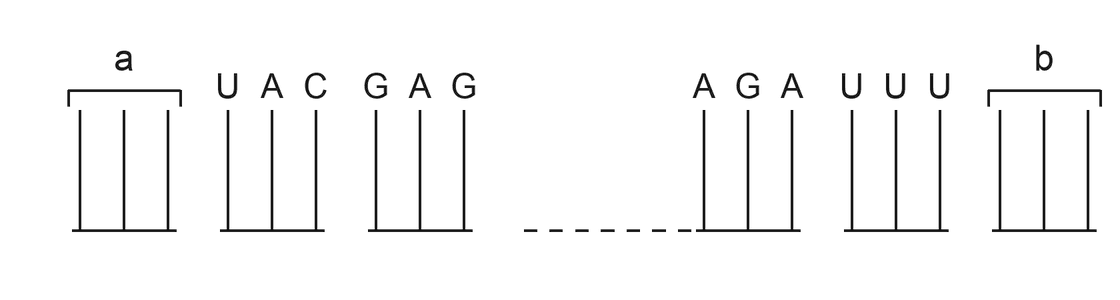
Codon a is the first codon of a complete reading frame, so it must be the start codon, AUG.
Step 2 — Part (i): identify codon b.
Codon b is the last codon, after UUU, so it must be a stop codon. Any one of UAA, UAG or UGA fits.
Step 3 — Part (ii): say what the codons code for.
AUG codes for methionine and also marks where translation starts. The stop codon codes for no amino acid: no tRNA pairs with it, and a release factor binds there to end translation. For this reason stop codons are also called nonsense or termination codons.
Step 4 — Part (iii): place the two amino acids on the ribosome.
The ribosome has a P site and an A site. The tRNA carrying the growing chain (at first, methionine) sits in the P site, and the next charged tRNA, whose anticodon pairs with the next codon, enters the A site.
Step 5 — Part (iii): form the peptide bond.
The enzyme peptidyl transferase, which is the rRNA of the large subunit acting as a ribozyme (23S rRNA in bacteria, 28S in eukaryotes), catalyses the reaction. The –NH₂ group of the amino acid at the A site reacts with the –COOH end of the amino acid at the P site, which is held to its tRNA by an ester bond. A peptide bond, –CO–NH–, forms between them, and the chain is moved onto the tRNA in the A site.
Step 6 — Part (iii): free the A site for the next amino acid.
The tRNA in the P site is now empty. The ribosome moves one codon along the mRNA, the empty tRNA leaves through the E site, and the next codon comes into the A site.
Note: Joining two free amino acids in a test tube releases a molecule of water (a condensation). On the ribosome the –COOH group is already held as an ester on the tRNA, so the tRNA is set free instead of water; the bond formed is the same peptide bond.
Therefore, (i) a = AUG and b = UAA, UAG or UGA; (ii) AUG codes for methionine and starts translation, while b codes for no amino acid and stops it; (iii) peptidyl transferase (a ribozyme in the large subunit) joins the –NH₂ group of the A-site amino acid to the –COOH end of the P-site amino acid, forming a peptide bond.