
Question 905 marksMedium
How are various parts of sperm modified to perform specific functions?
Confirming your payment
Sign up now and get 250 free tokens.
Human Reproduction · Question 90 of 104
How are various parts of sperm modified to perform specific functions?
Solution:
Key idea: A sperm is a small, streamlined, motile cell with very little cytoplasm. Each part of it is built for one job: carrying the genes, getting through the coverings of the egg, starting the zygote's first division, making energy and swimming.
Step 1 — Describe the overall build of the sperm.
A human sperm is about 50–60 µm long. Most of its cytoplasm is lost during spermiogenesis, so it is light and streamlined, which suits a cell that must swim a long way. It has four parts: the head, neck, middle piece and tail, all covered by the plasma membrane.
Step 2 — Explain how the nucleus is modified.
The head contains a haploid nucleus with 23 chromosomes. Its DNA is very tightly packed (highly condensed), which makes the head small and protects the genes during the journey.
Step 3 — Explain how the acrosome is modified.
The acrosome is a cap over the front part of the nucleus, formed from the Golgi body. It contains hydrolytic enzymes (sperm lysins such as hyaluronidase and acrosin). When the sperm reaches the egg, these are released (the acrosome reaction) and digest a path through the egg's coverings, so the sperm can penetrate it.
Step 4 — Explain how the neck is modified.
The short neck has two centrioles. The proximal centriole enters the egg and forms the centrosome that organises the spindle of the zygote's first cleavage division. The distal centriole acts as the basal body from which the axial filament of the tail grows.
Step 5 — Explain how the middle piece is modified.
The middle piece has many mitochondria wound in a spiral around the axial filament. They carry out aerobic respiration, using sugar such as the fructose of semen, and supply the ATP that powers the beating of the tail.
Step 6 — Explain how the tail is modified.
The tail is a long flagellum. Its axial filament has microtubules in the 9 + 2 pattern, and the sliding of these microtubules makes the tail beat like a whip. This propels the sperm through the fluids of the female tract towards the egg.
Step 7 — Show the parts in a labelled diagram.
The labelled diagram below shows the head with its acrosome and nucleus, the neck with its two centrioles, the middle piece with spiral mitochondria, and the tail with its axial filament.
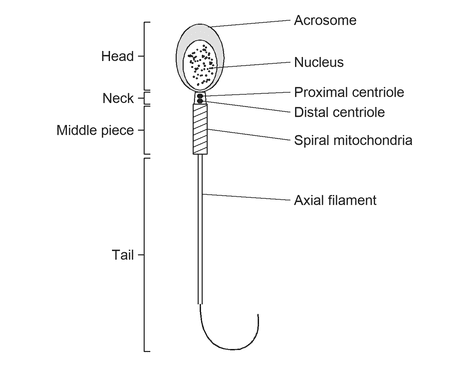
Therefore, the sperm is a streamlined cell with little cytoplasm whose head carries a compact haploid nucleus and an enzyme-filled acrosome for penetrating the egg, whose neck has the centrioles for the zygote's first division and the tail's base, whose middle piece has spiral mitochondria for energy, and whose 9 + 2 flagellum propels it.