
Question 1015 marksMedium
(i) Draw a schematic diagram of a human sperm and label the cellular components. Give the functions of any three parts.
(ii) Where are the sperm heads found embedded to survive after spermatogenesis?
Confirming your payment
Sign up now and get 250 free tokens.
Human Reproduction · Question 101 of 104
(i) Draw a schematic diagram of a human sperm and label the cellular components. Give the functions of any three parts.
(ii) Where are the sperm heads found embedded to survive after spermatogenesis?
Solution:
Key idea: A sperm has four parts, the head, neck, middle piece and tail, each made of particular cell components suited to its job.
Step 1 — Draw the outline of the sperm (part i).
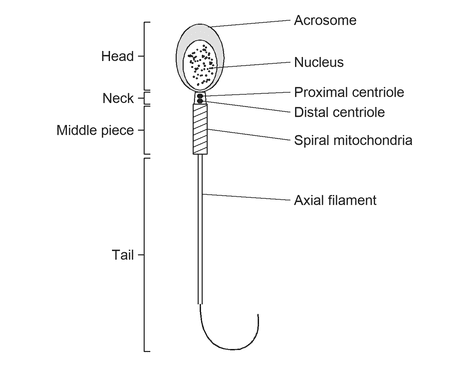
Draw a small oval head, a short neck, a thicker cylindrical middle piece and a long thin tail, as in the labelled diagram below.
Step 2 — Label the cellular components.
The head contains the acrosome, a cap at the front, and the haploid nucleus. The neck contains the proximal centriole and the distal centriole. The middle piece contains mitochondria wound in a spiral around the axial filament. The tail contains the axial filament of microtubules. The plasma membrane covers the whole sperm.
Step 3 — Give the function of the acrosome.
The acrosome contains hydrolytic enzymes (sperm lysins such as hyaluronidase and acrosin). These are released when the sperm reaches the egg and digest a path through its coverings, so the sperm can penetrate the egg.
Step 4 — Give the function of the middle piece.
The spiral mitochondria of the middle piece carry out aerobic respiration and supply the energy (ATP) for the beating of the tail.
Step 5 — Give the function of the tail.
The tail is a flagellum with a 9 + 2 axial filament. Its whip-like beating propels the sperm through the fluids of the female reproductive tract towards the egg.
Step 6 — State where the sperm heads are embedded (part ii).
During their development, the heads of the spermatids and young sperms are embedded in the Sertoli cells of the seminiferous tubules. The Sertoli cells support, protect and nourish them until the sperms are released into the lumen of the tubule by spermiation.
Therefore, (i) a sperm has a head with an acrosome and nucleus, a neck with two centrioles, a middle piece with spiral mitochondria and a tail with an axial filament; the acrosome helps it penetrate the egg, the middle piece supplies energy and the tail propels it; (ii) the sperm heads are embedded in the Sertoli cells of the seminiferous tubules.