Solution:
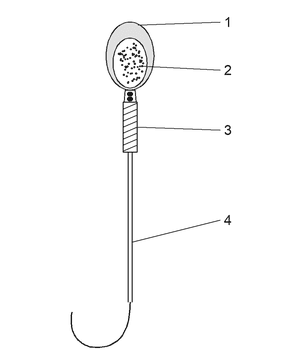
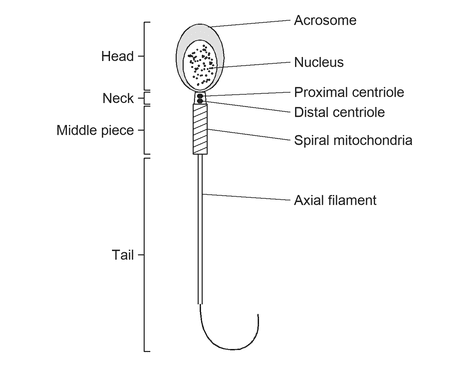
Key idea: A human sperm has a head (with the acrosome and nucleus), a neck, a middle piece and a tail. The numbered parts are identified from their shape and position.
Step 1 — Label the parts 1 to 4 (part i).
Part 1 is the cap at the front of the head, the acrosome. Part 2 is the dark body filling the head, the nucleus. Part 3 is the thick, spirally marked section behind the neck, the middle piece. Part 4 is the long thin flagellum, the tail. The labelled diagram below shows these parts.
Step 2 — Give the number of chromosomes in the nucleus (part ii).
The sperm is formed by meiosis, so its nucleus is haploid. It has 23 chromosomes: 22 autosomes and either an X or a Y chromosome.
Step 3 — State the function of part 1, the acrosome (part iii).
The acrosome contains hydrolytic enzymes (sperm lysins such as hyaluronidase and acrosin). They are released when the sperm reaches the egg and digest a path through its coverings, helping the sperm to penetrate the egg.
Step 4 — State the function of part 3, the middle piece.
The middle piece contains mitochondria wound in a spiral. They carry out respiration and supply the energy (ATP) for the movement of the tail.
Step 5 — State the function of part 4, the tail.
The tail beats like a whip and propels the sperm through the fluids of the female reproductive tract towards the egg.
Step 6 — State where sperms are produced (part iv).
Sperms are produced in the seminiferous tubules of the testes.
Therefore, (i) 1 is the acrosome, 2 the nucleus, 3 the middle piece and 4 the tail; (ii) the nucleus has 23 chromosomes; (iii) the acrosome helps the sperm penetrate the egg, the middle piece supplies energy and the tail propels the sperm; (iv) sperms are produced in the seminiferous tubules of the testes.