
Question 1243 marksMedium
Name the type of cells that provide acquired immunity. Give basic structure of an antibody.
Confirming your payment
Sign up now and get 250 free tokens.
Human Health and Diseases · Question 124 of 178
Name the type of cells that provide acquired immunity. Give basic structure of an antibody.
Solution:
Key idea: Acquired (adaptive) immunity is specific to each pathogen and has memory. It is provided by two kinds of lymphocytes, and one of them makes the Y-shaped protein molecules called antibodies.
Step 1 — Name the cells that provide acquired immunity.
Acquired immunity is provided by lymphocytes. B lymphocytes (B cells) give antibody-mediated (humoral) immunity: when activated they form plasma cells that release antibodies into the blood and lymph. T lymphocytes (T cells) give cell-mediated immunity: helper T cells direct the response and cytotoxic T cells kill infected cells.
Step 2 — Describe the chains of an antibody.
Each antibody (immunoglobulin) molecule is made of four polypeptide chains: two identical heavy (H) chains and two identical light (L) chains. It is therefore written as H₂L₂. Disulphide (–S–S–) bonds hold each light chain to a heavy chain and the two heavy chains to each other, giving a Y-shaped molecule.
Step 3 — Describe the regions of an antibody.
Each chain has a variable region at the tip of the arm and a constant region along the rest of the chain. The variable regions of one heavy and one light chain together form an antigen-binding site at the tip of each arm of the Y, so each antibody has two identical binding sites. The stem of the Y is formed by the constant regions of the two heavy chains. The figure shows these parts.
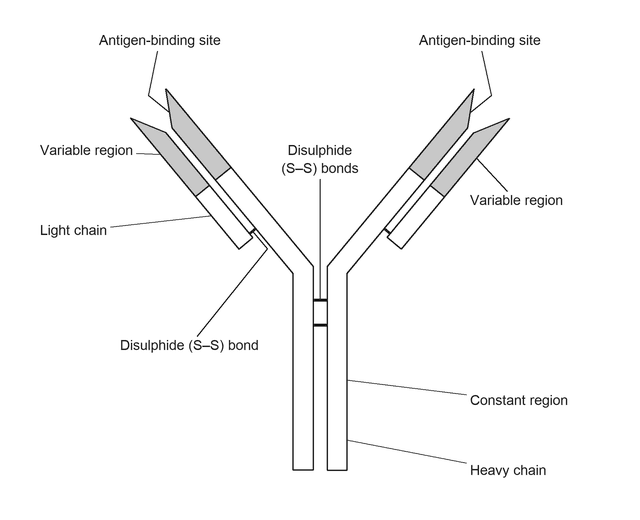
Therefore, acquired immunity is provided by B and T lymphocytes, and an antibody is a Y-shaped H₂L₂ molecule of two heavy and two light chains joined by disulphide bonds, with an antigen-binding site formed by the variable regions at the tip of each arm.