
Question 1455 marksMedium
Explain the structure of an immunoglobulin molecule/antibody.
Confirming your payment
Sign up now and get 250 free tokens.
Human Health and Diseases · Question 145 of 178
Explain the structure of an immunoglobulin molecule/antibody.
Solution:
Key idea: Antibodies, also called immunoglobulins (Ig), are proteins made by plasma cells (activated B cells). Each antibody binds one particular antigen.
Step 1 — Describe the polypeptide chains.
An antibody molecule is made of four polypeptide chains: two identical light (L) chains and two identical heavy (H) chains. It is therefore represented as H₂L₂.
Step 2 — Describe how the chains are joined.
Each light chain is joined to a heavy chain, and the two heavy chains are joined to each other, by disulphide (–S–S–) bonds. The molecule is shaped like the letter Y, with a flexible hinge where the arms meet the stem.
Step 3 — Describe the variable and constant regions.
Each chain has a variable (V) region at the end of the arm and a constant (C) region along the rest of the chain. The variable regions differ in amino-acid sequence from one antibody to another, while the constant regions are the same in all antibodies of one class.
Step 4 — Describe the antigen-binding sites.
At the tip of each arm, the variable regions of one light chain and one heavy chain form an antigen-binding site. The antigen fits into it like a key in a lock. Both arms of one antibody have identical binding sites, so one antibody can bind two antigen particles.
Step 5 — Describe the stem and the classes of antibodies.
The stem of the Y is formed by the constant regions of the two heavy chains. It decides what the antibody does after binding, for example whether it activates complement or binds to phagocytes. Differences in the heavy chains give five classes of antibodies: IgA, IgD, IgE, IgG and IgM. IgG, IgD and IgE are single Y-shaped units, IgA in secretions is usually a pair of units and IgM is a group of five.
Step 6 — Show the structure in a labelled diagram.
The figure shows the structure of an antibody with its parts labelled.
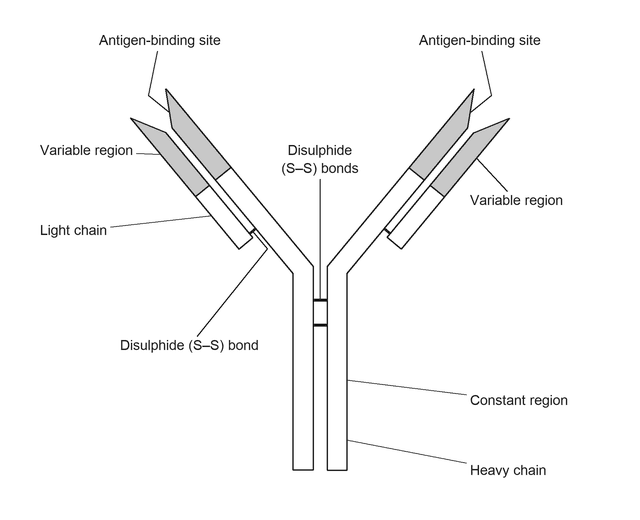
Therefore, an antibody is a Y-shaped H₂L₂ molecule of two heavy and two light chains joined by disulphide bonds, with variable regions forming an antigen-binding site at the tip of each arm and constant regions forming the stem.