
Question 1015 marksMedium
(a) Explain relative velocity in two-dimensional motion.
(b) Derive an expression for the relative velocity of a body with respect to another body moving in different directions.
Confirming your payment
Sign up now and get 250 free tokens.
Motion in a Plane - Vectors · Question 101 of 101
(a) Explain relative velocity in two-dimensional motion.
(b) Derive an expression for the relative velocity of a body with respect to another body moving in different directions.
Solution:
Concept: The relative velocity of A with respect to B is the velocity of A as seen by an observer moving with B: .
(a)
Step 1 — Explain the idea. When two bodies A and B move in a plane with velocities and , an observer on B sees A move as if B were at rest. To "bring B to rest" we give both bodies an extra velocity . Then B is at rest and A moves with
Similarly, the velocity of B relative to A is , the negative of .
Step 2 — Give an everyday example. Rain falling vertically seems, to a person walking forward, to come slantwise towards them. Its velocity relative to the person is , which points downwards and backwards (towards the person), so the person tilts the umbrella forward to keep the rain off.
(b)
Step 3 — Draw the parallelogram. Let and act at an angle to each other. From one point O we draw and and complete the parallelogram; its diagonal from O is :
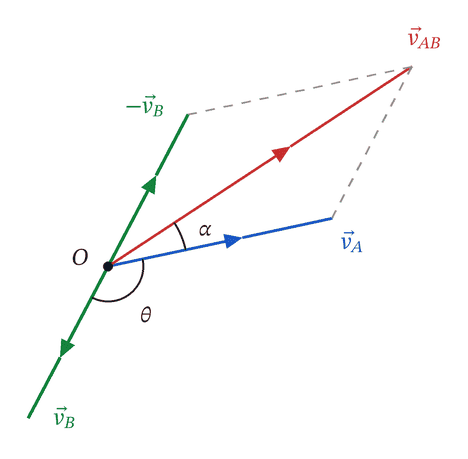
Step 4 — Find the magnitude. The angle between and is , and . The parallelogram law gives
Step 5 — Find the direction. Let make an angle with . Using :
Step 6 — Check the special cases. For (same direction), ; for (opposite directions), ; for , . These agree with the one-dimensional results.
Therefore, , with magnitude and direction measured from .