
Question 985 marksMedium
(a) Explain dot product of two vectors with suitable examples.
(b) Explain cross product of two vectors with suitable examples.
(c) Prove that the scalar product of two orthogonal vectors is zero.
Confirming your payment
Sign up now and get 250 free tokens.
Motion in a Plane - Vectors · Question 98 of 101
(a) Explain dot product of two vectors with suitable examples.
(b) Explain cross product of two vectors with suitable examples.
(c) Prove that the scalar product of two orthogonal vectors is zero.
Solution:
Concept: Two vectors can be multiplied in two ways: the dot (scalar) product gives a scalar, , and the cross (vector) product gives a vector of magnitude perpendicular to both.
(a)
Step 1 — Define the dot product. The dot product of and , with angle between them, is
Since is the projection ON of on , the dot product is times the projection of on :
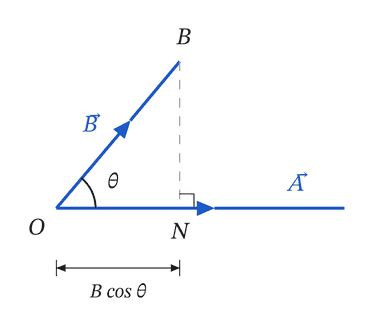
Step 2 — Note its properties. The dot product is a scalar. It is commutative, , and distributive over addition. For the unit vectors, each of , and equals 1, and each of , and is 0, so in components
Step 3 — Give examples. Work done by a force is , and power is . Both are scalars.
(b)
Step 4 — Define the cross product. The cross product of and is a vector
Here is the unit vector perpendicular to the plane of and . Its sense is given by the right-hand rule: when the fingers of the right hand curl from towards , the thumb points along :
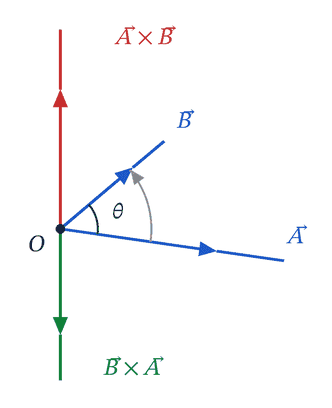
Step 5 — Note its properties. It is not commutative: . The cross product of parallel vectors is zero, so , while , and . Its magnitude, , is the area of the parallelogram with sides and .
Step 6 — Give examples. Examples are torque, ; angular momentum, ; and the linear velocity in circular motion, .
(c)
Step 7 — Prove the result. Orthogonal vectors are perpendicular, so and :
Therefore, (a) is a scalar (e.g. work ); (b) is a vector perpendicular to both (e.g. torque ); (c) for orthogonal vectors , so their scalar product is zero.