
Question 923 marksEasy
Distinguish between a scalar quantity and a vector quantity. Give two examples for each. What are (i) displacement vectors and (ii) coplanar vectors?
Confirming your payment
Sign up now and get 250 free tokens.
Motion in a Plane - Vectors · Question 92 of 101
Distinguish between a scalar quantity and a vector quantity. Give two examples for each. What are (i) displacement vectors and (ii) coplanar vectors?
Solution:
Concept: A scalar is described completely by its magnitude; a vector needs magnitude and direction and adds by the laws of vectors.
Step 1 — Scalar quantities. A scalar quantity has magnitude only, with no direction, and scalars are added by ordinary algebra. Examples: mass and time (also speed, work, temperature).
Step 2 — Vector quantities. A vector quantity has both magnitude and direction and obeys the triangle (or parallelogram) law of addition. Examples: velocity and force (also displacement, acceleration, momentum).
Step 3 — Displacement vectors. The displacement vector of a body is the vector drawn from its initial position to its final position. It gives the shortest distance between the two positions and the direction from the first to the second, whatever the actual path. In the figure, a body goes from A to B along a curved path, but its displacement is the straight arrow :
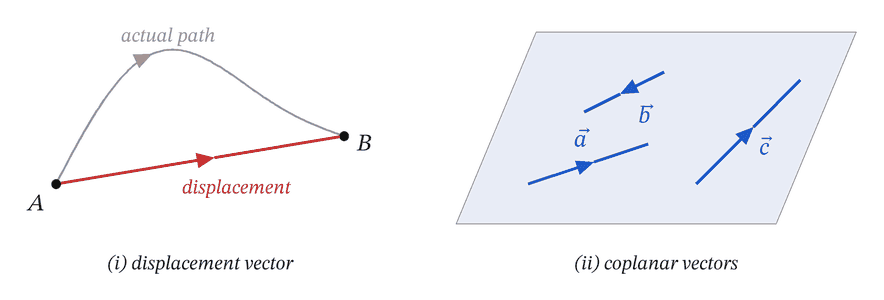
Step 4 — Coplanar vectors. Vectors that lie in the same plane are called coplanar vectors, like , and in the second part of the figure. Any two vectors are always coplanar; three or more vectors may or may not be.
Therefore, a scalar has magnitude only (e.g. mass, time), a vector has magnitude and direction (e.g. velocity, force); (i) a displacement vector joins the initial position of a body to its final position, and (ii) coplanar vectors are vectors lying in the same plane.