
Question 545 marksMedium
(a) What are the uses of dimensional analysis?
(b) Derive the formula for the period of oscillation of a simple pendulum using dimensions.
(c) Using dimensional analysis, find the number of dynes in one newton.
Confirming your payment
Sign up now and get 250 free tokens.
Dimensional Analysis · Question 54 of 55
(a) What are the uses of dimensional analysis?
(b) Derive the formula for the period of oscillation of a simple pendulum using dimensions.
(c) Using dimensional analysis, find the number of dynes in one newton.
Solution:
Concept: By the principle of homogeneity, every term of a correct physical equation has the same dimensions; matching the powers of , and gives equations we can use.
(a)
Step 1 — Uses of dimensional analysis. Dimensional analysis is used:
(b)
Step 2 — List what the period may depend on. The period of a simple pendulum, which we call here so that can stand for the dimension of time, may depend on the mass of the bob, the length of the string and the acceleration due to gravity , as in the figure. The angle of swing has no dimensions, so the method cannot show its effect; for small swings the period hardly depends on it.
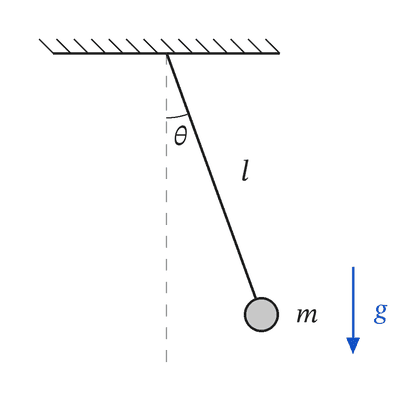
We assume
where is a dimensionless constant and , , are powers to be found.
Step 3 — Write the dimensional equation. The period is a time, ; mass is , length is and is :
Step 4 — Compare the powers. Equating the powers of , and on the two sides gives
Step 5 — Write the formula. Putting these powers back gives
The constant cannot be found by dimensions; experiment (or theory) gives , so the period is (usually written ). The period does not depend on the mass of the bob.
(c)
Step 6 — Convert one newton to dynes. The newton is the S.I. unit of force and the dyne is the C.G.S. unit. We use for force, whose dimensions are .
In the S.I. system (one newton); the S.I. units are , and ; the C.G.S. units are , and . The number of dynes is then
We put and into the ratios:
Therefore, (a) dimensional analysis is used to check equations, derive relations, convert units and find the dimensions of constants; (b) the period is , and with from experiment it is ; (c) .