
Question 753 marksMedium
Solve graphically and compare your answer with algebraic solution either by factorization or formula method:
(i)
(ii)
(iii)
(iv)
(v)
(vi)
(vii)
(viii)
Confirming your payment
Sign up now and get 250 free tokens.
Quadratic Equations · Question 75 of 129
Solve graphically and compare your answer with algebraic solution either by factorization or formula method:
(i)
(ii)
(iii)
(iv)
(v)
(vi)
(vii)
(viii)
Solution:
Concept: Draw the graph of .
The solutions (roots) of are the values of where this graph meets the -axis, because on the -axis the value of is . So we draw the graph and read off where it meets the -axis:
Then we check the reading by algebra (factorisation or the quadratic formula).
(i)
Step 1 — Table and graph. Work out for each whole-number in the range, plot these points and join them with a smooth curve:
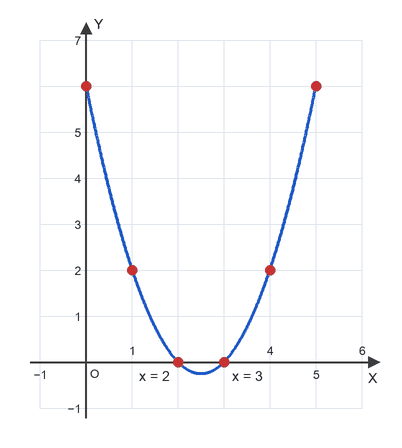
Step 2 — Read the graph. The curve cuts the -axis at two points, and .
Step 3 — Check by factorisation. We need two numbers whose product is and whose sum is ; they are and :
Setting each factor to zero gives and . The two methods agree.
Roots: .
(ii)
Step 1 — Table and graph. Work out for each whole-number in the range, plot these points and join them with a smooth curve:
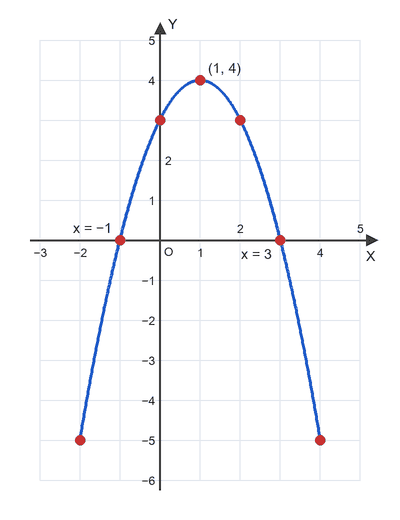
Step 2 — Read the graph. The downward curve cuts the -axis at and .
Step 3 — Check by factorisation. Multiply by to make the term positive:
Two numbers with product and sum are and :
So and . The two methods agree.
Roots: .
(iii)
Step 1 — Table and graph. Work out for each whole-number in the range, plot these points and join them with a smooth curve:
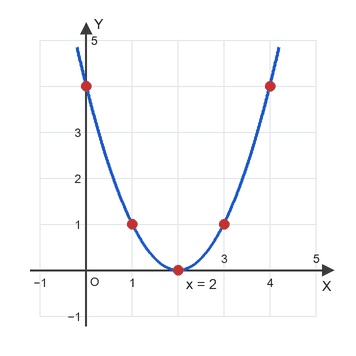
Step 2 — Read the graph. The curve does not cross the -axis; it only touches it at . So the equation has two equal roots, both .
Step 3 — Check by factorisation. The expression is a perfect square:
Setting to zero gives twice. The two methods agree.
Roots: (equal roots).
Note: The book's printed answer for this part, , is incorrect; it repeats the answer of part (iv). At the expression is
This is , not .
(iv)
Step 1 — Table and graph. Work out for each whole-number in the range, plot these points and join them with a smooth curve:
The vertex is on the line , where

Step 2 — Read the graph. The curve cuts the -axis at and .
Step 3 — Check by factorisation. Two numbers with product and sum are and :
So and . The two methods agree.
Roots: .
(v)
Step 1 — Table and graph. Work out for each whole-number in the range, plot these points and join them with a smooth curve:
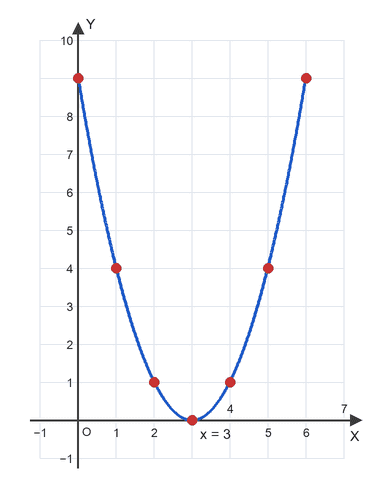
Step 2 — Read the graph. The curve only touches the -axis at , so there are two equal roots.
Step 3 — Check by factorisation. Factorise the expression to confirm the root read from the graph. It is a perfect square:
Setting to zero gives twice. The two methods agree.
Roots: (equal roots).
(vi)
Step 1 — Table and graph. Work out for each whole-number in the range, plot these points and join them with a smooth curve:
The vertex is on the line , where

Step 2 — Read the graph. The downward curve cuts the -axis at and .
Step 3 — Check by factorisation. Multiply by :
Two numbers with product and sum are and :
So and . The two methods agree.
Roots: .
(vii)
Step 1 — Table and graph. Work out for each whole-number in the range, plot these points and join them with a smooth curve:
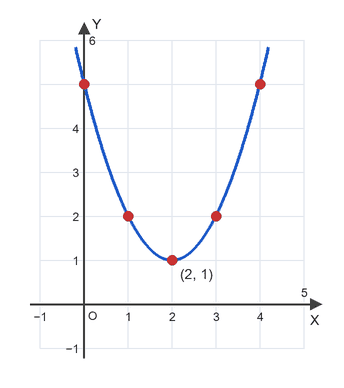
Step 2 — Read the graph. The lowest point of the curve is , which is above the -axis, so the curve never meets the -axis. The equation has no real roots.
Step 3 — Find the roots by the formula. Here , and . First the discriminant:
confirms there are no real roots. The quadratic formula gives complex roots:
Roots: (complex; the graph does not meet the -axis).
(viii)
Step 1 — Table and graph. Work out for each whole-number in the range, plot these points and join them with a smooth curve:
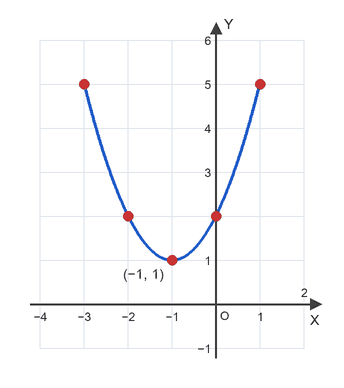
Step 2 — Read the graph. The lowest point is , above the -axis, so the curve never meets the -axis: no real roots.
Step 3 — Find the roots by the formula. Here , and :
Roots: (complex; the graph does not meet the -axis).
Therefore, the roots are: (i) ; (ii) ; (iii) ; (iv) ; (v) ; (vi) ; (vii) ; (viii) . In every part the graph and the algebra agree.