
Question 13 marksMedium
For each of the parabolas whose equations are given, find the coordinates of the focus, axis of the parabola, the equation of the directrix and the length of the latus rectum.
(i)
(ii)
(iii)
(iv)
(v)
(vi)
Confirming your payment
Sign up now and get 250 free tokens.
Parabola · Question 1 of 22
For each of the parabolas whose equations are given, find the coordinates of the focus, axis of the parabola, the equation of the directrix and the length of the latus rectum.
(i)
(ii)
(iii)
(iv)
(v)
(vi)
Solution:
Concept: A parabola is the set of points whose distance from a fixed point (the focus) equals their distance from a fixed line (the directrix). When the vertex is at the origin and , there are four standard forms:
In every form the latus rectum (the chord through the focus perpendicular to the axis) has length .
Watch out: The number is always taken as positive. The sign in front of tells us which way the parabola opens, and the squared variable tells us which axis it is symmetric about.
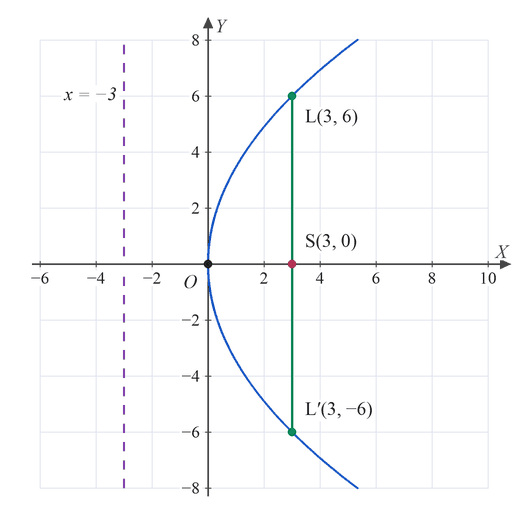
(i)
Step 1 — Match the equation with a standard form. The equation contains and the coefficient of is positive, so it has the form . We compare the coefficients:
Step 2 — Read off the facts. We put in the facts of this standard form:
The figure shows the parabola, its focus , the directrix (dashed) and the latus rectum .
(ii)
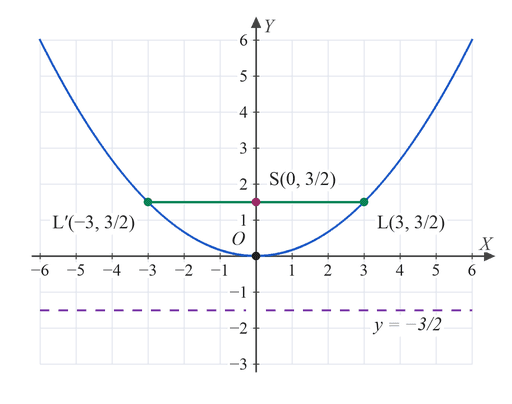
Step 1 — Match the equation with a standard form. The equation contains and the coefficient of is positive, so it has the form . We compare the coefficients:
Step 2 — Read off the facts. We put in the facts of this standard form:
The figure shows the parabola, its focus , the directrix (dashed) and the latus rectum .
(iii)
Step 1 — Match the equation with a standard form. The equation contains and the coefficient of is negative, so it has the form . We compare the coefficients:
Step 2 — Read off the facts. We put in the facts of this standard form:
The figure shows the parabola, its focus , the directrix (dashed) and the latus rectum .

(iv)
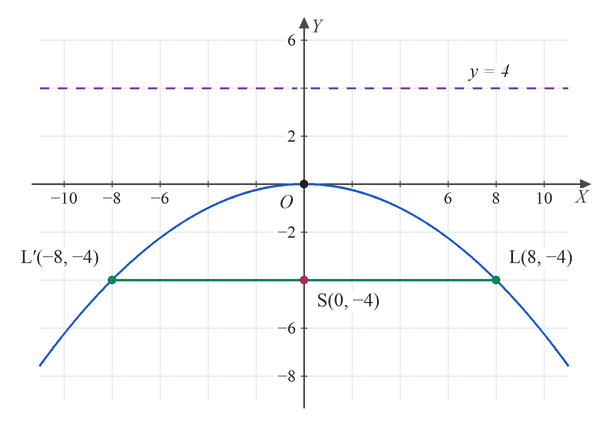
Step 1 — Match the equation with a standard form. The equation contains and the coefficient of is negative, so it has the form . We compare the coefficients:
Step 2 — Read off the facts. We put in the facts of this standard form:
The figure shows the parabola, its focus , the directrix (dashed) and the latus rectum .
(v)
Step 1 — Match the equation with a standard form. The equation contains and the coefficient of is positive, so it has the form . We compare the coefficients:
Step 2 — Read off the facts. We put in the facts of this standard form:
The figure shows the parabola, its focus , the directrix (dashed) and the latus rectum .

(vi)
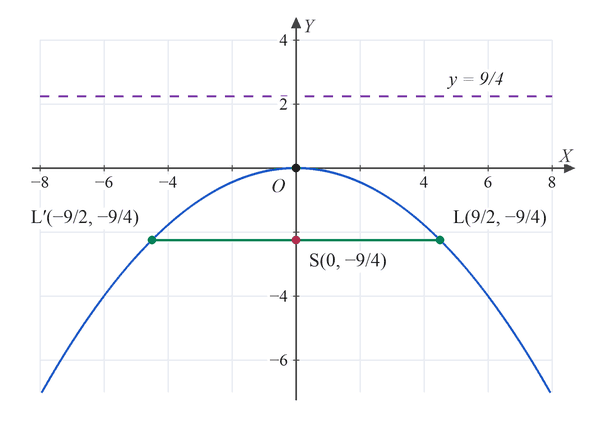
Step 1 — Match the equation with a standard form. The equation contains and the coefficient of is negative, so it has the form . We compare the coefficients:
Step 2 — Read off the facts. We put in the facts of this standard form:
The figure shows the parabola, its focus , the directrix (dashed) and the latus rectum .
Therefore, (i) focus , axis -axis, directrix , latus rectum ; (ii) focus , axis -axis, directrix , latus rectum ; (iii) focus , axis -axis, directrix , latus rectum ; (iv) focus , axis -axis, directrix , latus rectum ; (v) focus , axis -axis, directrix , latus rectum ; (vi) focus , axis -axis, directrix , latus rectum .