
Question 43 marksMedium
Find the equation to the circles which pass through the origin and cut off intercepts equal to
(i) and ,
(ii) and from the -axis and the -axis, respectively.
Confirming your payment
Sign up now and get 250 free tokens.
Circle · Question 4 of 60
Find the equation to the circles which pass through the origin and cut off intercepts equal to
(i) and ,
(ii) and from the -axis and the -axis, respectively.
Solution:
Concept: If and are the ends of a diameter, the angle in a semicircle is a right angle, so for every other point of the circle . This gives the diameter form
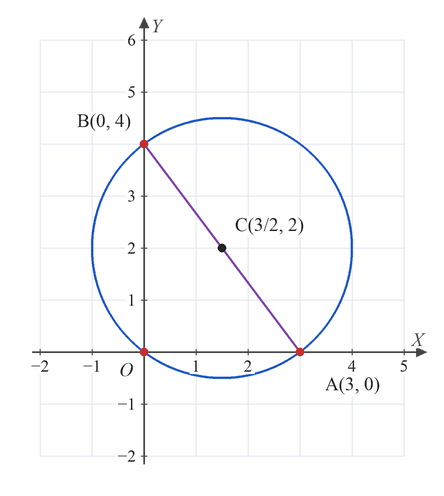
Step 1 — Spot the diameter. A circle through the origin that cuts off intercepts on the -axis and on the -axis passes through , and . Since (the angle between the axes) and an angle in a semicircle is a right angle, is a diameter. We take the intercepts along the positive directions of the axes, as the printed answer does.
(i)
Step 2 — Use the diameter form with and . We substitute the ends of the diameter:
The figure shows this circle with its diameter .
(ii)
Step 3 — Use the diameter form with and . We substitute the ends of the diameter:
Note: If an intercept is measured along a negative axis, the sign of that term changes; for example, intercepts on the negative -axis and on the positive -axis give .
Therefore, (i) ; (ii) .