Solution:
Concept: A circle is the set of all points at a fixed distance r (the radius) from a fixed point (h,k) (the centre). By the distance formula, a point (x,y) lies on it exactly when
(x−h)2+(y−k)2=r2
This is the centre-radius form of the equation of a circle.
(i)
Step 1 — Substitute the centre and radius. Here h=4, k=5 and r=7, so the centre-radius form gives
(x−4)2+(y−5)2=49
Step 2 — Expand and simplify. We expand both squares and bring 49 to the left side:
x2−8x+16+y2−10y+25−49=0
x2+y2−8x−10y−8=0
The circle is drawn below.

(ii)
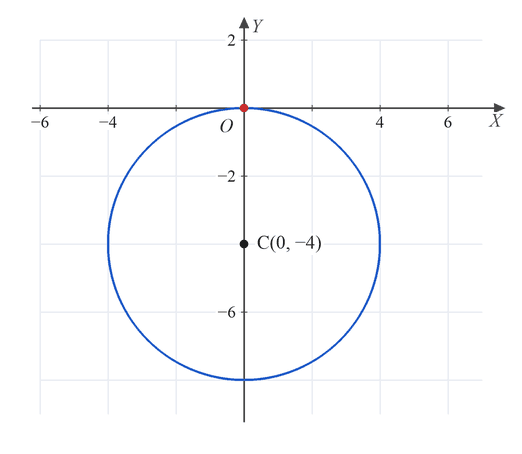
Step 1 — Find the radius. The circle touches the x-axis, so its radius equals the distance of the centre (0,−4) from the x-axis:
r=∣−4∣=4
Step 2 — Write the equation. We put h=0, k=−4 and r=4 in the centre-radius form:
(x−0)2+(y+4)2=16
Step 3 — Expand and simplify. We expand (y+4)2 and cancel 16 on both sides:
x2+y2+8y+16=16
x2+y2+8y=0
The figure shows this circle; it touches the x-axis at the origin.
(iii)
Step 1 — Read the intercepts. The circle passes through O(0,0) and cuts off a length a on the positive x-axis and on the positive y-axis, so it also passes through A(a,0) and B(0,a).
Step 2 — Spot a diameter. The angle AOB between the axes is 90∘. An angle in a semicircle is a right angle, so the chord AB that subtends this right angle at O is a diameter.
Step 3 — Use the diameter form. We put the ends A(a,0) and B(0,a) in (x−x1)(x−x2)+(y−y1)(y−y2)=0:
(x−a)(x−0)+(y−0)(y−a)=0
x2−ax+y2−ay=0
Check: The points O(0,0), A(a,0) and B(0,a) all satisfy x2+y2−ax−ay=0.
Therefore, (i) x2+y2−8x−10y−8=0; (ii) x2+y2+8y=0; (iii) x2+y2−ax−ay=0.
