Solution:
Key idea: The electrode with the lower (more negative) reduction potential is oxidised and is the anode; the other is the cathode. Ecell∘=Ecathode∘−Eanode∘, and it is positive for a working cell.
Step 1 — Pick the anode and cathode. Aluminium has the lower value (−1.66 V) so it loses electrons and is the anode; tin is the cathode, where Sn2+ ions are reduced. So statement (a) is correct, and statement (b), which says the same thing in terms of oxidation and reduction, is also correct.
2Al(s)+3Sn2+(aq)→2Al3+(aq)+3Sn(s)
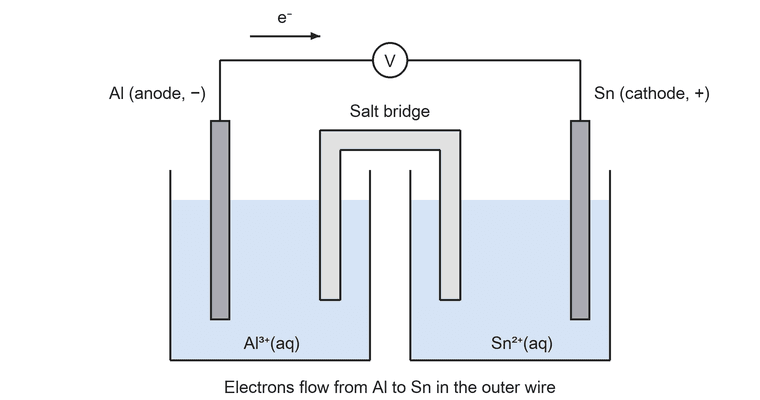
Step 2 — Check the cell notation. The anode is written on the left, so the cell is Al(s)∣Al3+(aq)∣∣Sn2+(aq)∣Sn(s). Statement (c) writes it the wrong way round, so it is wrong.
Step 3 — Work out the cell e.m.f. from the printed values. We subtract the anode value from the cathode value.
Ecell∘=0.14−(−1.66)
Ecell∘=+1.80 V
The e.m.f. is +1.80 V, not −1.80 V, so statement (d) is wrong.
Note: this item has more than one correct choice. Also, the true standard potential of Sn2+/Sn is −0.14 V, which would give Ecell∘ = +1.52 V; the choice of anode and cathode is the same either way.
Therefore, the correct statements are (a) and (b): Al is the anode where oxidation occurs and Sn is the cathode where reduction occurs.
