
Question 783 marksMedium
Give a sequence of chemical changes that occur at a synapse. Draw a labelled diagram of synapse and mark the related terms.
Confirming your payment
Sign up now and get 250 free tokens.
Neural Control and Coordination · Question 78 of 111
Give a sequence of chemical changes that occur at a synapse. Draw a labelled diagram of synapse and mark the related terms.
Solution:
Concept: At a chemical synapse the electrical impulse is changed into a chemical signal and back again.
Step 1 — Arrival of impulse: The action potential reaches the synaptic knob and opens voltage-gated Ca²⁺ channels; calcium ions enter the knob.
Step 2 — Release: Ca²⁺ makes the synaptic vesicles move to and fuse with the pre-synaptic membrane, releasing the neurotransmitter (e.g. acetylcholine) into the synaptic cleft by exocytosis.
Step 3 — Binding: The neurotransmitter diffuses across the cleft and binds to receptor molecules on the post-synaptic membrane, opening ion channels. Na⁺ entry produces a new potential that may start an impulse (excitatory synapse); at an inhibitory synapse the membrane becomes more negative.
Step 4 — Removal: The transmitter is then removed — broken down by an enzyme (acetylcholinesterase splits acetylcholine) or taken back into the knob — so that the signal stops.
Step 5 — Diagram: The labelled diagram of a chemical synapse is drawn below.
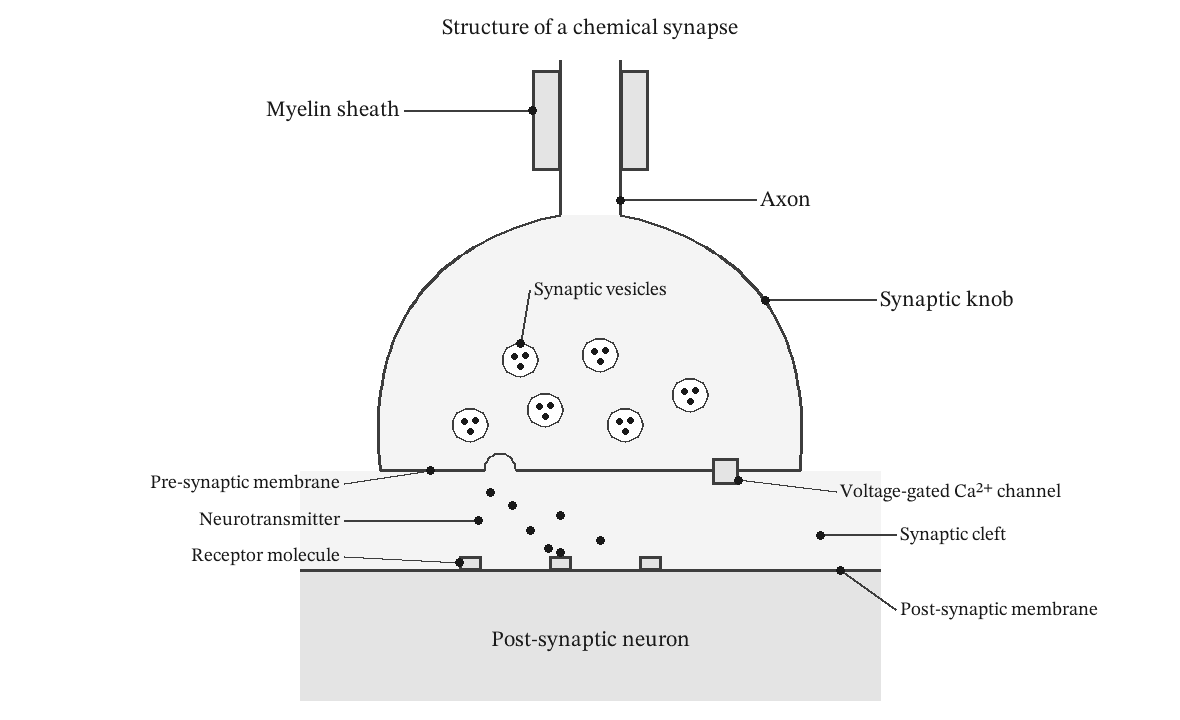
Therefore, at a synapse Ca²⁺ entry releases neurotransmitter, which crosses the cleft and binds receptors to start a new impulse, after which it is removed.