
Question 763 marksMedium
Explain the changes in an axon during action potential. What is repolarisation?
Confirming your payment
Sign up now and get 250 free tokens.
Neural Control and Coordination · Question 76 of 111
Explain the changes in an axon during action potential. What is repolarisation?
Solution:
Concept: An action potential is a rapid, temporary reversal of the membrane potential at a point on the axon.
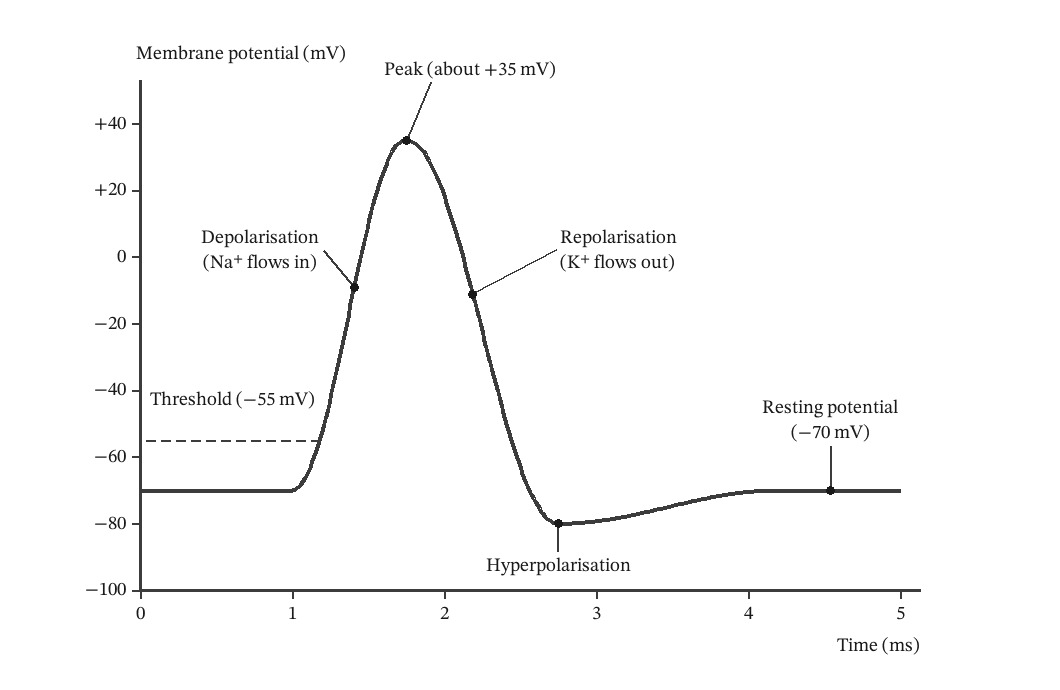
Step 1 — Depolarisation: When a threshold stimulus is applied, voltage-gated Na⁺ channels open and Na⁺ rushes in. The membrane potential rises from −70 mV and the inside becomes positive, reaching about +30 to +40 mV at the peak.
Step 2 — The graph: The changes are shown in the graph below.
Step 3 — Spread: The depolarised point sends local currents to the next region, which reaches threshold, so the action potential travels along the axon.
Step 4 — Repolarisation: At the peak the Na⁺ channels close and K⁺ channels open; K⁺ moves out and the inside becomes negative again, restoring the resting potential (often dipping briefly below −70 mV). This return to the resting state is repolarisation.
Therefore, during an action potential Na⁺ enters and reverses the polarity, and repolarisation is the return to the resting potential as K⁺ leaves the axon.