
Question 1065 marksMedium
How does a wave of depolarisation spread along a nerve fibre? What is a synapse? How does the nerve impulse cross the synapse? What is the action potential of a neuron? Do all neurons possess the same action potential?
Confirming your payment
Sign up now and get 250 free tokens.
Neural Control and Coordination · Question 106 of 111
How does a wave of depolarisation spread along a nerve fibre? What is a synapse? How does the nerve impulse cross the synapse? What is the action potential of a neuron? Do all neurons possess the same action potential?
Solution:
Concept: Nerve impulses are electrical along the fibre and usually chemical across the synapse.
Step 1 — Spread of depolarisation: At the stimulated point Na⁺ enters and the inside becomes positive. Local currents flow to the neighbouring resting region and depolarise it to threshold, so its Na⁺ channels open; the region behind repolarises and is refractory, so the wave moves forward along the fibre.
Step 2 — Synapse: A synapse is the junction between the axon terminal of one neuron and the next neuron (or an effector), formed by the pre-synaptic and post-synaptic membranes with a narrow synaptic cleft between them.
Step 3 — Crossing the synapse: The impulse opens Ca²⁺ channels in the synaptic knob; Ca²⁺ makes the synaptic vesicles fuse with the pre-synaptic membrane and release a neurotransmitter (e.g. acetylcholine). It diffuses across the cleft, binds to receptors on the post-synaptic membrane and opens ion channels, producing a new potential; then it is broken down (e.g. by acetylcholinesterase) or taken back. At an electrical synapse current passes directly through gap junctions.
Step 4 — Action potential: It is the brief reversal of the membrane potential when a neuron is stimulated — from about −70 mV to about +30 to +40 mV (the sodium equilibrium value of about +60 mV is approached but not reached) — followed by repolarisation, all in about 1–2 ms.
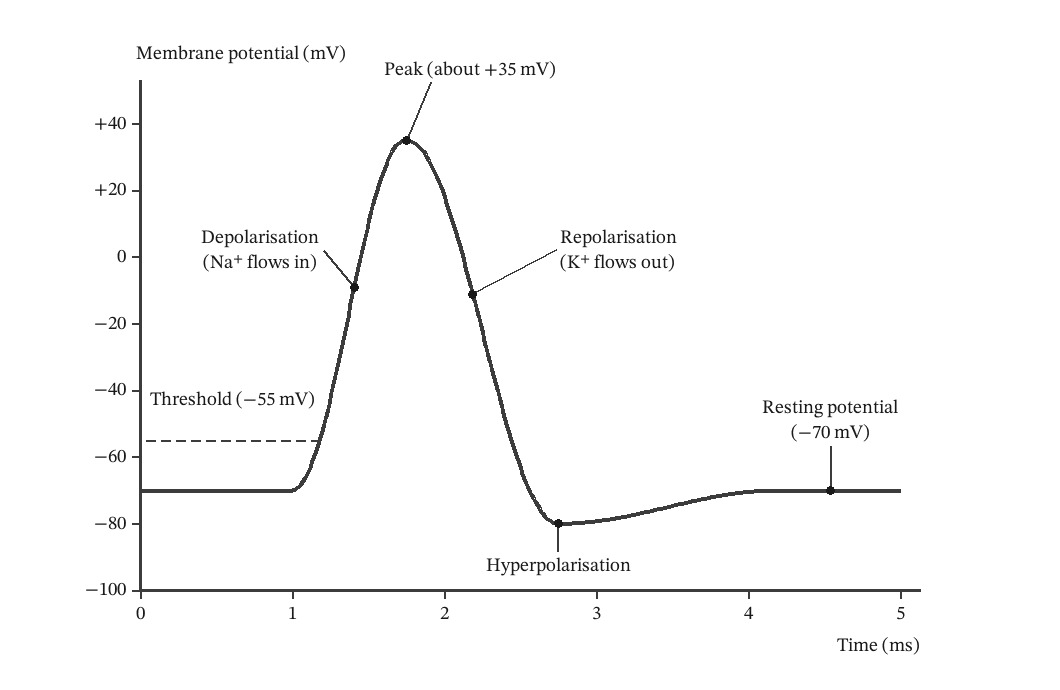
Step 5 — Same in all neurons: The answer is no. The size and duration of the action potential differ between kinds of neurons because their membranes carry different kinds and numbers of ion channels (Na⁺, K⁺ and Ca²⁺ channels); but for any one neuron the action potential is always the same size, whatever the strength of a stimulus above threshold (all-or-none law).
Therefore, depolarisation spreads by local currents, the impulse crosses a synapse by release of a neurotransmitter, the action potential is the brief reversal of membrane potential, and it differs between kinds of neurons though it is constant for one neuron.