
Question 503 marksMedium
How does JGA control the blood volume and pressure? Give a flowchart.
Confirming your payment
Sign up now and get 250 free tokens.
Excretory Products and Their Elimination · Question 50 of 66
How does JGA control the blood volume and pressure? Give a flowchart.
Solution:
Concept: The JGA works through the renin–angiotensin–aldosterone system (RAAS), a negative-feedback loop.
Step 1 — Trigger: Loss of Na⁺ and water lowers blood volume and blood pressure, so less blood reaches the glomerulus and GFR falls. The JGA senses this.
Step 2 — Hormones: JG cells release renin. Renin converts the plasma protein angiotensinogen to angiotensin I, which an enzyme (ACE, mainly in the lungs) converts to angiotensin II.
Step 3 — Effects: Angiotensin II constricts arterioles, raising blood pressure, and stimulates the adrenal cortex to release aldosterone. Aldosterone makes the DCT and collecting duct reabsorb more Na⁺ and water, so blood volume rises.
Step 4 — Flowchart: The flowchart below shows the sequence; when pressure is back to normal, renin release falls (negative feedback).
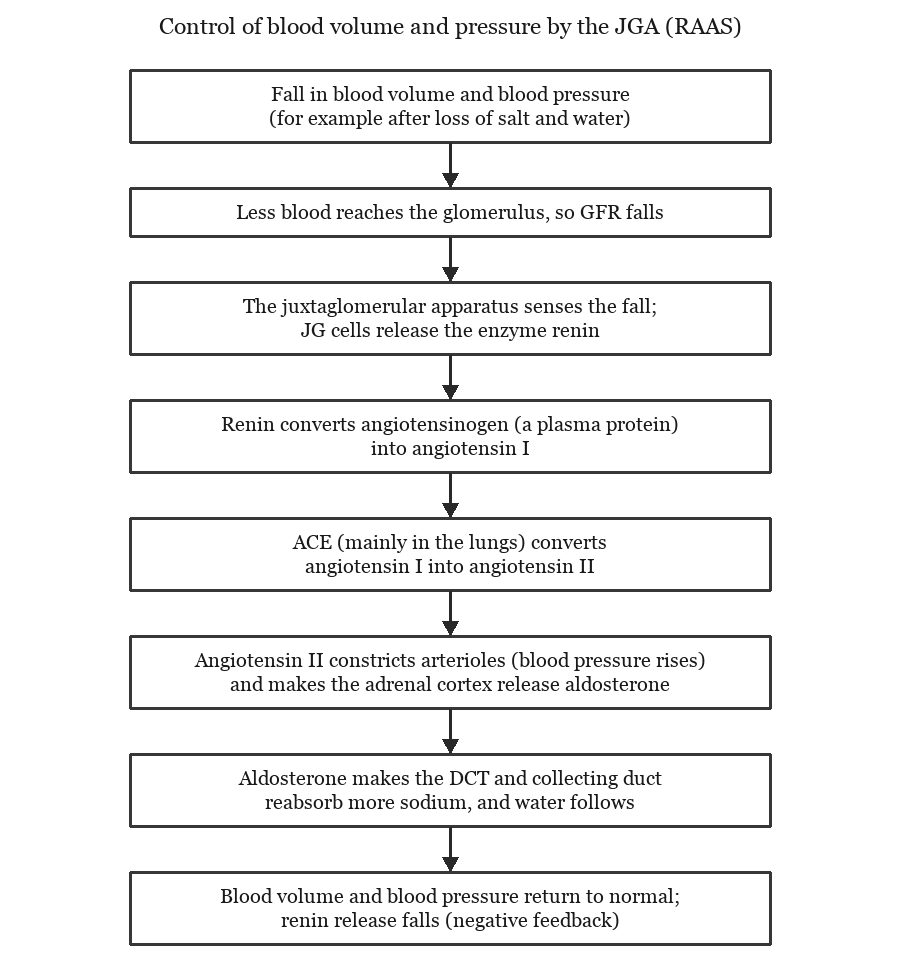
Note: Renin first forms angiotensin I; angiotensin II is formed from it by ACE.
Therefore, the JGA raises low blood volume and pressure by releasing renin, which leads to angiotensin II (vasoconstriction) and aldosterone (Na⁺ and water reabsorption).