
Question 655 marksMedium
State the position and function of juxtaglomerular apparatus. Describe the hormonal feedback circuits in controlling renal functions.
Confirming your payment
Sign up now and get 250 free tokens.
Excretory Products and Their Elimination · Question 65 of 66
State the position and function of juxtaglomerular apparatus. Describe the hormonal feedback circuits in controlling renal functions.
Solution:
Concept: Kidney function is adjusted by hormones that work through negative feedback: ADH, the renin–angiotensin–aldosterone system and ANF.
Step 1 — Position of JGA: The JGA lies at the vascular pole of the glomerulus, where the DCT of the same nephron touches the afferent arteriole; it consists of JG cells in the arteriole wall and the macula densa of the DCT.
Step 2 — Function of JGA: It senses a fall in blood pressure, GFR or Na⁺ and releases renin, which keeps GFR and blood pressure normal.
Step 3 — ADH circuit: A rise in blood osmotic pressure is sensed by osmoreceptors in the hypothalamus; more ADH is released from the posterior pituitary, the DCT and collecting duct reabsorb more water, and osmotic pressure falls back to normal; ADH release then falls (negative feedback).
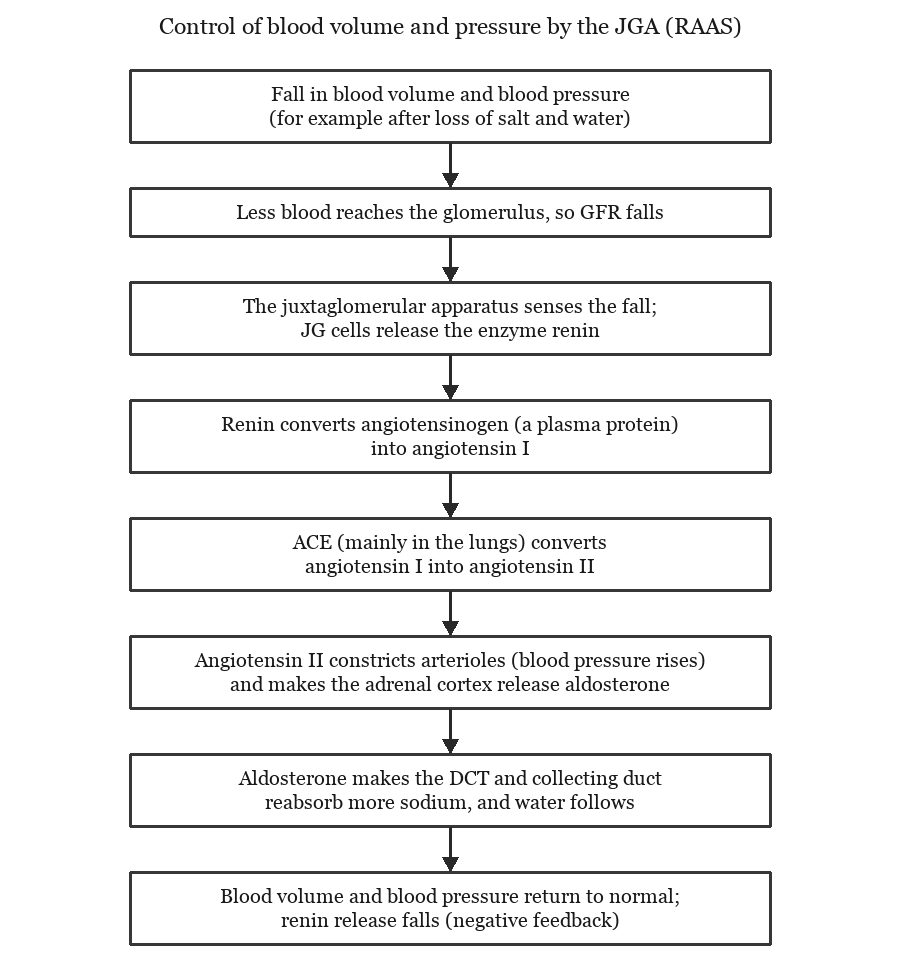
Step 4 — RAAS circuit: Low blood pressure or volume makes the JGA release renin: angiotensinogen becomes angiotensin I, which an enzyme (ACE, mainly in the lungs) converts into angiotensin II, which constricts arterioles and stimulates aldosterone release. Aldosterone increases Na⁺ and water reabsorption in the DCT and collecting duct; blood volume and pressure rise, and renin release falls.
Step 5 — ANF circuit: High blood volume stretches the atria, which release ANF. ANF dilates blood vessels and inhibits renin and aldosterone, so more Na⁺ and water are lost in urine and blood pressure falls. ANF acts as a check on the RAAS.
Therefore, the JGA lies where the DCT meets the afferent arteriole and releases renin; ADH, the RAAS and ANF form feedback circuits that control water reabsorption, sodium balance, blood volume and blood pressure.