
Question 565 marksMedium
What is the meaning of saturation of haemoglobin? Explain the oxygen dissociation curve of haemoglobin. How is it different from that of myoglobin and why?
Confirming your payment
Sign up now and get 250 free tokens.
Breathing and Exchange of Gases · Question 56 of 57
What is the meaning of saturation of haemoglobin? Explain the oxygen dissociation curve of haemoglobin. How is it different from that of myoglobin and why?
Solution:
Concept: The percentage of haemoglobin carrying oxygen depends mainly on the pO₂ around it.
Step 1 — Saturation: Percentage saturation is the percentage of haemoglobin present as oxyhaemoglobin at a given pO₂ (100 % when every haem group carries O₂).
Step 2 — The curve: The oxygen dissociation curve is a graph of percentage saturation against pO₂; for haemoglobin it is S-shaped (sigmoid). Haemoglobin is about 97 % saturated at pO₂ 100 mm Hg (lungs), about 75 % at 40 mm Hg (resting tissues), and 50 % at about 27 mm Hg.
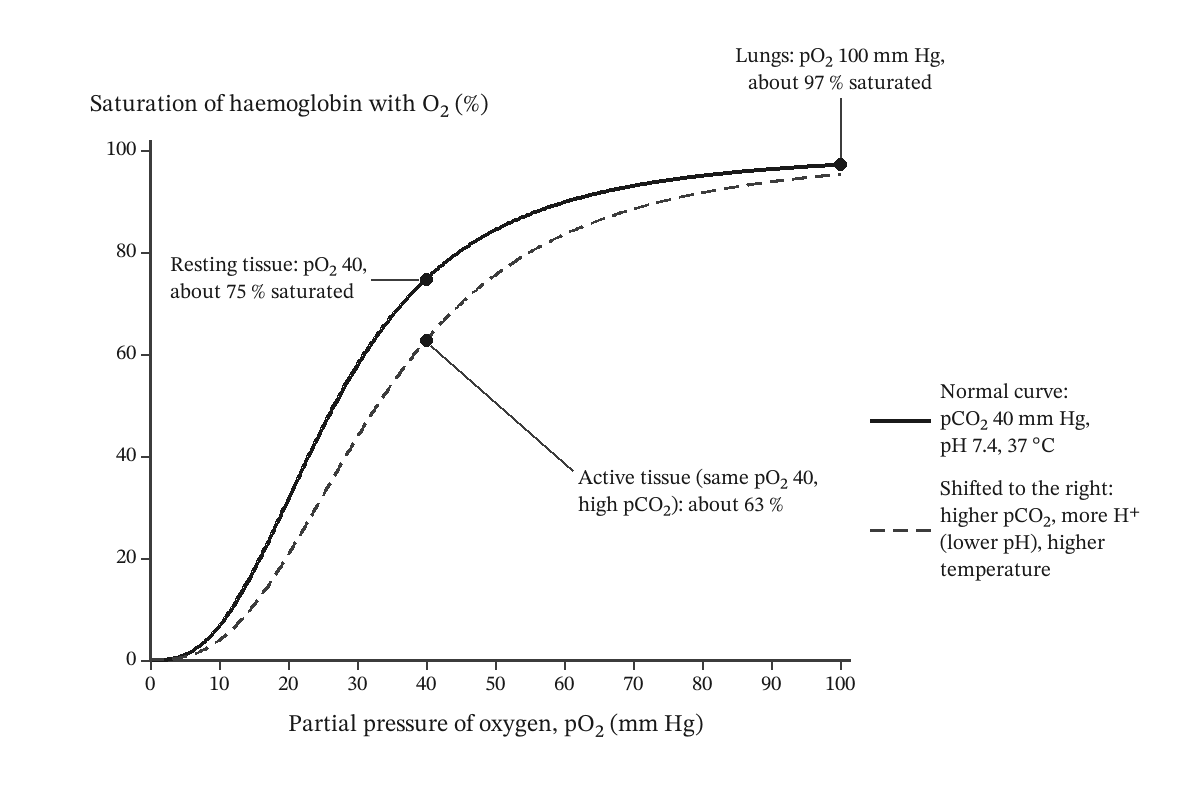
Step 3 — Why S-shaped: Binding of the first O₂ molecule makes it easier for the next ones to bind (cooperative binding), so the curve is flat at high pO₂ (safe loading in the lungs) and steep at tissue pO₂ (large unloading for a small fall in pO₂).
Step 4 — Shifts: High pCO₂, more H⁺ (low pH) and higher temperature shift the curve to the right (Bohr effect), so more O₂ is released in active tissues; the opposite conditions shift it to the left.
Step 5 — Myoglobin: Myoglobin's curve is hyperbolic and lies far to the left: it is half-saturated at only about 3 mm Hg. Myoglobin has one chain and one haem, so there is no cooperative binding, and its affinity is much higher; it therefore stores O₂ in muscle and releases it only when muscle pO₂ falls very low, as in heavy exercise.
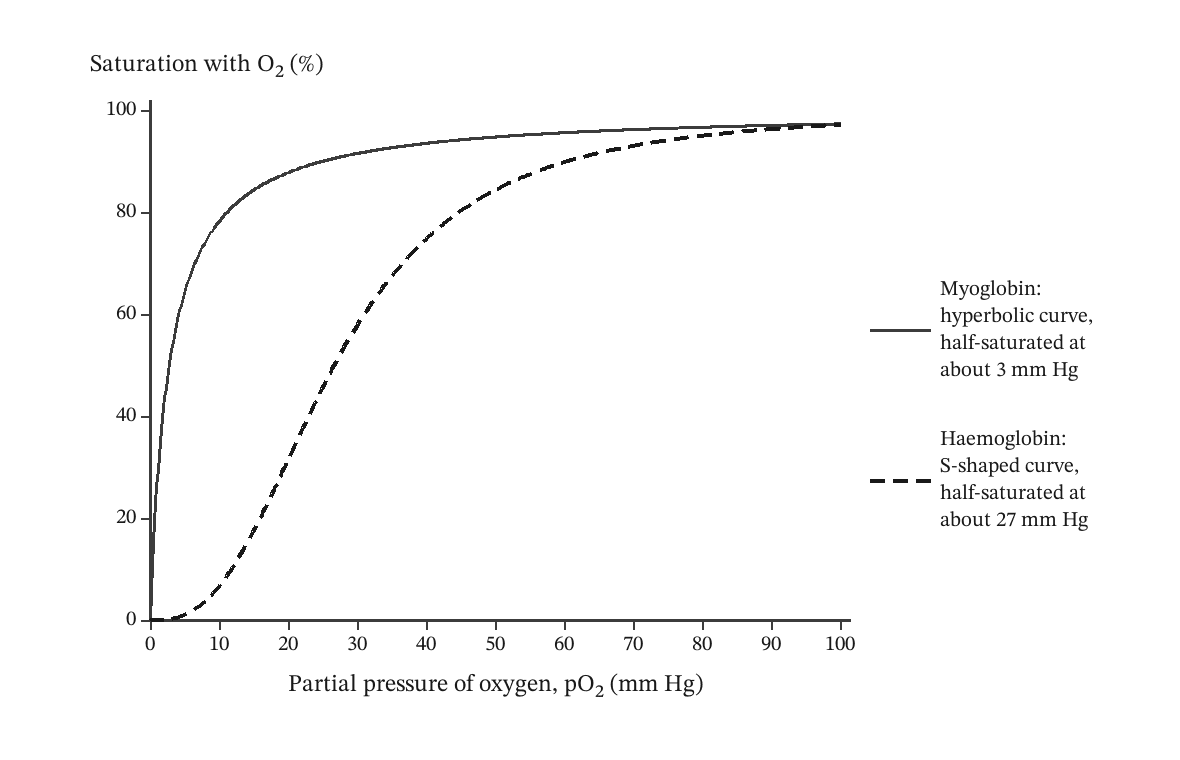
Therefore, saturation is the percentage of haemoglobin carrying oxygen; haemoglobin gives a sigmoid curve because of cooperative binding, while single-chain myoglobin gives a hyperbolic curve far to the left because of its much higher affinity.