
Question 533 marksMedium
What is a triglyceride? What are unsaturated fatty acids? What is the structure of a phospholipid molecule?
Confirming your payment
Sign up now and get 250 free tokens.
Biomolecules · Question 53 of 85
What is a triglyceride? What are unsaturated fatty acids? What is the structure of a phospholipid molecule?
Solution:
Concept: Lipids include simple lipids (fats) and compound lipids (phospholipids).
Step 1 — Triglyceride: An ester of one glycerol and three fatty acids, joined by three ester bonds; it is the neutral fat of fat and oil stores.
Step 2 — Unsaturated fatty acids: Fatty acids with one or more C=C double bonds, e.g. oleic acid (one) and linoleic acid (two); they make oils liquid.
Step 3 — Phospholipid: It is made of glycerol joined to two fatty acids and a phosphate group, which usually carries a nitrogenous base such as choline (lecithin). The phosphate end is a polar, hydrophilic head; the fatty acids form two non-polar, hydrophobic tails:
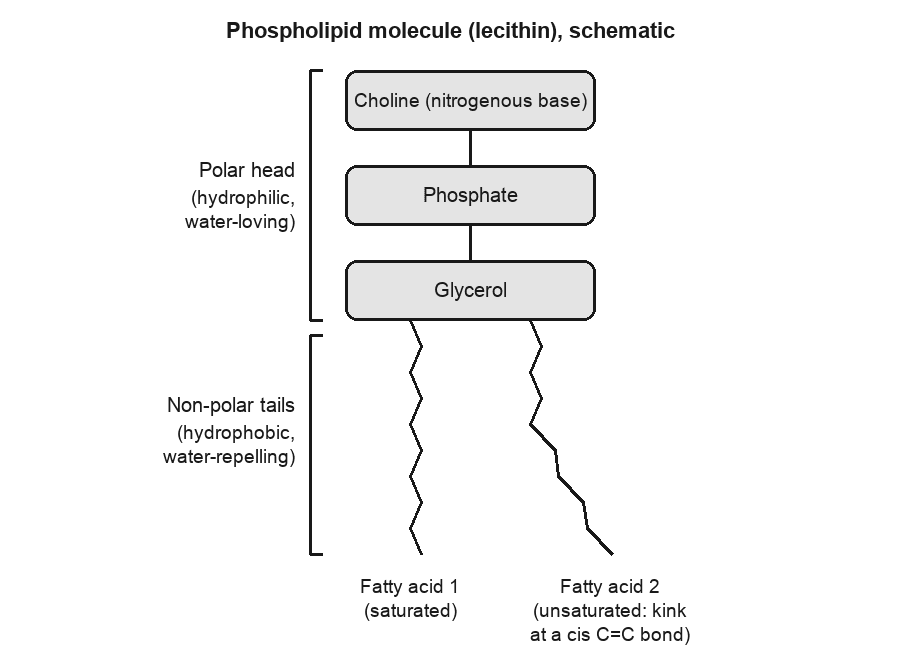
Therefore, a triglyceride is glycerol + three fatty acids, unsaturated fatty acids have C=C bonds, and a phospholipid has a polar phosphate head and two fatty acid tails.