
Question 492 marksEasy
Why is it not advisable to use a piece of copper wire as fuse wire in an electric circuit ?
Confirming your payment
Sign up now and get 250 free tokens.
Household Circuits · Question 49 of 73
Why is it not advisable to use a piece of copper wire as fuse wire in an electric circuit ?
Solution:
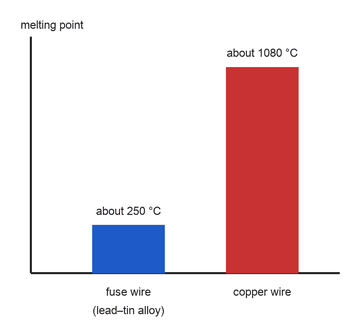
Concept: A fuse wire must melt as soon as the current goes above the safe limit. A fuse is a safety device that works on the heating effect of current. It is a short piece of thin wire of a tin–lead alloy, of high resistance and low melting point (about 250 °C), joined in series in the live wire. When the current goes above its current rating, it heats up, melts and breaks the circuit.
Step 1 — Compare the melting points.
Copper melts at about 1080 °C, while the fuse alloy melts at about 250 °C. A copper wire would not melt even when the current is dangerously high.
Step 2 — Compare the resistances.
Copper has a very low resistance, so it hardly heats up (H = I²Rt), and ordinary copper wire is also thick.
Step 3 — State the result.
The house wiring and the appliances would overheat first and could be damaged or catch fire, so a copper wire gives no protection.
Therefore, a copper wire should not be used as a fuse wire, because its high melting point and low resistance stop it from melting when the current is too large.