
Question 552 marksEasy
(a) The earthing of an electric appliance is useful only if the fuse is in the live wire. Give the reason.
(b) Name the part of the appliance which is earthed.
Confirming your payment
Sign up now and get 250 free tokens.
Household Circuits · Question 55 of 73
(a) The earthing of an electric appliance is useful only if the fuse is in the live wire. Give the reason.
(b) Name the part of the appliance which is earthed.
Solution:
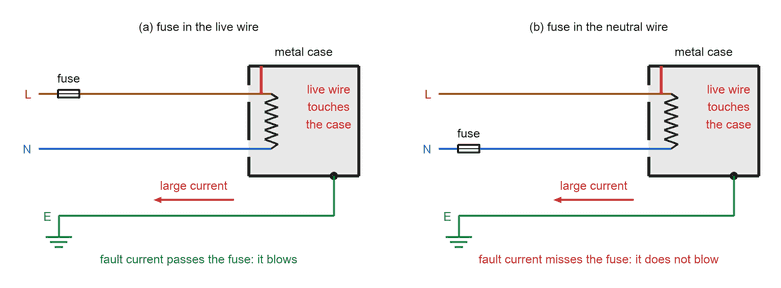
Concept: In earthing, the metal case of an appliance is joined to the earth wire, whose resistance is almost zero. If a fault makes the live wire touch the case, a very large current flows from the live wire through the case to the earth, and the fuse in the live wire blows at once.
(a)
Step 1 — Follow the fault current.
When the live wire touches the earthed case, the large fault current flows from the live wire, through the case, to the earth. It never passes through the neutral wire.
Step 2 — Fuse in the live wire.
The fault current passes through a fuse in the live wire, so the fuse blows and cuts off the live supply. The appliance is then safe.
Step 3 — Fuse in the neutral wire.
The fault current would not pass through a fuse in the neutral wire, so that fuse would not blow. The large current would keep flowing to the earth, the wiring could overheat, and the appliance would stay joined to the live wire.
(b)
Step 4 — Name the part.
The part that is earthed is the metallic body (case) of the appliance.
Therefore, (a) earthing is useful only with the fuse in the live wire, because only then does the fault current pass through the fuse and blow it; (b) the metallic body (case) of the appliance is earthed.