
Question 91 markMCQEasy
A person connects his household appliances in series. Which of the following is true ?
Confirming your payment
Sign up now and get 250 free tokens.
Household Circuits · Question 9 of 73
A person connects his household appliances in series. Which of the following is true ?
(A) Each appliance operates independently
(B) The current in the circuit is reduced as resistance increases
(C) Each appliance does not operate at its rated voltage
(D) Both (B) and (C)
Answer: (D) Both (B) and (C)
Concept: In series there is only one path for the current. The same current flows through every part, the supply voltage is shared among the parts, and a break anywhere stops the current everywhere.
Step 1 — Check statement (B).
In series the resistances add up, so the total resistance is larger than that of any one appliance. With the same 220 V mains, the current I = V ÷ R is therefore reduced. Statement (B) is true.
Step 2 — Check statement (C).
The 220 V is shared among the appliances in the ratio of their resistances. For example, two identical appliances get only half of it each, so none works at its rated voltage. Statement (C) is true.
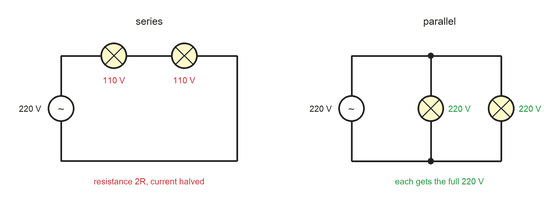
Step 3 — Check statement (A).
In series there is only one path for the current, so switching off one appliance stops all the others. The appliances do not work independently, so statement (A) is false.
Why the other options are wrong:
Therefore, both (B) and (C) are true for appliances joined in series, option (D).