
Question 71 markMCQEasy
The electrical appliances in a house are connected in :
Confirming your payment
Sign up now and get 250 free tokens.
Household Circuits · Question 7 of 73
The electrical appliances in a house are connected in :
(A) series
(B) parallel
(C) either in series or parallel
(D) both in series and parallel
Answer: (B) parallel
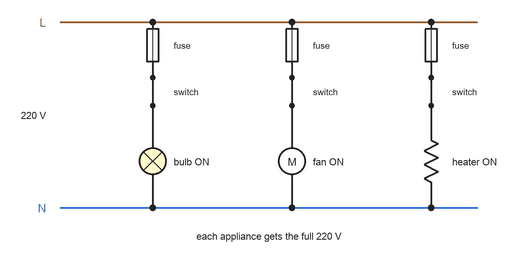
Concept: In a house every appliance is connected in parallel across the live and the neutral wire. So each one gets the full 220 V, and each can be switched on or off by its own switch without affecting the others.
Step 1 — See what each appliance needs.
Each appliance is made to work at 220 V (its rated voltage), and each must be switched on or off without affecting the others.
Step 2 — Choose the connection.
In parallel, every appliance is joined directly between the live and the neutral wire, so each gets the full 220 V. Each has its own switch in the live wire, so it works independently. A series connection would do neither.
Why the other options are wrong:
Therefore, the electrical appliances in a house are connected in parallel, option (B).