
Question 281 markMCQEasy
The purpose of earthing in a household circuit is to :
Confirming your payment
Sign up now and get 250 free tokens.
Household Circuits · Question 28 of 73
The purpose of earthing in a household circuit is to :
(A) provide a connection to appliance
(B) complete the circuit
(C) prevent electric shock
(D) increase the voltage
Answer: (C) prevent electric shock
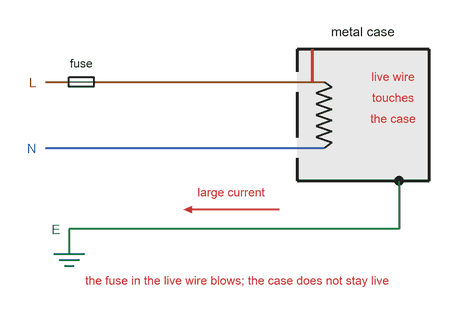
Concept: In earthing, the metal case of an appliance is joined to the earth wire, whose resistance is almost zero. If a fault makes the live wire touch the case, a very large current flows from the live wire through the case to the earth, and the fuse in the live wire blows at once.
Step 1 — Look at a fault.
Suppose the insulation inside an appliance wears out and the live wire touches its metal body. Because the body is joined to the earth wire, a very large current flows from the live wire through the body to the earth.
Step 2 — See why there is no shock.
This large current blows the fuse in the live wire at once, so the appliance is cut off from the supply. The body never stays at a high potential, so a person who touches it does not get a shock.
Watch out: No current flows in the earth wire in normal use; it carries current only when there is a fault.
Why the other options are wrong:
Therefore, the purpose of earthing in a household circuit is to prevent electric shock, option (C).