
Question 245 marksMedium
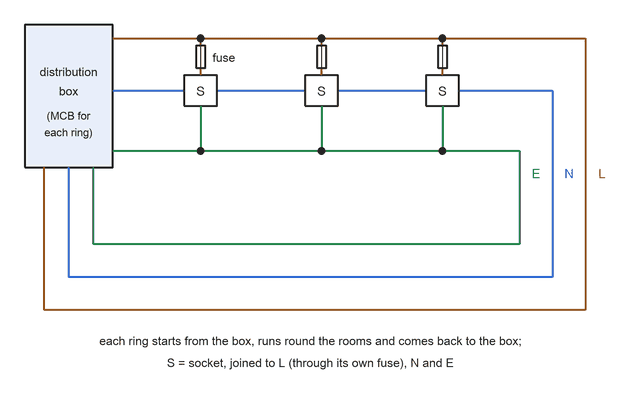
Draw a circuit diagram to explain the ring system of house wiring. State two advantages of it.
Confirming your payment
Sign up now and get 250 free tokens.
Household Circuits · Question 24 of 73
Draw a circuit diagram to explain the ring system of house wiring. State two advantages of it.
Solution:
Concept: In the ring system, the live, neutral and earth wires start from the distribution box, run round all the rooms of one part of the house in a closed ring, and come back to the box. A separate ring is used for each part of the house, each protected by its own MCB (about 30 A) in the distribution box.
Step 1 — Draw the circuit.
After the kWh meter, the main switch and the main fuse, each ring is taken from the distribution box. Every socket is joined to the live ring through its own fuse (and switch), to the neutral ring, and by its earth terminal to the earth ring. So all the sockets are in parallel.
Step 2 — First advantage: cheaper wiring.
The current can reach each socket by two paths, one each way round the ring. Each path carries only part of the current, so a wire of lower current-carrying capacity (thinner) is enough, which reduces the cost of wiring.
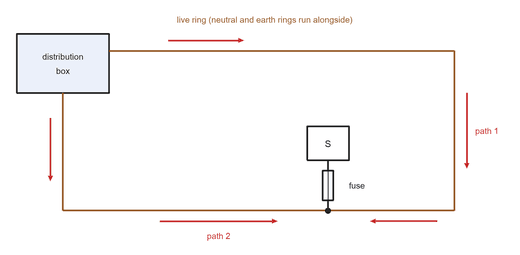
Step 3 — Second advantage: a separate fuse for each appliance.
Each appliance has its own fuse. If a fault makes the fuse of one appliance blow, the other appliances are not affected.
Step 4 — Other advantages.
All the plugs and sockets can be of the same size, each socket having its own fuse suited to its appliance; and a new appliance can be connected to the ring directly, provided the total current does not exceed the rating of the main fuse.
Therefore, in the ring system the L, N and E wires run round the house and back to the box, as drawn; two advantages are cheaper (thinner) wiring, since the current has two paths to each socket, and a separate fuse for each appliance.