
Question 1282 marksEasy
You are given three circuits. Identify the circuit with the minimum dissipation of heat.

Confirming your payment
Sign up now and get 250 free tokens.
Current Electricity · Question 128 of 160
You are given three circuits. Identify the circuit with the minimum dissipation of heat.
Solution:
Concept: All three circuits use the same 6 V cell. The rate of heating is the power P = V² ÷ R, so with a fixed voltage the circuit with the largest total resistance draws the least current and dissipates the least heat.
Step 1 — Find the heating in circuit (I).
It has one 3 Ω resistor, so R = 3 Ω, and we find the power from P = V² ÷ R.
Step 2 — Find the heating in circuit (II).
It has two 3 Ω resistors in parallel, so we first find their equivalent resistance.
Now we find the power with this resistance.
Step 3 — Find the heating in circuit (III).
It has 2 Ω and 3 Ω in series, so the resistances add.
Now we find the power with this resistance.
Step 4 — Compare the three circuits.
Circuit (II) dissipates the most heat (24 W) and circuit (III) the least (7.2 W), because its series resistors give the largest resistance and the smallest current (1.2 A).
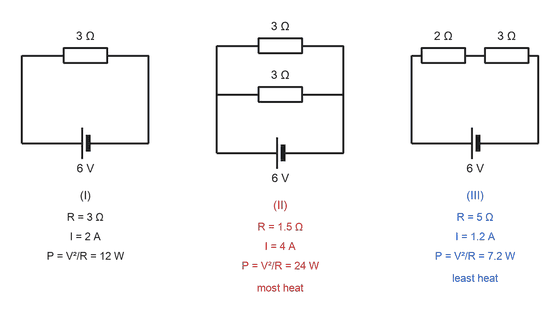
Watch out: With the same voltage, more resistance means LESS heating (P = V² ÷ R); 'H = I²Rt, so more R gives more heat' holds only when the current is the same.
Note: the book's answer key prints (II), but (II) has the least resistance and dissipates the most heat (24 W), so the key is incorrect; the minimum is in (III).
Therefore, circuit (III) has the minimum dissipation of heat.