
Question 772 marksEasy
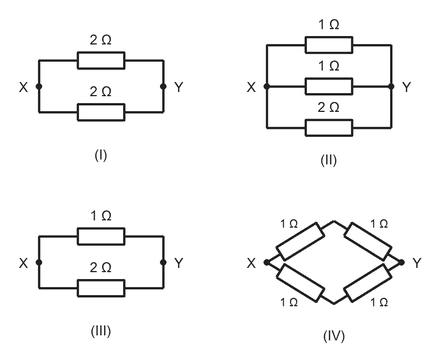
Which of the following combinations have the same equivalent resistance between X and Y ?
Confirming your payment
Sign up now and get 250 free tokens.
Current Electricity · Question 77 of 160
Which of the following combinations have the same equivalent resistance between X and Y ?
Solution:
Concept: Find the equivalent resistance of each combination and compare them. In parallel the p.d. is the same across each resistor, the currents add up (I = I₁ + I₂ + …), and the equivalent resistance is given by 1/R = 1/R₁ + 1/R₂ + …, less than the smallest one. For two resistors, R = R₁R₂ ÷ (R₁ + R₂).
Step 1 — Combination (I).
It has two 2 Ω resistors joined between X and Y, so they are in parallel. Use product ÷ sum for two resistors.
Step 2 — Combination (II).
It has three resistors, 1 Ω, 1 Ω and 2 Ω, each joined between X and Y, so all three are in parallel and their reciprocals add.
Now invert to get the resistance.
Step 3 — Combination (III).
It has a 1 Ω and a 2 Ω resistor joined between X and Y, so they are in parallel.
Step 4 — Combination (IV): each path.
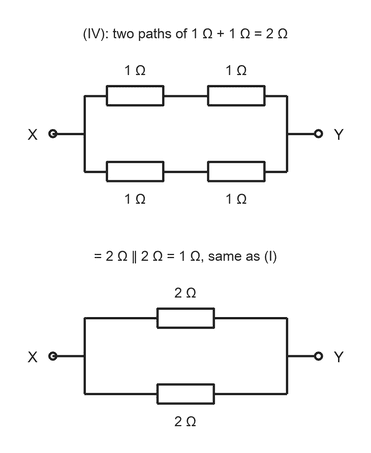
There are two paths from X to Y, and each path has two 1 Ω resistors joined end to end, so they are in series.
Step 5 — Combination (IV): the two paths together.
The two 2 Ω paths both join X to Y, so they are in parallel.
Step 6 — Compare the four values.
The values are 1 Ω, 0.4 Ω, about 0.67 Ω and 1 Ω, so only (I) and (IV) have the same equivalent resistance.
Watch out: In (IV), first add the two resistors along each path; do not treat all four 1 Ω as being in parallel.
Therefore, combinations (I) and (IV) have the same equivalent resistance, 1 Ω.