
Question 332 marksEasy
(a) Name and state the law which relates the potential difference and current in a conductor.
(b) What is the necessary condition for a conductor to obey the law named above in part (a) ?
Confirming your payment
Sign up now and get 250 free tokens.
Current Electricity · Question 33 of 160
(a) Name and state the law which relates the potential difference and current in a conductor.
(b) What is the necessary condition for a conductor to obey the law named above in part (a) ?
Solution:
Concept: The law that relates the potential difference across a conductor to the current through it is Ohm's law.
(a)
Step 1 — Name the law.
The law is Ohm's law.
Step 2 — State the law.
Ohm's law states that the current flowing in a conductor is directly proportional to the potential difference applied across its ends, provided the physical conditions and the temperature of the conductor remain the same.
Step 3 — Write it as an equation.
The constant ratio of V to I is called the resistance R of the conductor, so the law can be written as an equation. For example, if the p.d. is doubled, the current also doubles.
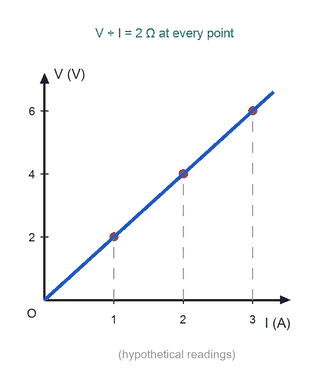
(b)
Step 4 — State the necessary condition.
The temperature (and the other physical conditions) of the conductor must remain constant. If the conductor heats up, its resistance changes and V/I no longer stays the same.
Watch out: The condition matters: a bulb filament does not obey Ohm's law because its temperature rises a great deal.
Therefore, (a) Ohm's law: the current in a conductor is directly proportional to the p.d. across its ends (V = IR); (b) its temperature and other physical conditions must remain constant.