Solution:
Concept: The e.m.f. ε of a cell is the p.d. across its terminals when it sends no current (open circuit). When it sends a current I through an external resistance R, a part Ir of the e.m.f. is used up inside the cell (internal resistance r), so the terminal voltage is V = ε − Ir, and ε = I(R + r). The internal resistance r and the external resistance R are in series, so one current I flows through both.
(a)
Step 1 — Total resistance of the circuit.
The current passes through R outside the cell and through r inside it, and these are in series, so the resistances add.
Rtotal=R+r
(b)
Step 2 — Current drawn from the cell.
By Ohm's law for the whole circuit, the current is the e.m.f. divided by the total resistance.
I=R+rε
(c)
Step 3 — P.d. across the cell.
The p.d. across the terminals of the cell (the terminal voltage) is the p.d. across the external resistance R, which is I × R.
V=IR=R+rεR
(d)
Step 4 — Voltage drop inside the cell.
The voltage drop inside the cell is the p.d. across the internal resistance r, which is I × r.
v=Ir=R+rεr
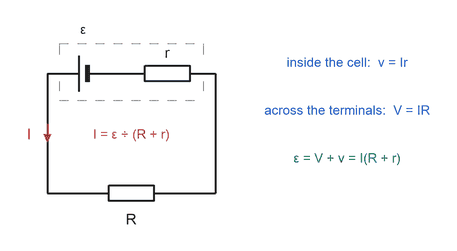
Check: The two p.d.s together give the whole e.m.f.
V+v=I(R+r)=ε
Watch out: The p.d. across the cell is the terminal voltage IR, not the e.m.f.; it is less than ε by Ir.
Therefore, (a) R + r, (b) I = ε ÷ (R + r), (c) V = εR ÷ (R + r), and (d) v = εr ÷ (R + r).
