
Question 282 marksEasy
How is the electric potential difference between two points defined ? State its S.I. unit.
Confirming your payment
Sign up now and get 250 free tokens.
Current Electricity · Question 28 of 160
How is the electric potential difference between two points defined ? State its S.I. unit.
Solution:
Concept: In a circuit what matters is the difference in potential between two points, because charge flows from the point at the higher potential to the point at the lower potential.
Step 1 — Define potential difference.
The potential difference between two points is the work done per unit positive charge in moving a positive test charge from one point to the other. If W joule of work is done in moving a charge Q coulomb from B to A, the p.d. between A and B is W divided by Q.
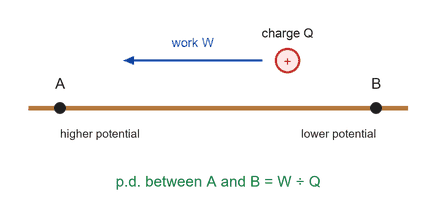
Step 2 — State the S.I. unit.
The S.I. unit of potential difference is the volt (V), which is 1 joule per coulomb (1 V = 1 J C⁻¹).
Step 3 — Say how it is measured.
A potential difference is measured with a voltmeter joined in parallel across the two points.
Watch out: Potential difference is work per unit charge, not work alone.
Therefore, the potential difference between two points is the work done per unit positive charge in moving a test charge from one point to the other, and its S.I. unit is the volt (V).