
Question 472 marksEasy
What is a superconductor ? Give one example of it.
Confirming your payment
Sign up now and get 250 free tokens.
Current Electricity · Question 47 of 160
What is a superconductor ? Give one example of it.
Solution:
Concept: Every ordinary conductor has some resistance, which becomes smaller as it is cooled. Some substances, however, lose their resistance completely when they are cooled below a particular temperature.
Step 1 — Define a superconductor.
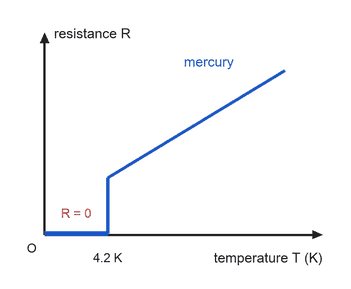
A superconductor is a substance of zero resistance (or infinite conductance) at a very low temperature. Its resistance falls suddenly to zero when it is cooled below a particular temperature, called its critical temperature. For metals such as mercury and lead, this is only a few kelvin above absolute zero.
Step 2 — State a special property.
Once a current is started in a superconducting loop, it keeps flowing without any loss of energy, even when there is no potential difference across it.
Step 3 — Give an example.
Mercury becomes a superconductor below about 4.2 K. Lead (below about 7.2 K) and niobium (below about 9.2 K) are other examples. Some ceramic compounds become superconducting at higher temperatures, but still far below room temperature.
Watch out: A superconductor has ZERO resistance, not just a very small one, and only below its critical temperature.
Therefore, a superconductor is a substance of zero resistance at a very low temperature; for example, mercury below 4.2 K.