
Question 623 marksEasy
Two wires of the same material and same length have radii 1 mm and 2 mm respectively. Compare : (i) their resistances, (ii) their specific resistance.
Confirming your payment
Sign up now and get 250 free tokens.
Current Electricity · Question 62 of 160
Two wires of the same material and same length have radii 1 mm and 2 mm respectively. Compare : (i) their resistances, (ii) their specific resistance.
Solution:
Concept: The resistance of a wire is R = ρl ÷ a, where l is its length, a its area of cross-section and ρ the specific resistance (resistivity) of its material. So R ∝ l and R ∝ 1/a; for a wire of radius r, a = πr², so R ∝ 1/r². Specific resistance ρ is the resistance of a wire of the material of unit length and unit area of cross-section; its S.I. unit is the ohm metre (Ω m). It depends only on the material and its temperature, not on the length or thickness of the sample.
Given: same material and length; r₁ = 1 mm, r₂ = 2 mm
(i)
Step 1 — Set up the ratio.
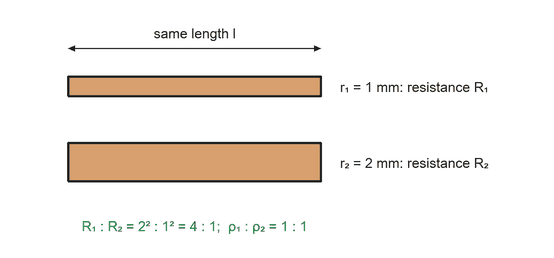
Both wires have the same ρ and the same l, so in R = ρl ÷ πr² only r differs, and R ∝ 1/r². The ratio of the resistances is the inverse ratio of the squares of the radii.
Step 2 — Substitute the radii.
Put r₁ = 1 mm and r₂ = 2 mm; the units cancel, so mm can be used.
(ii)
Step 3 — Compare the specific resistances.
Specific resistance depends only on the material (and temperature), and both wires are of the same material, so their specific resistances are equal.
Watch out: Square the radii: R₁ : R₂ is 4 : 1, not 2 : 1, and the thinner wire has the larger resistance.
Therefore, (i) R₁ : R₂ = 4 : 1, and (ii) ρ₁ : ρ₂ = 1 : 1.