
Question 593 marksEasy
A car bulb connected to a 12 volt battery draws 2 A current when glowing . What is the resistance of the filament of the bulb ? Will the resistance be more, same or less when the bulb is not glowing ?
Confirming your payment
Sign up now and get 250 free tokens.
Current Electricity · Question 59 of 160
A car bulb connected to a 12 volt battery draws 2 A current when glowing . What is the resistance of the filament of the bulb ? Will the resistance be more, same or less when the bulb is not glowing ?
Solution:
Concept: Ohm's law: the current in a conductor is directly proportional to the p.d. across its ends, provided its physical conditions (temperature) stay the same. So V = IR, where R is the resistance, measured in ohm (1 Ω = 1 V A⁻¹). With a rise in temperature the resistance of a metal increases, that of an alloy (manganin, constantan, nichrome) increases only very slightly, and that of a semiconductor or carbon decreases.
Given: V = 12 V, I = 2 A (bulb glowing)
Step 1 — Find the resistance of the glowing filament.
Ohm's law gives the resistance as the p.d. divided by the current while the bulb glows.
Step 2 — Compare with the bulb not glowing.
The filament is a metal (tungsten). When the bulb is not glowing the filament is cold, and the resistance of a metal is lower at a lower temperature. So the resistance will be less than 6 Ω.
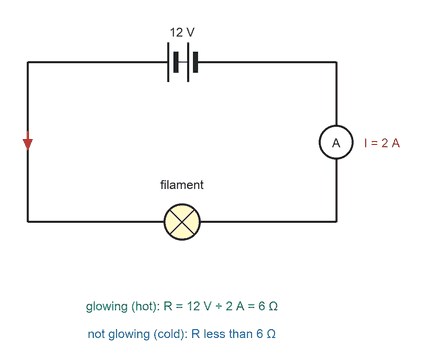
Watch out: The 6 Ω value holds only while the filament is hot; it is not a fixed value for the bulb.
Therefore, the resistance of the glowing filament is 6 Ω, and it will be less when the bulb is not glowing.