Solution:
Concept: Ohm's law: the current in a conductor is directly proportional to the p.d. across its ends, provided its physical conditions (temperature) stay the same. So V = IR, where R is the resistance, measured in ohm (1 Ω = 1 V A⁻¹). The music system is treated as a fixed resistance.
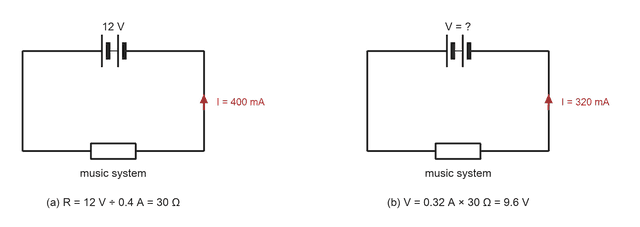
Given: V = 12 V, I = 400 mA; finally I' = 320 mA.
(a)
Step 1 — Change the current into ampere.
Since 1 mA = 0.001 A, 400 mA is 0.4 A.
I=0.4 A
Step 2 — Find the resistance.
By Ohm's law, the resistance is the p.d. divided by the current.
R=IV=0.412=30 Ω
(b)
Step 3 — Change the new current into ampere.
In the same way, 320 mA is 0.32 A.
I′=0.32 A
Step 4 — Find the battery voltage.
The resistance of the music system stays 30 Ω, so the p.d. that drives 0.32 A through it is I' × R.
V′=I′R=0.32×30=9.6 V
Watch out: Change mA into A before using Ohm's law; 12 ÷ 400 would give a wrong resistance.
Therefore, (a) the resistance of the music system is 30 Ω, and (b) it stops playing when the battery voltage drops to 9.6 V.
