Solution:
Concept: In series the same current flows through each resistor, the p.d.s add up (V = V₁ + V₂ + …), and the equivalent resistance is R = R₁ + R₂ + …, more than the largest one. Ohm's law: the current in a conductor is directly proportional to the p.d. across its ends, provided its physical conditions (temperature) stay the same. So V = IR, where R is the resistance, measured in ohm (1 Ω = 1 V A⁻¹).
Given: 6 Ω and 4 Ω in series, V = 20 V.
(a)
Step 1 — Find the total resistance.
The 6 Ω and 4 Ω are in series, so their resistances add.
Rs=6+4=10 Ω
Step 2 — Find the current.
Divide the applied p.d. by the total resistance.
I=1020=2 A
(b)
Step 3 — Find the p.d. across the 6 Ω resistor.
The same 2 A flows through the 6 Ω resistor, so its p.d. is I × 6.
V6=2×6=12 V
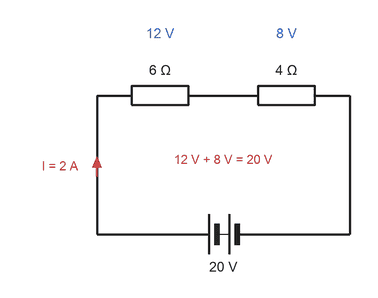
Check: The other 8 V is across the 4 Ω resistor (2 × 4), and 12 V + 8 V gives the applied 20 V.
12+8=20 V
Watch out: In series the current is the same in both resistors, but the p.d. is shared in proportion to the resistance.
Therefore, (a) the current in the circuit is 2 A, and (b) the p.d. across the 6 Ω resistor is 12 V.

